

True Crime Word Search for Adults by Max Charles
Case notes
Every one of the 50 cases in the book has a file here. It holds the archive picture at full size, the record with every blank filled in, and links if you want to read more.
A case file shows the answers, so it stays shut until you open it. Solve the page first.
The 50 cases
 01Dr Crippen1910Holloway, London, England
 02Lizzie Borden1892 to 1893Fall River, Massachusetts, United States
 03Ruth Snyder1927Queens Village, New York, United States
 04François Courvoisier1840Park Lane, London, England
 05The Mona Lisa Theft1911 to 1914Paris, France, and Florence, Italy
 06The Tichborne Case1854 to 1874London and Hampshire, England
 07Buck Ruxton1935 to 1936Moffat, Scotland and Lancaster, England
 08Sacco and Vanzetti1920 to 1927South Braintree and Boston, Massachusetts, United States
 09The Brides in the Bath1912 to 1915Herne Bay, Blackpool and London, England
 10William Palmer1855 to 1856Rugeley, Staffordshire, England
 11The Pyjama Girl1934 to 1944Albury, New South Wales, Australia
 12Madeleine Smith1857Glasgow and Edinburgh, Scotland
 13Marie Lafarge1839 to 1840Le Glandier, Correze, France
 14Charles Stielow1915 to 1918West Shelby, New York, United States
 15The Duc de Praslin1847Paris, France
 16Sir Lee Stack1924 to 1925Cairo, Egypt
 17Roland Molineux1898 to 1902New York City, United States
 18Valentine's Day Massacre1929Chicago, Illinois, United States
 19President Garfield1881Washington, D.C., and Elberon, New Jersey, United States
 20Franz Muller1864North London Railway, London, England
 21Patrick Mahon1924Eastbourne, Sussex, and London, England
 22Thomas Neill Cream1891 to 1892Lambeth, London, England
 23The Sausage Vat Murder1897 to 1898Chicago, Illinois, United States
 24Oscar Slater1908 to 1928Glasgow and Edinburgh, Scotland
 25The Steinheil Affair1908 to 1909Paris, France
 26Adolf Beck1895 to 1904London, England
 27The Rathenau Murder1922Berlin, Germany
 28The Phoenix Park Murders1882 to 1883Dublin, Ireland, and London, England
 29Giacomo Matteotti1924 to 1947Rome, Italy
 30The Pigott Forgeries1887 to 1890London, England
 31The Wigwam Murder1942 to 1943Hankley Common, Surrey, England
 32Harry Gleeson1940 to 1941New Inn, County Tipperary, Ireland
 33The Urschel Kidnapping1933Oklahoma City, Oklahoma, United States
 34President McKinley1901Buffalo, New York, United States
 35John Dillinger1934Indiana and Illinois, United States
 36Bonnie and Clyde1933Joplin, Missouri, United States
 37The Stratton Brothers1905Deptford, London, England
 38The Dreyfus Affair1894 to 1906Paris, France
 39The Mannings1849Bermondsey, London, England
 40The Somerton Man1948 to 2022Adelaide, South Australia, Australia
 41The Bocarme Poisoning1850 to 1851Bitremont, near Mons, Belgium
 42The Acid Bath Murders1944 to 1949Crawley, Sussex, England
 43The Dickman Train Murder1910Newcastle upon Tyne and Morpeth, Northumberland, England
 44Tunnel 13 Train Robbery1923 to 1927Siskiyou Mountains, Oregon, United States
 45The LA Times Bombing1910 to 1911Los Angeles, California, United States
 46The Chicken Run Murder1924 to 1925Crowborough, Sussex, England
 47Herbert Rowse Armstrong1920 to 1922Hay-on-Wye, on the Wales-England border
 48Harry Dobkin1941 to 1943London, England
 49Parramatta River Murders1872Sydney, New South Wales, Australia
 50Reginald Birchall1890Blenheim Swamp, Ontario, Canada
Case files
Dr Crippen
The house at Hilldrop Crescent
Solved it? Open the case fileClose the case file
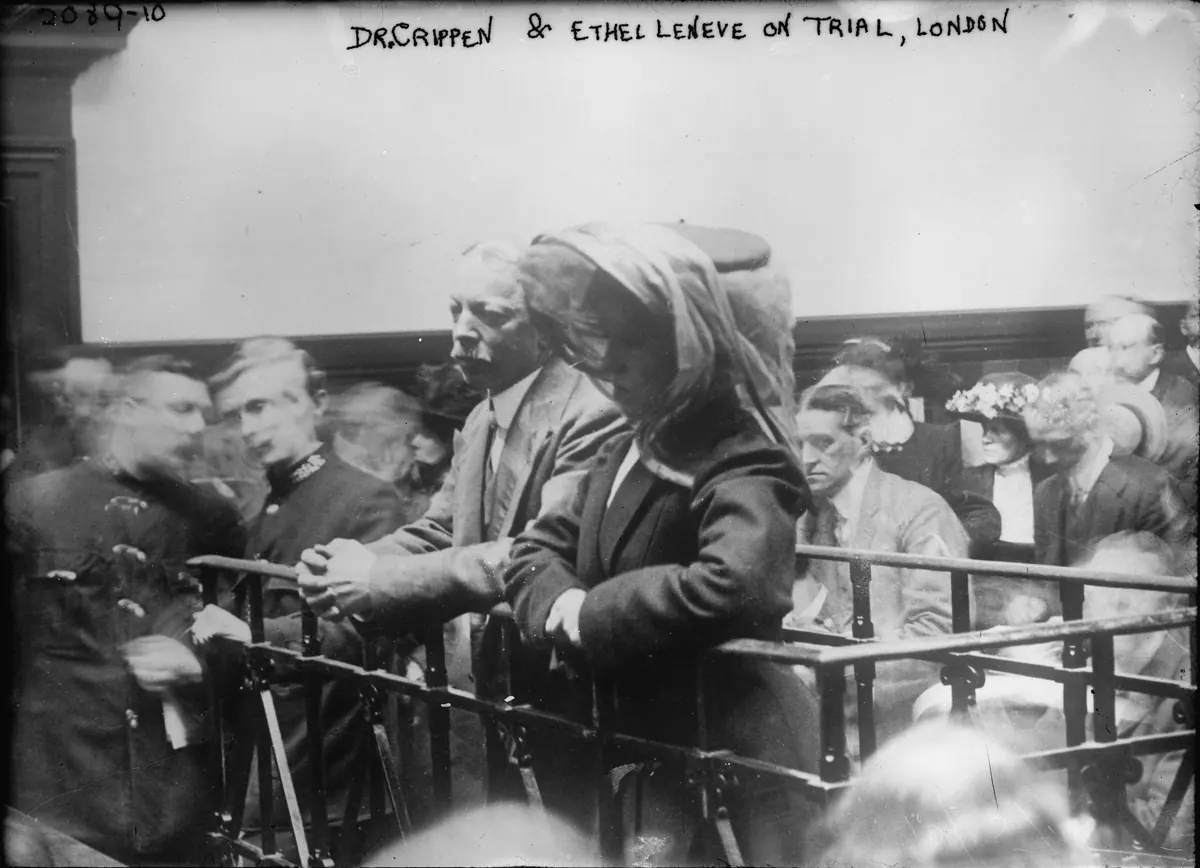
What happened
Cora Crippen sang in the music halls as Belle Elmore. Her friends last saw her on the last night of January 1910. Her husband, an American doctor who sold patent medicines by post, told her friends a first story, that she had gone to America, then a second, that she had died there.
Her friends did not believe him. In July a chief inspector named Walter Dew called at the house, and Crippen told a third story: she had left him for another man, and he had invented her death to save face. Dew searched, found nothing, and left satisfied. Days later Crippen and his typist were gone.
One search had found nothing, and the man with three stories had run. What had Dew missed, and could he still catch him?
The record, filled in
From Dew's second visit to the arrest. Watch what the second search turns up, what tied it to Crippen, and how a ship's captain gave him away.
Dew came back days later, found the pair gone, and searched again. This time he had the cellar floor taken up. Under the bricks lay part of a human body; the head, the limbs and the bones were never found.
The Home Office analyst found hyoscine in the remains, a sedative that kills in a large enough dose. On 19 January 1910, twelve days before Cora was last seen, Crippen had collected five grains of it from a chemist and signed the poisons Register, the book a buyer must sign for a dangerous drug.
A scar on a strip of the skin matched the mark of an operation Cora was known to have had, and on that the court named the body hers. A pajama jacket in the grave was of a cloth a Holloway shop first stocked in late 1908, and the shop had sent nightclothes of it to the Crippens in January 1909. So the body went under the floor after late 1908, while they lived there.
Crippen was already at sea, bound for Canada on the SS Montrose with his typist, Ethel Le Neve, her hair cut short and her clothes a boy's, a disguise that fooled nobody for long. The captain knew them and sent a wireless telegram to Scotland Yard; ship to shore radio was new enough in 1910 to make headlines by itself.
Dew took a faster ship on the same route, the Laurentic, boarded dressed as a harbor pilot, and arrested the pair before the liner could dock at Quebec.
The payoff
Running is what sent Dew back to dig. The poison Crippen had signed for was in the body, and the court named that body as Cora's. He was hanged that November. Ethel, tried separately, was acquitted.
The grid, solved
Afterwards
Crippen denied it to the end. In 2007 a Michigan State team tested DNA from the surviving 1910 slide of the skin that named the body, and reported that it did not match the maternal line of Cora's living relatives. The finding is contested and no court has revisited the verdict.
The disappearance and the arrest at sea are not in doubt. The identification that hanged him is.
Go deeper
- Where the picture is kept
- Sources
- Hawley Harvey Crippen Britannica
- The Modern Manhunt Began With An Arrest by Wireless Telegraph Atlas Obscura
- Dr Hawley Harvey Crippen crimeandinvestigation.co.uk
- On This Day an Arrest at Sea blog.britishnewspaperarchive.co.uk
- Trial t19101011-77 Old Bailey Online
- Homicide by hyocine: the case of Dr Crippen imt.ie
- US National Library of Medicine
- Was Dr. Crippen Innocent After All? New Forensic Evidence 100 Years After his... promegaconnections.com
16 more sources
- news.msu.edu
- Hawley Crippen PBS
- 1910: Hawley Harvey Crippen executedtoday.com
- Account Suspended history-room.co.uk
- The Crippen Case US National Library of Medicine
- Stratton brothers and the 1905 Deptford murders: Britain’s first fingerprint... deptford.org
- Dr Hawley Harvey Crippen crimeandinvestigation.co.uk
- Was Dr Crippen wrongly executed for his wife's murder? crimeandinvestigation.co.uk
- Crippen yarn lawgazette.co.uk
- The notorious case of Dr Crippen thehistorypress.co.uk
- Dr Crippen The Case details freepages.rootsweb.com
- Hawley Harvey Crippen Wikipedia
- Walter Dew Wikipedia Wikipedia
- Ethel Le Neve Wikipedia
- William Willcox (toxicologist) Wikipedia
- Henry George Kendall Wikipedia
Lizzie Borden
Every blade in the house
Solved it? Open the case fileClose the case file
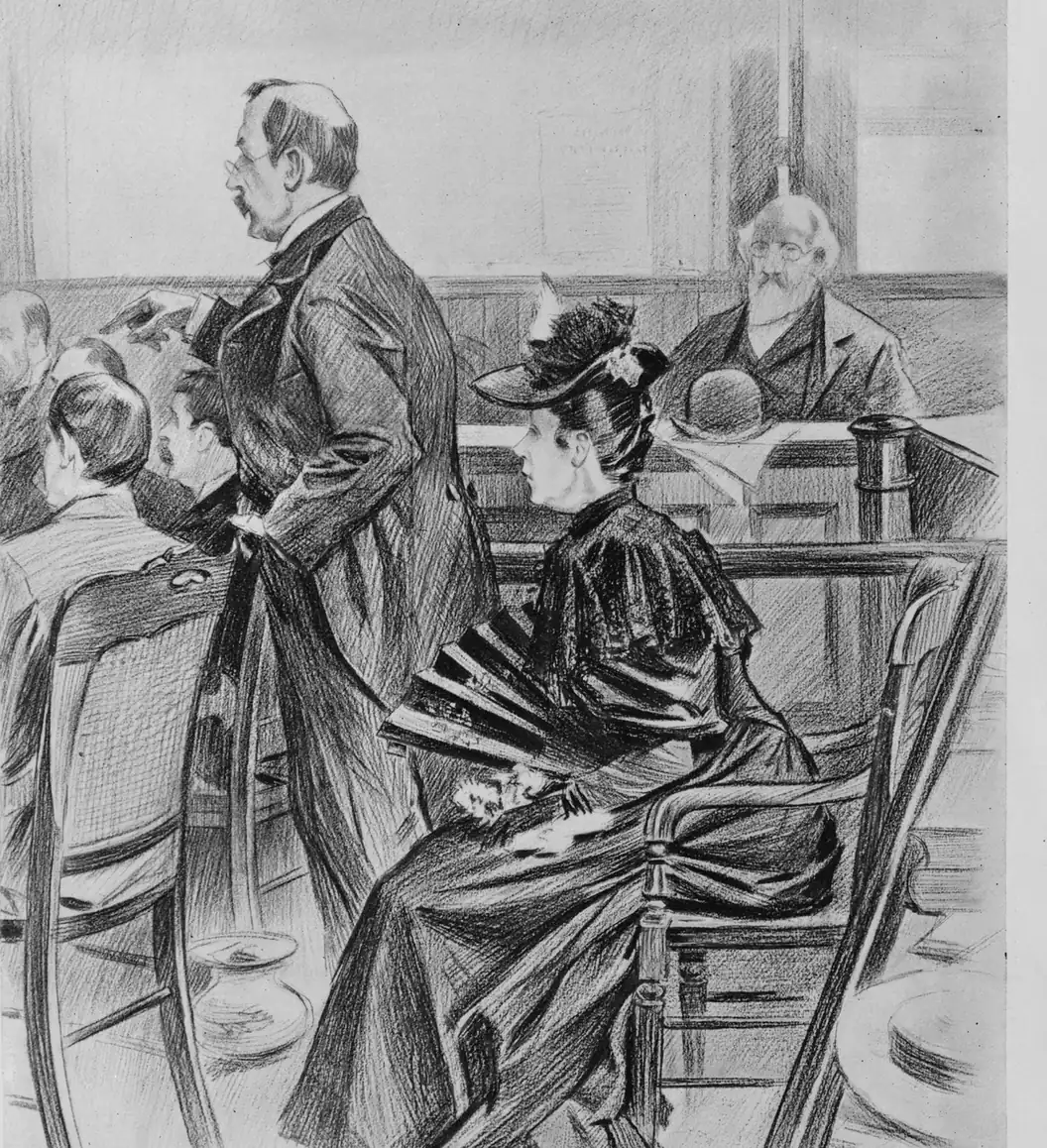
What happened
Andrew Borden was one of the richest men in Fall River. On the morning of 4 August 1892 he and his wife Abby, sixty four, were killed in their house on Second Street, ninety minutes apart. The servant was outside. His younger daughter Lizzie, thirty two, lived there. When her father was killed, she said, she was out in the barn loft looking for fishing weights.
Nothing had been forced. The house had no corridor, so anyone crossing it walked through an occupied room, and the inside doors had been kept locked since a robbery the year before. It looked like someone inside. Days in, police brought up a hatchet head from a cellar box, its handle broken off.
No blood was found on anyone in the house. Everything police took went to a Harvard chemist. Could he tie a blade to the killings?
The record, filled in
Lizzie's trial, 1893. The state says the cellar hatchet head was the weapon, washed afterwards. Knowlton prosecutes, Adams defends, and Wood is the state's chemist.
Wood, On The Other Blades The claw-hammer hatchet had several stains on it which appeared like bloodstains, on handle, side and edge. All the stains on the head of the hatchet were subjected by me to chemical and microscopic tests for blood, and with absolutely negative results. The two axes, which I designated A and B, had stains which appeared like blood, but tests showed them absolutely free from blood.
Wood, On The Cellar Hatchet Head ... There were several suspicious spots on the side of it, but they were not blood.
Knowlton, For The State ... Assuming this hatchet to have been used for inflicting the wounds ... and then subjected to some sort of a cleaning process, whether or not that could be reasonably possible to have occurred without your having discovered traces of blood upon the hatchet ...?
Adams We object to that question.The Chief Justice He may answer.
Wood, Answering Knowlton ... Before the handle was broken, not after.
Knowlton ... That is to say, the conditions I named could have existed before the handle was broken off. Why do you make that difference, Professor?
Wood ... Because it would be very hard to wash blood off that broken end.
Wood, Later, Cross-Examined By Adams ... As to the break in the handle ... I would not express any opinion as to the freshness of the break.
The payoff
No blade showed blood. A broken end is hard to wash, so the cellar head fit only if its handle broke after it was washed. Wood would not say when it broke, so nothing tied it to the killings: not guilty.
The grid, solved
Afterwards
Nobody else was ever charged. She died in Fall River in 1927, and her sister nine days later.
Go deeper
- The original record
Professor Edward S. Wood, examined by District Attorney Knowlton and cross-examined by Melvin Adams for the defense, with the objection and ruling that interrupted him, at the trial of Lizzie Andrew Borden, Superior Court, New Bedford, Massachusetts, 13 June 1893. Ellipses mark cuts; no word is changed.
- Where the picture is kept
- Sources
- Internet Archive (saved copy)
- Internet Archive (saved copy)
- Testimony of Dr. Seabury W. Bowen in the Trial of Lizzie Borden Internet Archive (saved copy)
- Internet Archive (saved copy)
- The Trial of Lizzie Borden: Chronology Internet Archive (saved copy)
- Internet Archive (saved copy)
- Internet Archive (saved copy)
- Internet Archive (saved copy)
13 more sources
- Internet Archive (saved copy)
- Lizzie Borden Trial Testimony/Alice M. Russell historictrialtranscripts.com
- CrimeArchives: Lizzie Borden crimearchives.net
- CrimeArchives: Lizzie Borden crimearchives.net
- Lizzie Borden Trial: 1893 Encyclopedia.com
- Lizzie Borden Trial: 1893 law.jrank.org
- How Lizzie Borden Got Away With Murder Smithsonian Magazine
- Death of Lizzie Borden in 1927.... rarenewspapers.com
- Library of Congress
- CrimeArchives: Lizzie Borden crimearchives.net
- Internet Archive (saved copy)
- Lizzie Borden (1860-1927) Find a Grave
- Emma Lenora Borden (1851-1927) Find a Grave
Ruth Snyder
The pin on the bedroom floor
Solved it? Open the case fileClose the case file
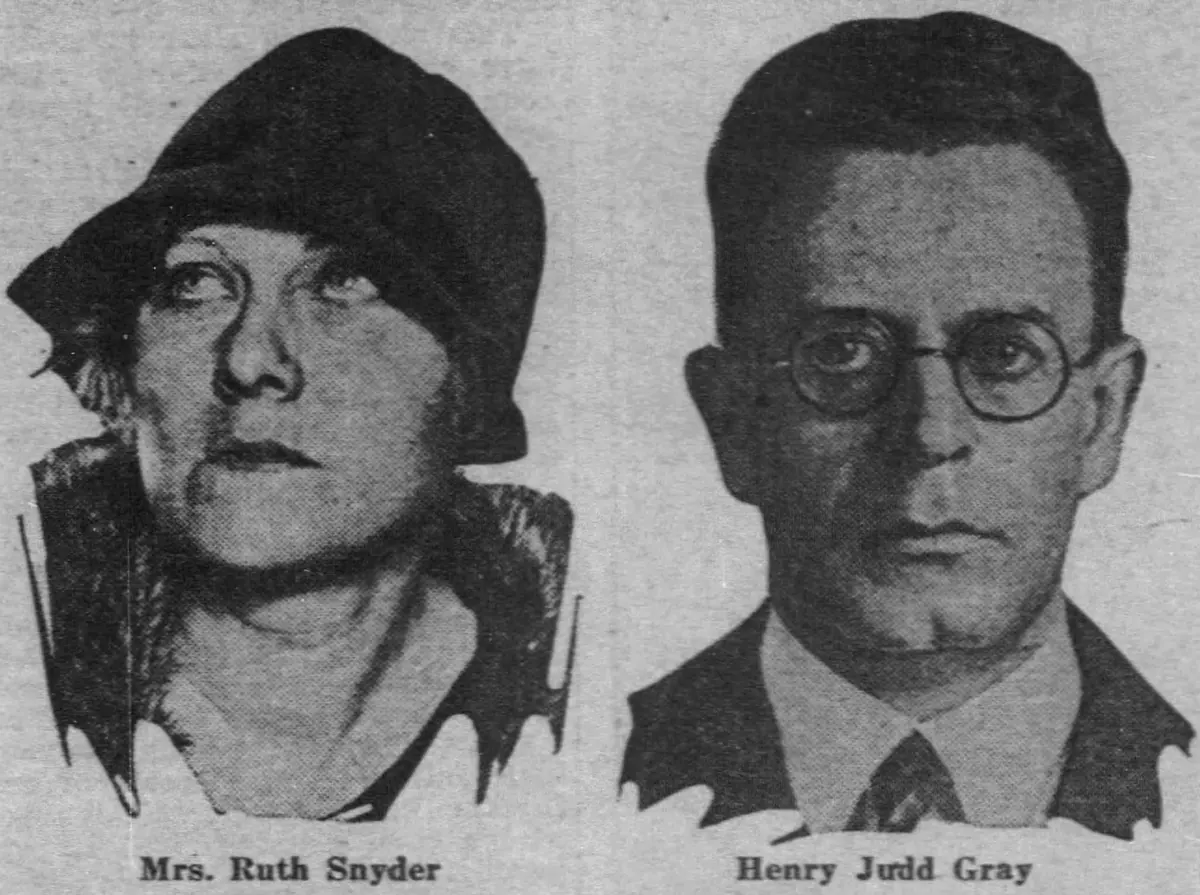
What happened
Albert Snyder was the art editor of a boating magazine, and on a Sunday morning in March 1927 he was found beaten and strangled in his bed at home in Queens Village. His wife Ruth lay bound in the upstairs hallway. Their nine year old daughter loosened the gag, ran along the street for help, and the neighbor who came back untied her and called the police.
Ruth said a tall man with a dark mustache had knocked her out and left her there for five hours while he went through the house. Drawers were out, the rooms were turned over, and she said he had taken her jewelry.
Nobody believed in her intruder, but nobody had another name. How did police get from that bedroom to the man in the picture?
The record, filled in
The police side of that Sunday: how the intruder story fell apart, and where a small pin found on the bedroom floor led them.
Nothing had been forced, not a door and not a window, so whoever came in had been let in. The jewelry Ruth said he took was still in the house, under a mattress.
Tying leaves marks and her wrists had none, and a doctor found no bruise to explain five hours knocked out. Albert's revolver lay on the bed, never fired: a clumsy try, as the police read it, at showing he had fought back.
By the afternoon the police were sure the burglary was staged, but they still had no suspect. Then, on the bedroom floor, they found a small pin with the initials J.G. on it.
The detectives looked for a J.G. in Ruth's address book and found Judd Gray, a corset salesman and Ruth's lover. Asked about him, Ruth asked whether Gray had confessed. The police said yes. It was a bluff, and Ruth made a statement naming Gray and herself.
Gray was arrested at the hotel Ruth named, upstate in Syracuse. That room was his alibi: a friend had rumpled the bed so it would look slept in.
The pin was Albert's memento of Jessie Guishard, a fiancée who died before he married Ruth. J.G. fit Gray by pure chance. The motive was on paper: Albert's life insurance paid double for a violent death, and Ruth paid the premiums herself, without his knowing.
The payoff
So a pin that had nothing to do with Gray led the police to him, and their lie made Ruth talk. Ruth Snyder and Judd Gray were both convicted that May and executed at Sing Sing in January 1928.
The grid, solved
Afterwards
Each blamed the other for the plan and the blows. The clause that paid double gave James M. Cain the title of his novel Double Indemnity, and Billy Wilder filmed it in 1944.
A reporter smuggled a camera into the execution chamber. That photograph is not reproduced here.
Go deeper
- Where the picture is kept
- Sources
- She Had To Die! (October/November 1980, Volume 31, Issue 6) n:54184 American Heritage
- Ruth Snyder-Judd Gray Trial: 1927 Encyclopedia.com
- Snyder, Ruth (1893-1928) Encyclopedia.com
- A True Case of Double Indemnity in Queens Village qchron.com
- Snyder Murder Case Still Remembered In Queens Village qgazette.com
- How the New York 'Daily News' Photographed Ruth Snyder's Execution by the... Smithsonian Magazine
- Ruth Snyder, housewife and murderer headstuff.org
- A Torrid Affair an Inept Murder and a Historic... gizmodo.com
9 more sources
- Ruth Snyder History ebsco.com
- Library of Congress
- Hearst Networks EMEA History.com
- Double Indemnity rottentomatoes.com
- Ruth May Brown Snyder (1895-1928) Find a Grave
- Henry Judd Gray (1892-1928) Find a Grave
- Albert Edward Snyder (1882-1927) Find a Grave
- Ruth Snyder Wikipedia Wikipedia
- Double Indemnity (novel) Wikipedia
François Courvoisier
Left until Tuesday
Solved it? Open the case fileClose the case file
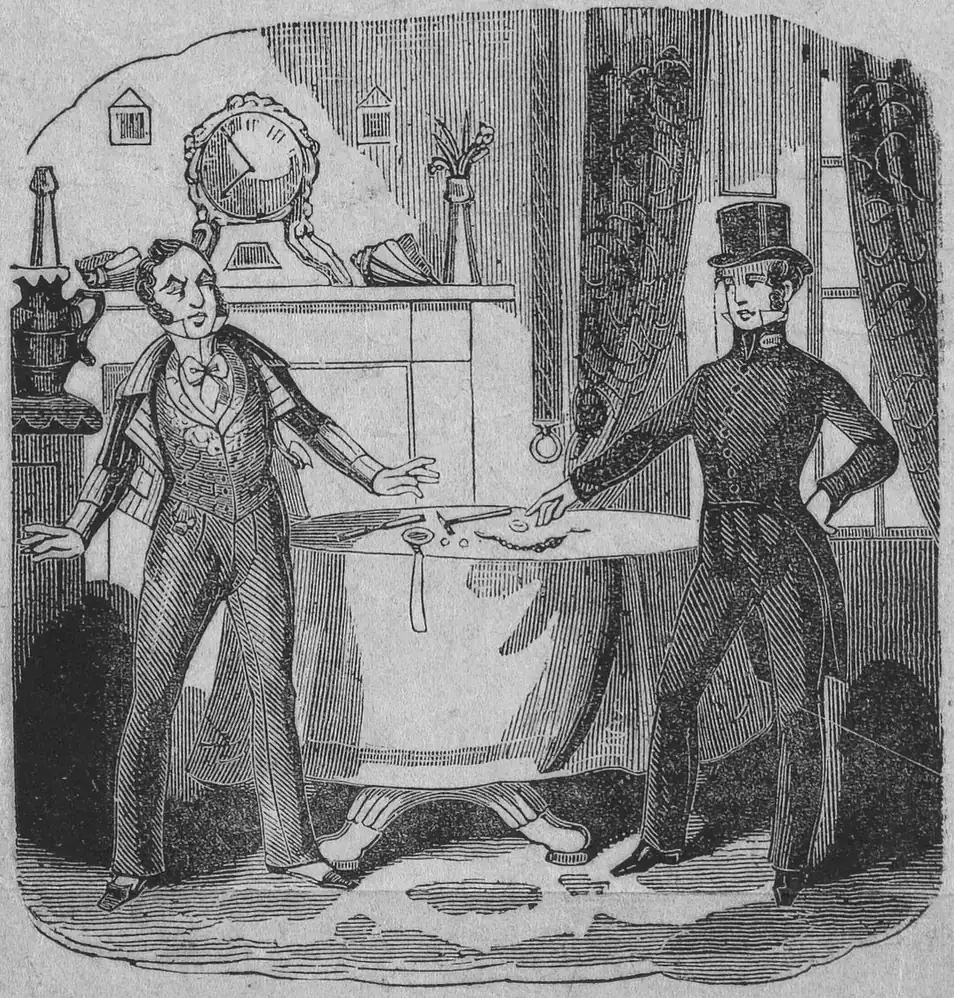
What happened
Early on 6 May 1840 a housemaid at 14 Norfolk Street, off Park Lane, found the ground floor ransacked. Upstairs her master, Lord William Russell, an elderly member of the Duke of Bedford's family, lay dead in his bed.
The police judged the break-in staged from inside, and within a week found his rings, a banknote and his watch hidden in the pantry of his Swiss valet, François Courvoisier.
At the trial in June the defense attacked every one of those searches. Then, late on the first day, a solicitor came into court with a parcel. Whose was it, and where had it been?
Nobody had seen the killing, and everything against the valet had come out of searches the police had made themselves.
The record, filled in
Day two. Mrs Peolaine, a hotel keeper's wife, on the parcel Courvoisier left with her; then Cumming, the solicitor who brought it to court. Watch when it was left.
Mrs Peolaine We keep the Hotel Dieppe, Leicester-place, Leicester-square; I know the prisoner ... he came to a situation, to take a place in the hotel as waiter ... I saw him again ... it was on a Sunday evening ... he had a paper parcel in his hand; he asked me if I would take care of it till the Tuesday following, and he would call for it ... I put the parcel in a closet, and locked it up ... tied with a string, and sealed.
The Prosecution Had the parcel been left with you before you heard of the murder, or not?
Mrs Peolaine Oh yes ... I also sent for Mr. Cumming, an attorney, who is an intimate friend of ours ... the parcel was opened in the presence of those persons; it had never been opened before, from the moment it came into my possession ... the parcel contained spoons and forks, silver I suppose ... I think it is tow, round the plate; it is like raveled rope, that would have the effect of preventing the plate being felt, or from jingling; it did not make the least noise.
Cumming I am a solicitor ... I opened it myself ... I noticed a crest on the forks and spoons; after doing it up, I proceeded to a bookseller's shop, in order that I might see by the Peerage-book the crest of the Bedford family, and having satisfied myself that a goat, which was on the spoons, was the crest of that family ... I immediately came here in a cab; I arrived here about six o'clock.
The payoff
That crest was the Bedford family's: Lord William's own silver, left a week or two before the murder and locked away where no policeman could reach it. The planted-evidence defense fell, and the jury convicted him.
The grid, solved
Afterwards
Courvoisier was hanged outside Newgate on 6 July 1840, with Charles Dickens and William Makepeace Thackeray in the crowd. He had confessed to his counsel during the trial.
Go deeper
- The original record
Evidence of Charlotte Peolaine and of Richard Cumming, witnesses for the Crown, at the trial of Francois Benjamin Courvoisier for the murder of Lord William Russell, Central Criminal Court, June 1840, before Lord Chief Justice Tindal and Mr Baron Parke. Proceedings of the Central Criminal Court, Eighth Session, 1840, pages 266 to 269. Old Bailey Proceedings Online (www.oldbaileyonline.org, version 9.0), reference t18400615-1629.
- Where the picture is kept
- Sources
- Trial t18400615-1629 Old Bailey Online
- The Newgate Calendar exclassics.com
- The Newgate Calendar: Francois Benjamin Courvoisier pascalbonenfant.com
- gould.usc.edu
- Francois Benjamin Courvoisier Capital Punishment UK
- 20,000 Hang on Words of Killer lawgazette.co.uk
- Lord Russell executedtoday.com
- In the bedroom, with a carving-knife spectator.com
11 more sources
- Trial, confession, and execution of Courvoisier for the murder of Lord Wm.... Wellcome Collection
- The Courvoisier Case mason.gmu.edu
- Stamp Owners armorial.bibsoc.org.uk
- Murder of Lord William Russell shadyoldlady.com
- Charles Phillips libraryireland.com
- Charles Dickens westminster-abbey.org
- Charles Dickens (1812-1870) victorianweb.org
- William Makepeace Thackeray westminster-abbey.org
- William Makepeace Thackeray: A Brief Biography victorianweb.org
- Dictionary of National Biography, 1885-1900/Phillips, Charles (1787?-1859) Wikisource
- François Benjamin Courvoisier Wikipedia
The Mona Lisa Theft
Closed on Mondays
Solved it? Open the case fileClose the case file
What happened
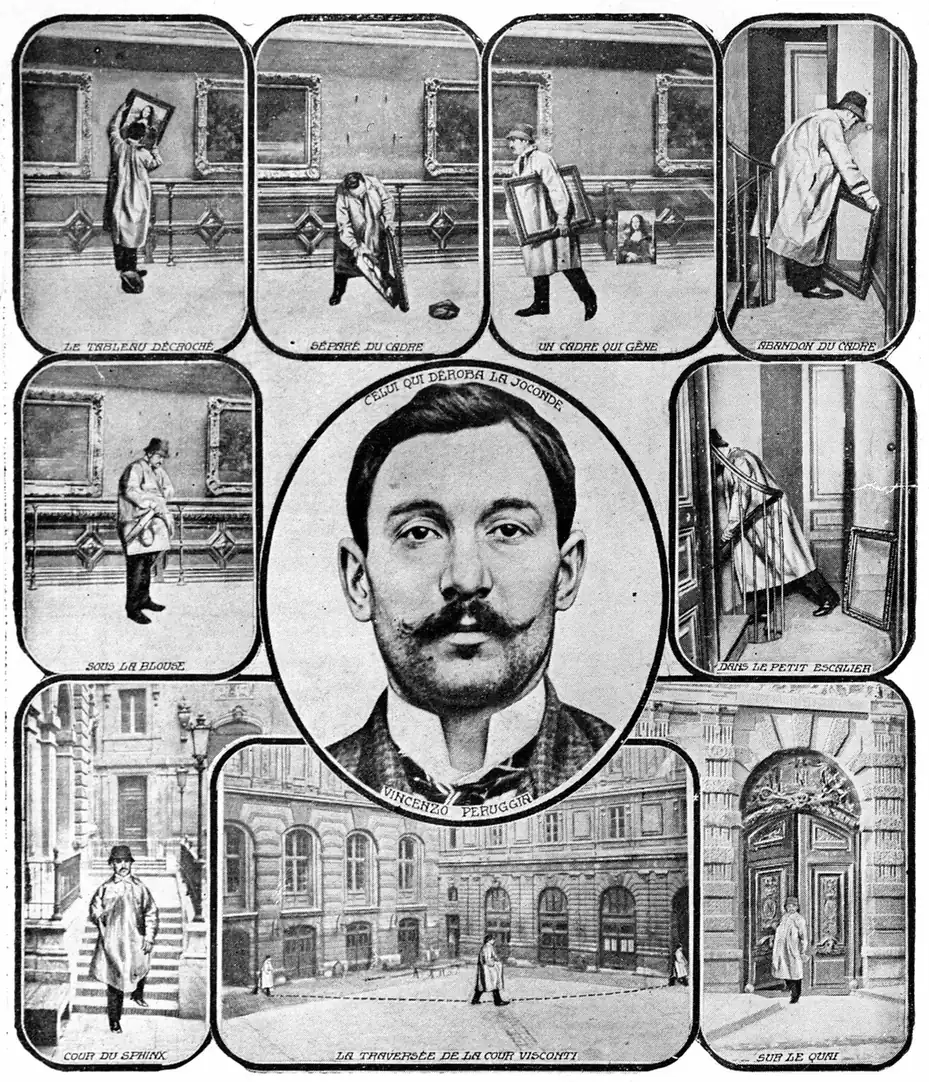
Vincenzo Peruggia, a former employee, hid inside the Louvre overnight. On Monday 21 August 1911, the museum's weekly closed day for cleaning, he lifted the Mona Lisa off the wall, took the small panel out of its frame and glass case, and walked out with it hidden under his clothes. The frame was left behind in the museum. Nobody noticed the empty wall until the museum reopened on Tuesday.
The theft made the painting famous overnight and set off a nationwide search. That autumn, French police questioned dozens of former Louvre staff, Peruggia among them, and let every one of them go without a second look.
Police had spoken to the thief and let him go. Two years on, the wall was still empty. What finally brought the painting out?
The record, filled in
From the police call at Peruggia's lodgings in 1911 to a meeting in Florence in 1913. Watch who finally brings the painting out of hiding.
Peruggia was a glazier, a glass fitter, and had worked on the painting's own protective case. A photograph and a set of his fingerprints sat in a Paris police file from an earlier arrest. Detectives went down a false trail instead: they held the poet Guillaume Apollinaire and questioned the painter Pablo Picasso, because a man the two knew had once stolen small statues from the Louvre. Both were released.
That autumn a police inspector called at his lodgings on a routine round of former museum staff. Peruggia had carried the panel out under his smock, the loose white overall the Louvre's own staff wore, but he told the officer he had only read about the theft in the newspapers.
Judged an ordinary workman, he was let go, and nobody opened his file. For over two years the painting lay in a false-bottomed trunk in his room.
In late 1913 he wrote to Alfredo Geri, an art dealer in Florence, offering to sell it. He gave his motive as patriotism: he believed Napoleon had looted it from Italy.
In December 1913 Peruggia carried the panel to Florence. Geri brought in Giovanni Poggi, director of the Uffizi gallery, and the two men met Peruggia and checked the panel against photographs. It was authentic. They called the police, who arrested him at his hotel.
The payoff
No detective found the Mona Lisa: the thief brought it out himself, trying to cash it in. It went back to the Louvre in January 1914, and an Italian court jailed him for about seven months.
The grid, solved
Afterwards
France had in fact owned the painting lawfully since the sixteenth century, long before Napoleon. Peruggia later married, had a daughter, and died near Paris in 1925, on his forty fourth birthday.
Go deeper
- Where the picture is kept
- Sources
- Stolen: How the Mona Lisa Became the World’s Most Famous Painting Smithsonian Magazine
- Vincenzo Perugia, Thief of the Mona Lisa Encyclopedia.com
- How Did Vincenzo Peruggia Steal the Mona Lisa? thecollector.com
- Hearst Networks EMEA History.com
- The Curious Story of the Man Who Stole the Mona Lisa guinnessworldrecords.com
- Vincenzo Peruggia 1881 1925 ancestors.familysearch.org
- Vincenzo Peruggia geni.com
The Tichborne Case
Her son, she said
Solved it? Open the case fileClose the case file
What happened
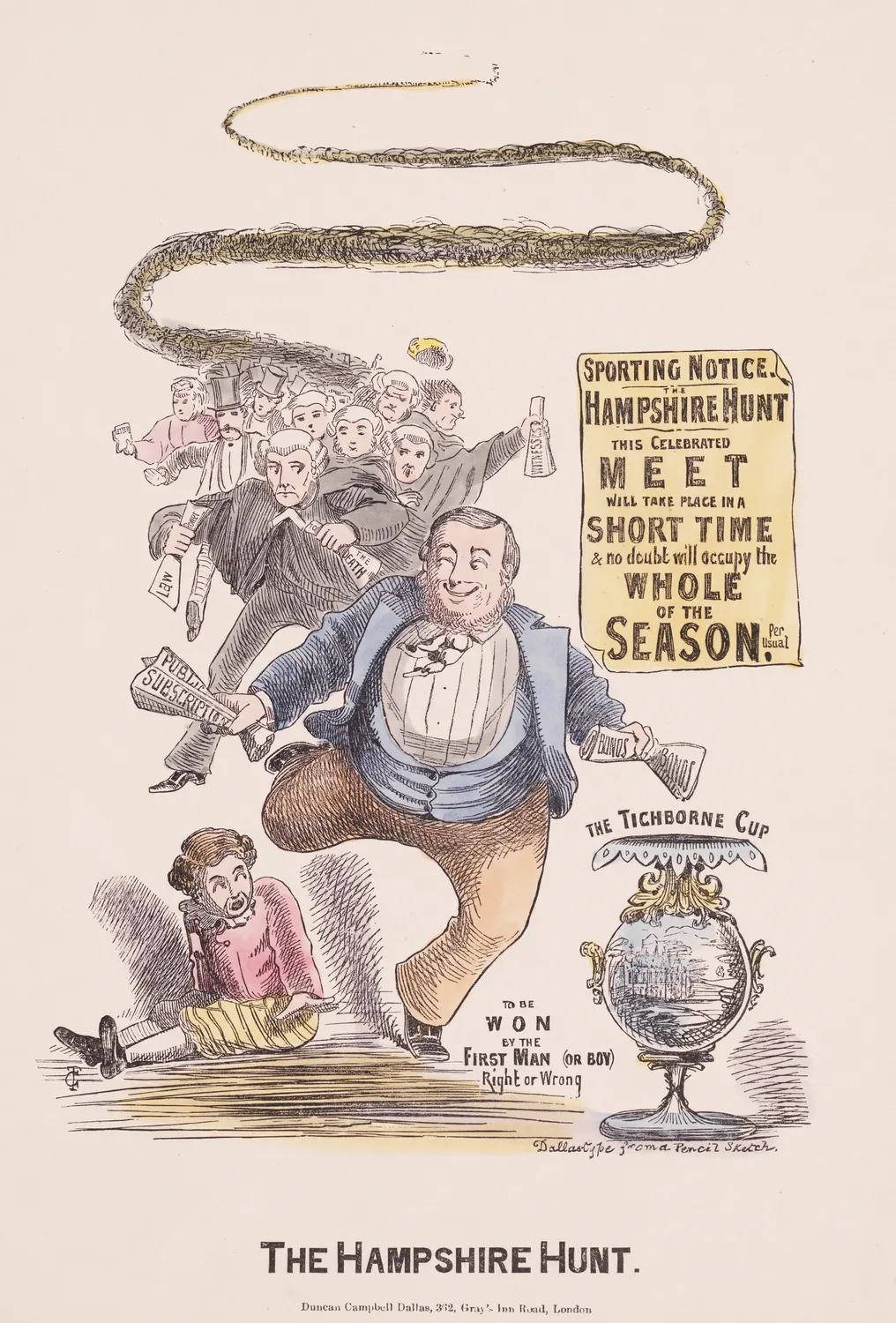
Roger Tichborne was the eldest son of a Hampshire baronet and heir to the estates. He was born in Paris in 1829 and raised by a French mother, and sent to school in England only at sixteen, by which time French was the language he thought in. In 1854 he sailed from Rio de Janeiro on the Bella. She never arrived, and after some years the family had him declared dead.
His mother never accepted it. She advertised for years, and in 1866 a heavy man arrived from Australia saying he was her son. She met him and said at once that he was. The rest of the family said he was a fraud.
A mother's word against a family's. Was there anything on Roger himself that could settle who this man really was?
The record, filled in
Twenty years in dated steps, from the wreck to the verdict. Watch for what Roger had and the man from Australia did not.
April 1854. The ship Bella sank off Brazil with Roger aboard; only her longboat was found, floating and empty. He was twenty-five, slight, under ten stone (140 pounds), and had spent his schooldays at Stonyhurst.
July 1865. The Dowager Lady Tichborne, Roger's mother, advertised for him in the Australian papers. A butcher at Wagga Wagga, known there as Thomas Castro, answered. He landed in England in December 1866, nearly twenty stone (280 pounds), to be known as the claimant to Roger's title.
1867. An inquiry agent took his photograph to Wapping, in East London, and came back with a name: Arthur Orton, a local man in the same trade who had gone to South America and then Australia.
May 1871. The man from Australia sued for the estates as Roger. Asked in the witness box if he could speak French, the language Roger thought in, he said no. Testifying for him, an old family valet, Andrew Bogle, swore he had seen Roger's bare arms and never a mark on them. Then a schoolfellow of Roger's, by then Lord Bellew, swore that he had himself tattooed a cross, a heart and an anchor on Roger's left forearm.
Yet the man in the witness box had no tattoo on his left forearm at all, only a mark where some other one had been removed. Evidence was given that Arthur Orton had once had his initials on his arm. The civil case collapsed in March 1872.
The payoff
The arm settled it: Roger's bore a schoolfellow's tattoos, and the arm in court bore only the mark of a removed one. He was Arthur Orton of Wapping, and in 1874 a jury gave him fourteen years for perjury.
The grid, solved
Afterwards
He served ten years, sold a confession to a newspaper in 1895, then took it back, and died in poverty in London in 1898. The Tichbornes let a plate reading Sir Roger Charles Doughty Tichborne go on his coffin all the same.
Go deeper
- Where the picture is kept
- Sources
- The Tichborne Trial: The Summing-up by the Lord Chief Justice of England.... Internet Archive
- Famous trials: The Tichborne claimant, Troppmann, Prince Pierre Bonaparte, Mrs.... Internet Archive
- Illustrations in advocacy Internet Archive
- The trial at Bar of Sir Roger C.D. Tichborne, bart.,?Bin the court of Queen's... Internet Archive
- The Tichborne Trials Archive collections.hampshireculture.org.uk
- Tichborne Case Victorian Melodrama sl.nsw.gov.au
- The Tichborne Claimant specialcollectionsuniversityofsouthampton.wordpress.com
- The Tichborne Case brightonmuseums.org.uk
7 more sources
- Convicts and the Cultural Significance of Tattooing in Nineteenth Century... eprints.whiterose.ac.uk
- Body Double JSTOR Daily JSTOR
- Timeline: The Tichborne Claimant victorianweb.org
- 161 Andrew Bogle 1802-1877. Jamaican in Britain & Australia jeffreygreen.co.uk
- From Jamaica to Tichborne: the life of Andrew Bogle (part 2) hampshirearchivesandlocalstudies.wordpress.com
- The Tichborne Dole historic-uk.com
- Dictionary of National Biography, 1885-1900/Kenealy, Edward Vaughan Hyde Wikisource
Buck Ruxton
Near the Devil's Beeftub
Solved it? Open the case fileClose the case file
What happened
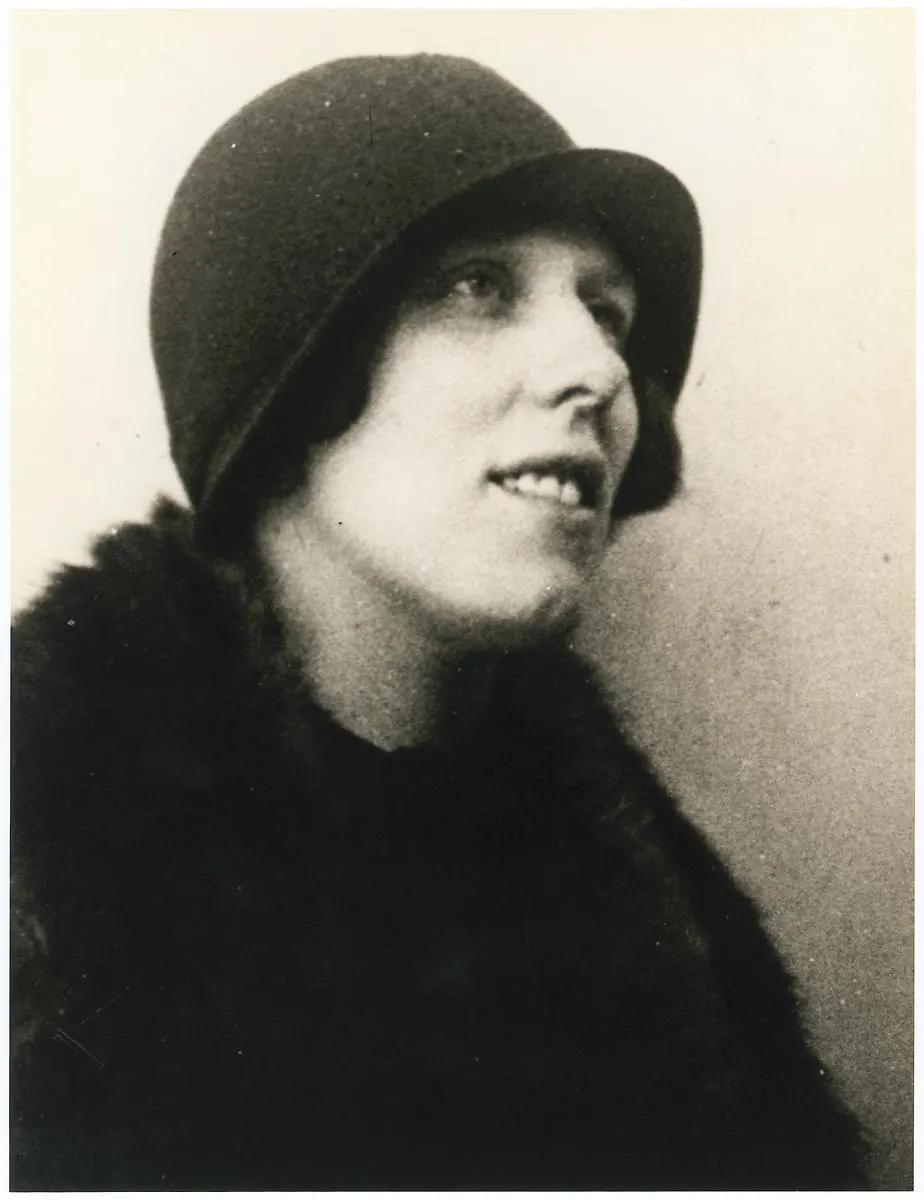
A woman walking above a stream in the Scottish borders on 29 September 1935 looked over a bridge and saw what she took for a human arm. A search of the gully below brought up about thirty separate parcels.
Whoever wrapped them had removed everything a body is recognized by. No faces, no fingertips. Two professors, John Glaister and James Brash, spent weeks reassembling the parts before anyone could ask who these people were.
One wrapping was a special Sunday newspaper edition sold only around Lancaster and Morecambe, where Isabella Ruxton and Mary Jane Rogerson, the maid in her husband's house, had been missing since 15 September. The husband was Buck Ruxton.
No faces, no fingertips, nothing left to match. Without names for the dead there was no case. How could anyone say who they were?
The record, filled in
Ruxton's trial, Manchester, 1936. Professor Brash laid photos of both skulls over portraits of the two missing women. Birkett, defending, objects that it is too rough.
Birkett ... I submit that the evidence ought not to be allowed ... It is constructed evidence which is so liable to error ... approximate is the best that can be done; and in such a matter, where the purpose of the evidence is to show exactitude ...
The Judge I gather that it is the superimposition of one photograph upon another in some form ... I do not feel able to exclude the evidence on that.
Birkett The objection really went to the weight of the evidence and not to the admissibility.
Brash ... each skull was placed in the position of the photograph of Mrs. Ruxton, the one wearing the tiara ... I found in dealing with the tracings, that the tracing of Skull No. 1 would not in any way fit the tracing of Photograph A, but I found that the tracing of Skull No. 2 would fit it ...
The Judge When you put them together, which do you put on which?Brash That does not matter: they were both done on transparent X-ray film.
Jackson, For The Crown What conclusions do you draw ...?Brash In my opinion these demonstrate conclusively, in the first place, that Skull No. 1 could not possibly be the skull of Mrs. Ruxton.
The Judge That is clear: they may demonstrate that something is not something else, but do they demonstrate more than that?Brash They also demonstrate, in my opinion, that Skull No. 2 might be the skull of Mrs. Ruxton.
The payoff
Each skull fit one woman and was ruled out for the other: the same test on Mary Rogerson's photographs showed No. 2 could not be hers. So the dead were Isabella and Mary. Ruxton was convicted and hanged in May 1936.
The grid, solved
Afterwards
His written confession was published after he died. The press called it the jigsaw murders.
Go deeper
- The original record
Professor James Couper Brash, examined by Mr. J. C. Jackson, K.C., with an objection from Mr. Norman Birkett, K.C., and interventions from Mr Justice Singleton, at the trial of Buck Ruxton for the murder of Isabella Ruxton, Manchester Winter Assizes, opening 2 March 1936. R. H. Blundell and G. Haswell Wilson (eds.), Trial of Buck Ruxton, Notable British Trials (Edinburgh and London: William Hodge & Company, 1937), pages 181 to 184.
- Where the picture is kept
- Sources
- Visible Proofs: Forensic Views of the Body: Galleries: Cases: The Buck Ruxton... US National Library of Medicine
- Dr. Buck Ruxton Capital Punishment UK
- Murder, maggots and forensic entomology nhm.ac.uk
- Parked Domain name on Hostinger DNS system truecrimearchives.blog
- The Ruxton Murders policemuseum.org.uk
- Isabella (Belle) Ruxton (1901 moffatmuseum.co.uk
- Buck Ruxton (1899-1936) moffatmuseum.co.uk
Sacco and Vanzetti
A form of words
Solved it? Open the case fileClose the case file
What happened
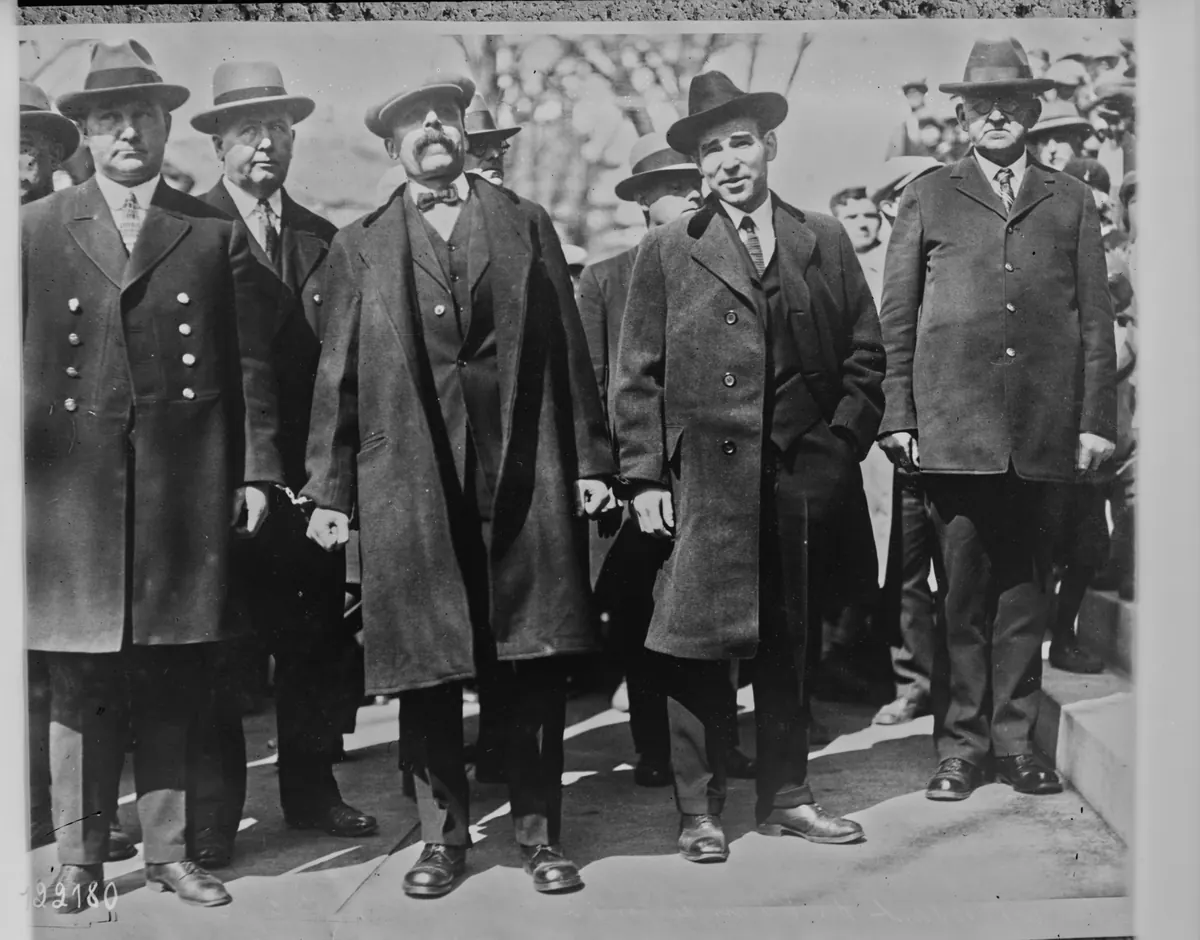
On the afternoon of 15 April 1920 two men from a shoe company were carrying the week's wages along Pearl Street in South Braintree, Massachusetts. Both were shot in the road and died of it, and a car took the two steel boxes away.
Three weeks later a garage owner in West Bridgewater telephoned the police about a car nobody had collected. Two Italian immigrants who called for it were in custody within hours. Nicola Sacco was carrying a loaded .32 Colt automatic pistol, with loose cartridges in his pocket. Bartolomeo Vanzetti was carrying a loaded revolver, which the state said had been taken from one of the two men in the road. Both men were anarchists, and both had lied about their movements.
The state's firearms witness would only say one bullet could have come from Sacco's pistol. Could anyone ever say more than that?
The record, filled in
Seven years in dated steps, from the robbery to the last test before the executions. Watch the sixth bullet, and one cartridge case from the road.
15 April 1920. About fifteen thousand dollars of payroll money left Pearl Street in a car. A bystander picked three or four spent cartridge cases out of the road, and six bullets were taken from the two men and numbered.
5 May 1920. Sacco and Vanzetti were taken off a streetcar at Brockton, hours after calling at the garage the police were watching. Sacco's pistol was a .32 Colt automatic, the same caliber as the bullets.
14 July 1921. Five bullets had been cut by barrels spiraling right. The sixth, bullet III, had a left-hand twist, and among American makes that meant a Colt, like Sacco's. Bullet III was Winchester ammunition, and so was one case from the road, marked W. The state's firearms witness, Captain Proctor, would only call bullet III consistent with being fired by Sacco's pistol. Both men were convicted of murder.
20 October 1923. Proctor swore an affidavit that his wording had been agreed with the prosecution beforehand, and that, asked plainly whether the bullet came from that pistol, he would have had to answer no.
3 June 1927. Calvin Goddard brought a comparison microscope to Boston: two microscopes joined, so the marks on an exhibit and on a freshly fired round sit side by side in one view. He test-fired Sacco's pistol and said bullet III and case W had come from it and no other. The defense's own chemist, Augustus Gill, came round to the match, and its firearms expert, James Burns, who had sworn in 1921 that the bullet was not from Sacco's pistol, recanted.
The payoff
So the microscope said what the 1921 witness would not: bullet III and case W came from Sacco's pistol. Eleven weeks later, on 23 August 1927, both men were executed. The test never touched Vanzetti.
The grid, solved
Afterwards
Examiners went back to the exhibits in 1961 and 1983 and reached the same finding. Some historians argue the exhibits were tampered with before any test. In 1977 a governor of Massachusetts called the trial unjust without ruling on guilt, and historians disagree still.
Go deeper
- Where the picture is kept
- Sources
- Sacco Vanzetti the Crime Scene mass.gov
- Sacco Vanzetti Proclamation mass.gov
- The Case of Sacco Vanzetti mass.gov
- Sacco Vanzetti the Madeiros Confession Felix Frankfurter mass.gov
- Sacco and Vanzetti digitalarchives.sec.state.ma.us
- digitalarchives.sec.state.ma.us
- Famous Trials
- Famous Trials
26 more sources
- Famous Trials
- Famous Trials
- Famous Trials
- Famous Trials
- Famous Trials
- Famous Trials
- Famous Trials
- Sacco Guilty, Vanzetti Innocent? (June 1962, Volume 13, Issue 4) American Heritage
- Module 02 :: 1961-1963 archive.gfjc.fiu.edu
- Module 02 :: 1980-1989 archive.gfjc.fiu.edu
- Examination of Firearms Related Evidence: The Nicola Sacco and Bartolomeo... afte.org
- The Birth of Ballistics stvalentinemassacre.org
- Smithsonian
- Sacco and Vanzetti: An Exchange nybooks.com
- The Sacco-Vanzetti Case nybooks.com
- umasspress.com
- Found letter indicates Upton Sinclair believed Sacco & Vanzetti were guilty historynewsnetwork.org
- Alvan Tufts Fuller nga.org
- Verification Required archives.albany.edu
- Gallica
- Gallica
- wikitree.com
- Frederick Albert Parmenter (1874-1920) Find a Grave
- Alexander Berardell (1876-1920) Find a Grave
- Dr Calvin Hooker Goddard (1891-1955) Find a Grave
- Judge Webster Thayer (1857-1933) Find a Grave
The Brides in the Bath
Three accidents
Solved it? Open the case fileClose the case file
What happened
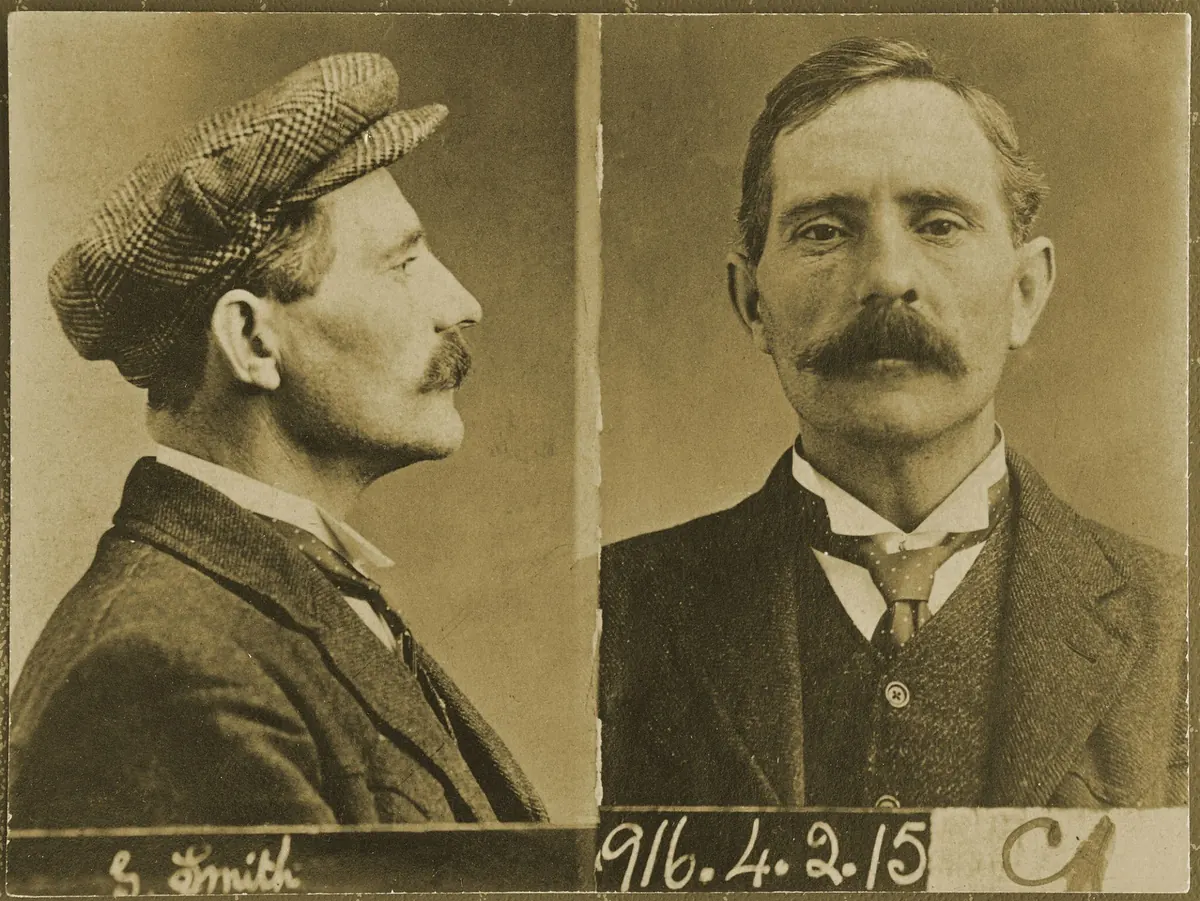
In July 1912 a woman drowned in her bath at Herne Bay. A doctor guessed at a fit and the verdict was misadventure. In December 1913 another drowned in a Lancashire boarding house, and that hearing took half an hour. In December 1914 a third drowned in north London, the day after her wedding.
Each woman had made her money over to her husband days before she died. Each husband gave a different name. There was no witness to any of the three and no mark of violence on any of the bodies.
Taken one at a time, each was exactly what the coroner called it.
The record, filled in
How Scotland Yard joined three deaths into one case, from two newspaper readers to the trial at the Old Bailey. Watch what the three deaths had in common.
The third death made the papers: a bride found dead in her bath in Highgate, north London, the day after her wedding. Two readers saw an earlier death in it. The father of the second woman to die sent a report of the Highgate inquest to the police, and the landlord of the Blackpool house where his daughter had died posted Scotland Yard the story with a cutting about her death.
Detective Inspector Arthur Neil followed bank and savings accounts through more than a dozen towns and half a dozen names, and found one husband behind all three deaths: George Joseph Smith. Every marriage after his first, in 1898, was bigamy, because that first wife never divorced him.
The money moved the same way each time. Days before each death a will was signed or insurance taken out on the wife's life, always in his favor, and he collected afterwards.
Smith was tried at the Old Bailey for the first death only, the one at Herne Bay. Over the defense's objection the judge let the jury hear about the other two, so it could decide whether three deaths so alike were chance or a system.
How does a grown woman die in a bath without a mark? One of the detectives found out before the trial. A young woman he knew, a practiced swimmer, sat in a bath filled to the Herne Bay depth, knowing the detective would try to put her under. Then, suddenly, he did. Once her head went down she could not lift it or cry out, and almost at once she stopped struggling. He ended the test then and there, satisfied how easily a strong man could do it.
The payoff
Put side by side, the three accidents were one man's routine. The jury took twenty-two minutes to find Smith guilty of the Herne Bay death, and he was hanged at Maidstone on 13 August 1915.
The grid, solved
Afterwards
The ruling that let the jury hear all three deaths is still taught: other acts cannot show that a man is the sort to do it, but they can show that an apparent coincidence is a method.
The other two deaths were never charged at all, because they did not need to be.
Go deeper
- Where the picture is kept
- Sources
- Trial Of George Joseph Smith Internet Archive
- British Executions
- Brides in Bath historybytheyard.co.uk
- Crime of the Century: The Brides in the Bath heinonline.com
- The Blackpool 'bride in the bath' murder which changed British law forever uk.news.yahoo.com
- The ‘Brides in the Bath’ Murders That Shocked Edwardian London Mental Floss
- The People's Pathologist Transcript shedunnitshow.com
- 13 August 1915: The ‘Brides in the Bath’ murderer is hanged moneyweek.com
5 more sources
- 1915: George Joseph Smith, Brides in the Bath murderer executedtoday.com
- George Joseph Smith and the Brides in the Bath synwritestruecrime.school.blog
- academic.oup.com
- Rex v. Smith harvardwiki.atlassian.net
- George Joseph Smith Wikipedia
William Palmer
The jar that went up to London
Solved it? Open the case fileClose the case file
What happened
John Parsons Cook, twenty eight, owned racehorses. In November 1855 his mare won at Shrewsbury, and he came back to Rugeley with about two thousand pounds in winnings due to him on his bets. He fell ill at the Talbot Arms, across the road from his friend William Palmer, a surgeon turned racing man, and four days later he was dead. Palmer had attended him throughout.
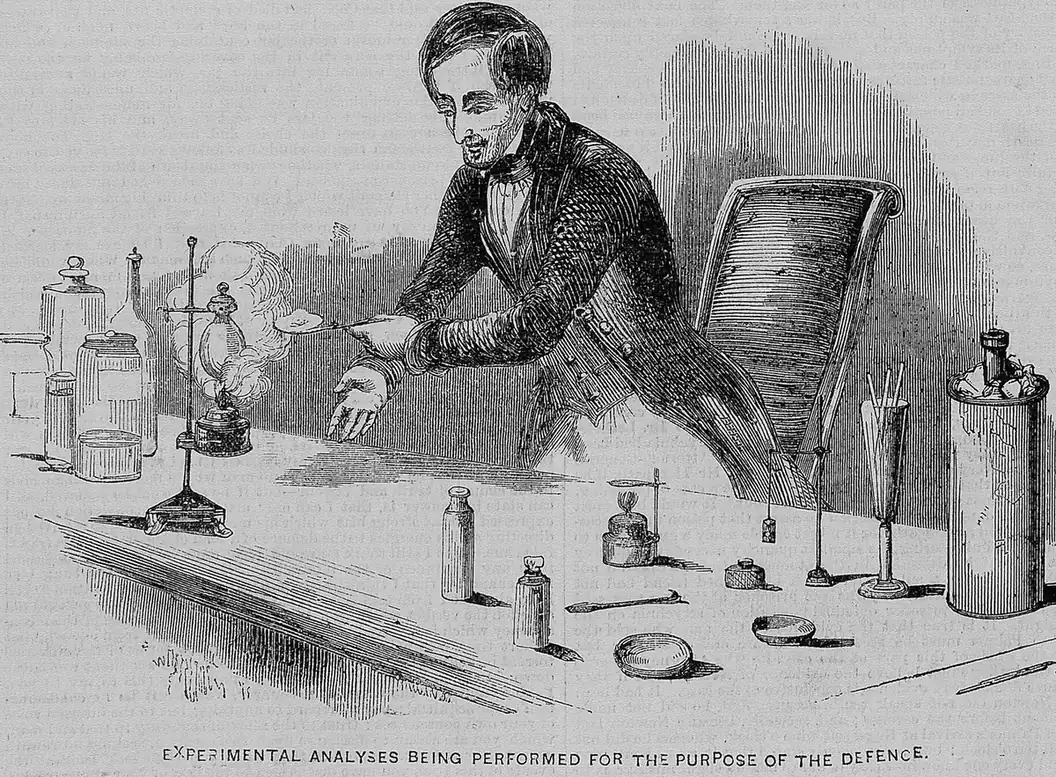
Palmer owed thousands on bills he had raised by forging his mother's signature, and he had bought strychnine twice in the town that month. At the post-mortem he jostled the men opening the body, and the sealed jar holding the stomach turned up in his hands with a cut in its cover. It went up to London all the same.
Strychnine leaves the mind clear through every spasm. What did the bedside see, and what did London find in the jar?
The record, filled in
Elizabeth Mills, the inn's chambermaid, on Cook's last days. Then Dr Alfred Taylor, the poisons expert who opened the jar in London, questioned for the Crown.
Mills Mr. Cook got up at one o'clock on that Monday. He appeared a great deal better ... About eight o'clock that night Miss Bond, the housekeeper, gave me a pillbox to take upstairs to Mr. Cook's room ... It was wrapped up in white paper. ... Palmer came, and went into Cook's room.
Mills There was one mold candle burning. ... His body, his hands, and neck were moving then, a sort of jumping or jerking. ... Cook was conscious while this jerking of the body was going on. He recognized Palmer when he came in.
Mills I next saw Cook again about six o'clock on the Tuesday morning. ... I asked “What do you think was the cause of all that, Mr. Cook?” and he said the pills that Palmer gave him at half-past ten.
Attorney-General How did you account physiologically for the absence of any indication of strychnia where you know strychnia to have been given and to have caused death?Taylor By absorption into the blood so that it is no longer in the stomach ... If the minimum of the quantity required to destroy life was given, I do not think I would find any.
Taylor After the post-mortem examination on the body of Mr. Cook some portion was sent up to me. ... We sought for prussic acid, oxalic acid, morphia, strychnia ... the poison of tobacco, hemlock, arsenic, mercury ... We only found small traces of antimony. ... The stomach had been completely cut from end to end; all the contents were gone ... In journeying up to London it must have been shaken in every possible way.
The payoff
No strychnine was found in a stomach that reached London cut open, emptied and tossed about. The jury went by the bedside: a man clear-headed through every spasm, who blamed what Palmer gave him. It found Palmer guilty.
The grid, solved
Afterwards
Palmer was hanged at Stafford on 14 June 1856, saying to the last he had not poisoned Cook.
Go deeper
- The original record
Elizabeth Mills, chambermaid at the Talbot Arms, examined 14 May 1856, and Dr Alfred Swaine Taylor, examined by the Attorney-General 19 May 1856, at the trial of William Palmer, Central Criminal Court. Shorthand writers' record, printed in Trial of William Palmer, ed. George H. Knott, Notable British Trials, 1912. Ellipses mark cuts; no word is changed.
- Where the picture is kept
- Sources
- The Project Gutenberg eBook of Trial of William Palmer, edited by George H.... Project Gutenberg
- Trial Of William Palmer Internet Archive
- Visible Proofs: Forensic Views of the Body: Galleries: Cases: Toxicology in the... US National Library of Medicine
- Palmer the Poisoner sciencehistory.org
- gethistories.com
- The Prince of Poisoners rcsiheritage.blogspot.com
- radar.brookes.ac.uk
- A rigorous medico-legal expert: Alfred Swaine Taylor rcseng.ac.uk
7 more sources
The Pyjama Girl
On view in Sydney
Solved it? Open the case fileClose the case file
What happened
On the first morning of September 1934, on a country road outside Albury in New South Wales, a man found the body of a young woman pushed into the drain that ran under the road. She had been badly beaten and burned. She wore the remains of yellow silk pyjamas, and the papers called her the Pyjama Girl.
Her fingerprints matched nothing on file, and her description went to every police station in two states. Rather than bury her nameless, the police preserved the body and for years showed her face to anyone who thought they might know her.
Some of those who filed past her gave a name. Her dental chart said they were wrong.
The record, filled in
How the police got a name for her in 1944, and how a Melbourne court closed the case that June. Keep an eye on the dental chart.
In February 1944 the police asked a new dentist to chart the teeth of the body, which had been kept all those years in a bath of formalin at the University of Sydney. The new chart showed what the 1934 examiner, a local man with no forensic training, had got wrong: he had missed fillings and mistaken one tooth for another. Those two errors had ruled out the right woman.
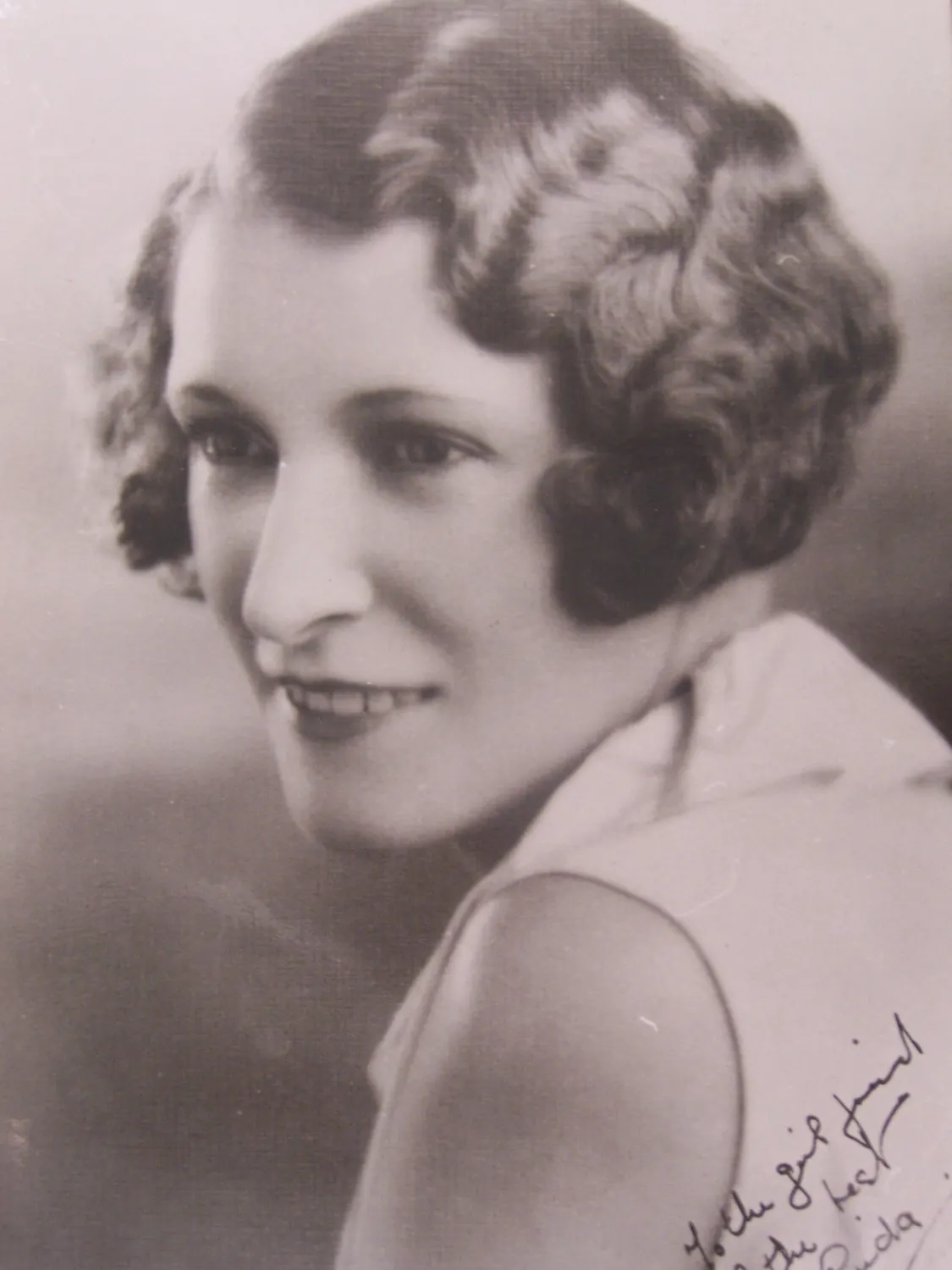
The new chart matched a woman the police already had on file as missing: Linda Agostini, born Linda Platt in London. As a check, freckles on the upper arm of the body matched those in old photographs of her, and friends who were shown the body named her too.
Her husband, Antonio Agostini, was by then a waiter at Romano's, a Sydney restaurant where the state's police commissioner, William MacKay, often ate. On 4 March 1944 MacKay, who had reopened the case, questioned Agostini in person, and Agostini made a confession.
Agostini said they had quarreled in bed at home in Carlton, Melbourne, in 1934, and that she was shot with a pistol which, he said, she had been holding. To keep the police away he drove her body across the state border, hid it in a culvert on the Howlong road and tried to burn it.
The payoff
Charted properly, the dental work named the body, and the name led to her husband. The jury rejected his story of an accident but, the judge said, thought years of her conduct had provoked him: manslaughter, not murder.
The grid, solved
Afterwards
Agostini served part of six years with hard labor, went free early under a general amnesty and was sent back to Italy in 1948. The name is still argued over: the 1934 description gave the body light blue eyes, Linda's were brown, and the historian Richard Evans argues the body was never hers.
Go deeper
- Where the picture is kept
- Sources
- Making sure you're not a bot! Trove
- Making sure you're not a bot! Trove
- Biography Antonio Agostini Australian Dictionary of Biography
- Biography Linda Agostini Australian Dictionary of Biography
- "Pyjama Girl" killer's prison record among files opened 1 Jan 2020 prov.vic.gov.au
- Big Bill MacKay mhnsw.au
- MacKay, William John dictionaryofsydney.org
- How Did Past Social Values Affect Legal Outcomes Australia mhnsw.au
11 more sources
- True Crime Pyjama Girl and Graeme Thorne Cases nfsa.gov.au
- Fabulous Century Solving Pyjama Girl Mystery nfsa.gov.au
- History of Forensic Odontology in Australia ausfo.org.au
- US National Library of Medicine
- The Pyjama Girl Mystery by Richard Evans sydneycrimemuseum.com
- The Pyjama Girl Mystery, Richard Evans austcrimefiction.org
- the pyjama girl project: Who was Linda Agostini? pyjamagirlproject.blogspot.com
- A 1934 Mystery of a Woman in Pyjamas Ended When Police Accused an Italian... wegotthiscovered.com
- The Pyjama Girl Mystery Case Closed or Forced... paulinemontagna.medium.com
- US National Library of Medicine
- The Pyjama Girl murder Wikipedia
Madeleine Smith
I talked to him from the window
Solved it? Open the case fileClose the case file
What happened
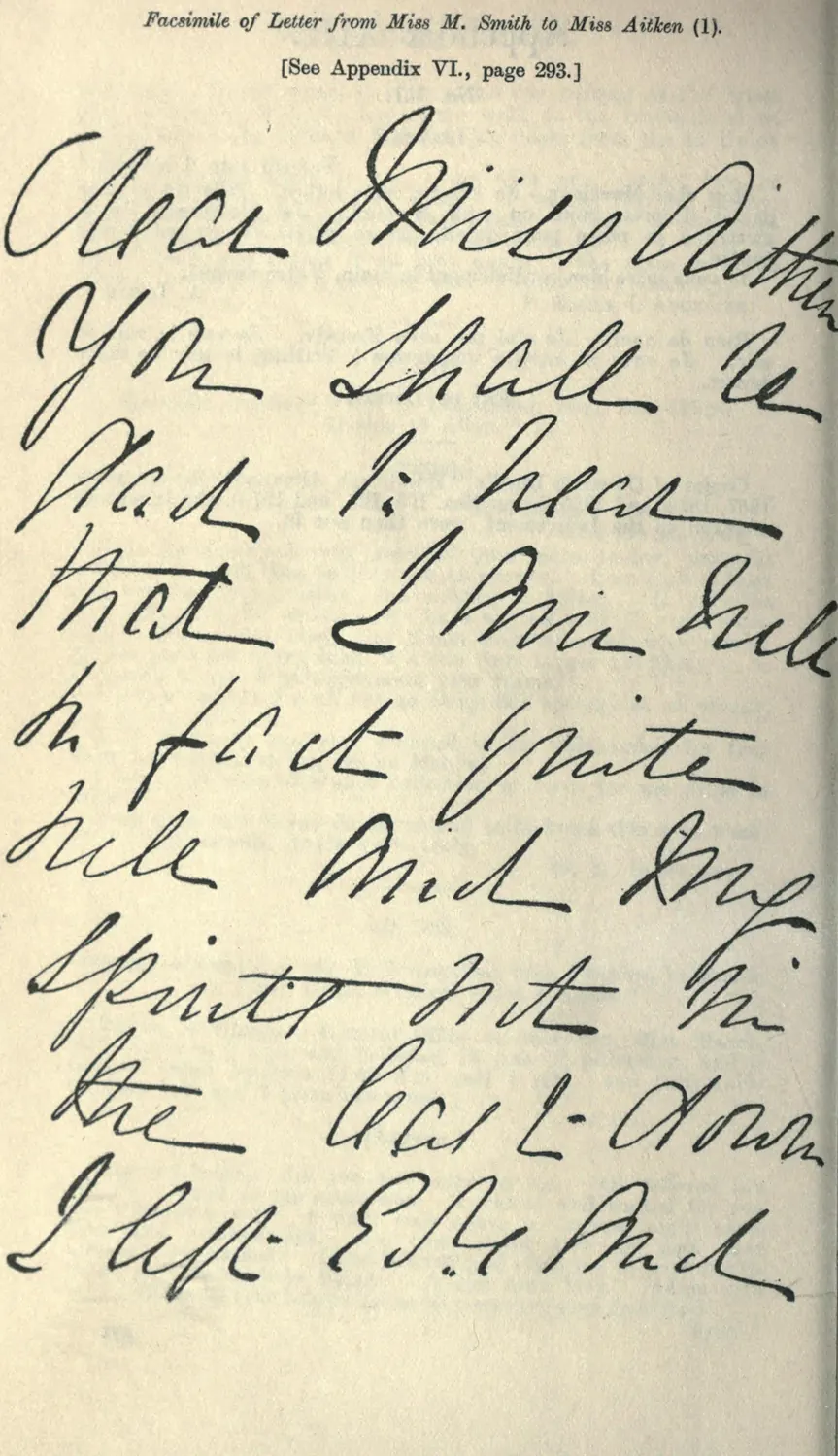
Madeleine Smith was the daughter of a wealthy Glasgow family. For two years she had secretly courted Pierre Emile L'Angelier, a warehouse clerk her parents would never have received. They met at night at the window of her ground-floor room and wrote to each other almost every day.
In February 1857 she accepted a proposal from William Minnoch, a merchant her family approved of, and asked L'Angelier for her letters back. He refused. On Sunday 22 March he went out at night and came home violently ill, and by the next morning he was dead, with nearly a fifth of an ounce of arsenic in him.
She had signed for arsenic three times. To convict her, the Crown had to prove she saw him that Sunday night.
The record, filled in
Madeleine Smith's own statement to the sheriff, a Scottish judge, eight days after his death. Watch what she says about that Sunday night, and about the arsenic.
My name is Madeleine Smith. I am a native of Glasgow; twenty-one years of age; and I reside with my father, James Smith, architect, at No. 7 Blythswood Square, Glasgow. For about the last two years I have been acquainted with P. Emile L'Angelier ... I had not seen M. L'Angelier for about three weeks before his death ... he tapped at my bedroom window ... I talked to him from the window, which is stanchioned outside, and I did not go out to him, nor did he come in to me.
... I expected him to visit me on Saturday night, the 21st current ... but he did not come, and sent no notice. There was no tapping at my window on said Saturday night, or on the following night, being Sunday. I went to bed on Sunday night about eleven o'clock ...
... He was very unwell for some time ... and he complained of sickness, but I have no idea what was the cause of it. I remember giving him some cocoa from my window one night some time ago, but I cannot specify the time particularly.
I have bought arsenic on various occasions. ... I used it all as a cosmetic, and applied it to my face, neck, and arms, diluted with water. The arsenic I got in Currie's shop I got there on Wednesday, the 18th March, and I used it all on one occasion, having put it all in the basin where I was to wash myself.
... on all the three occasions, as required in the shops, I signed my name to a book in which the sales were entered. ... I never administered, or caused to be administered, to M. L'Angelier arsenic or anything injurious. And this I declare to be truth.
The payoff
Nobody proved he came to her window that Sunday. Shops had to dye arsenic by law, but nobody searched his body for dye, so nothing tied hers to his death. Not proven: she went free, but was not declared innocent.
The grid, solved
Afterwards
His sickness in February had become two more charges, ending not guilty and not proven. She was twenty-two, was never tried again, and died in New York in 1928.
Go deeper
- The original record
The prisoner's declaration, 31 March 1857, read in evidence 2 July 1857. A. Duncan Smith (ed.), Trial of Madeleine Smith, Notable British Trials (Glasgow and Edinburgh: William Hodge & Company, 1905), pages 77 to 78.
- Where the picture is kept
- Sources
- Trial of Madeleine Smith Internet Archive
- Trial of Madeleine Smith Internet Archive
- Report of the trial of Madeleine Smith before the High Court of Justiciary at... Internet Archive
- Madeleine Smith: Biography on Undiscovered Scotland undiscoveredscotland.co.uk
- Page Lostlives Detail billgreenwell.com
- Old Glasgow Murders: The Sensational Story of Madeleine Smith oldglasgowmurders.blogspot.com
- Glasgow Accused Murderess Known as Madeleine Smith from the 1800s geriwalton.com
- The ‘ordinary’ Victorian murderess historiamag.com
4 more sources
- dangerouswomenproject.org
- The Trials of Madeleine Smith Transcript shedunnitshow.com
- Madeleine Hamilton Wardle “Lena” Smith Sheehy (1835-1928) Find a Grave
- Pierre Emile L'Angelier (1823-1857) Find a Grave
Marie Lafarge
The trial that put a test on trial
Solved it? Open the case fileClose the case file
What happened
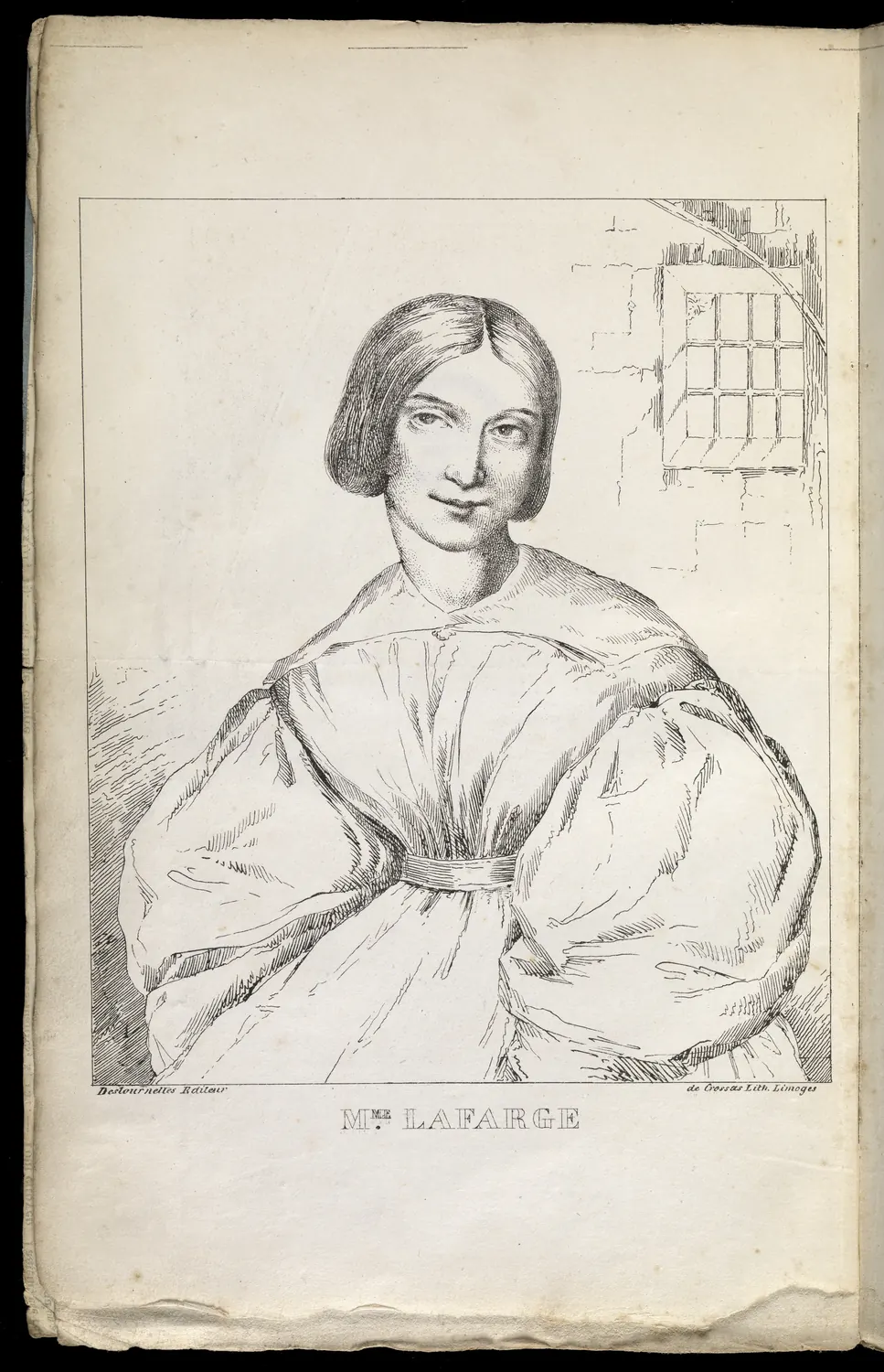
Charles Lafarge owned an ironworks, a business that smelted and forged iron, at Le Glandier in central France. In December 1839, away on business in Paris, he fell ill after eating a cake his wife had sent him. He came home sick, grew worse, and died on 14 January 1840.
His mother accused his wife of poisoning him. Marie Lafarge was twenty three and had married him only months before, after answering a marriage advertisement. Local pharmacists ran the newest chemical test there was on what was left of his stomach, and it found nothing.
The test had found nothing. Either he was never poisoned, or the test had been run badly.
The record, filled in
How the court at Tulle settled it in 1840, and why chemists went on arguing. Watch what the second chemist tested besides the body.
After Charles Lafarge came home, servants saw Marie Lafarge stir a white powder into food meant for her husband, and she had bought poison from a local druggist, saying it was for rats. The pharmacists had tried the Marsh test, a method for detecting the poison, then four years old, but they were new to it and got nothing they could use.
The court summoned Mathieu Orfila, the leading toxicologist in France, a specialist in poisons and the traces they leave. He ran the test himself, on tissue from the body, which had been exhumed, and found arsenic in it. The pharmacists, Orfila said, had run the test wrongly.
Then Orfila did what settled the trial. A body in the ground lies in earth that can hold the same poison, so he also tested soil from the grave. It held none, so the poison in the body had not come from the ground.
The court at Tulle convicted her in September 1840 and sentenced her to life with hard labor. Historians call her the first person convicted largely on the evidence of a chemical test.
Other chemists were not satisfied. Francois-Vincent Raspail argued that impure chemicals could put the poison into a test, that it could turn up naturally in any buried body, and that her guilt had never been proven.
The payoff
Testing the grave as well as the body ruled out the ground as the source of the poison, and Orfila's evidence carried the trial. Twelve years later, in failing health, she was released with a pardon.
The grid, solved
Afterwards
Marie Lafarge died a few months after her release, still saying she was innocent.
This was the case that brought forensic chemistry into a courtroom, and the argument over whether it was ready has never been settled either way. This book does not claim to know which side was right.
Go deeper
- Where the picture is kept
- Sources
- Visible Proofs: Forensic Views of the Body: Galleries: Cases: Toxicology on... US National Library of Medicine
- Marie Lafarge: The Arsenic Poisoner amusingplanet.com
- Marsh test Science ebsco.com
- Prefiguring the Arsenic Wars sciencehistory.org
- The Arsenic Cake of Madame Lafarge JSTOR
- Lafarge, Marie (1816-1852) Encyclopedia.com
- Memoirs of Madame Lafarge Internet Archive
Charles Stielow
Doctor of everything
Solved it? Open the case fileClose the case file
What happened
A farmer named Charles Phelps and his housekeeper Margaret Wolcott were shot at his farm near West Shelby on a March night in 1915. At five in the morning his farmhand, Charles Stielow, found her in the snow on the doorstep of his own house across the road. Phelps lay shot in the farmhouse and never woke.
Stielow and his brother in law, Nelson Green, who lived with him, had told the inquest they owned no firearm. Detectives found two guns hidden with a relative, one of them the caliber used that night. By July Stielow had been convicted, and the judge told the jury that without the statement taken from him in his cell he would have directed an acquittal.
By 1917 he had come within an hour of the electric chair. The bullets that convicted him had been sworn to, never compared.
The record, filled in
The case against Stielow, step by step, from his arrest to the day he walked out. Watch who finally looked at the bullets, and how.
Stielow lived as a tenant in a house Phelps owned, and he was illiterate. The confession detectives typed after days of questioning was read to him, not by him. He refused to sign it, and it reached the jury unsigned.
The state's firearms witness was a charlatan, a druggist who called himself doctor and sold expertise in chemistry, poisons, handwriting and guns all at once. He swore that marks on the fatal bullets matched a flaw in the barrel of Stielow's revolver. The witness had never once test-fired it.
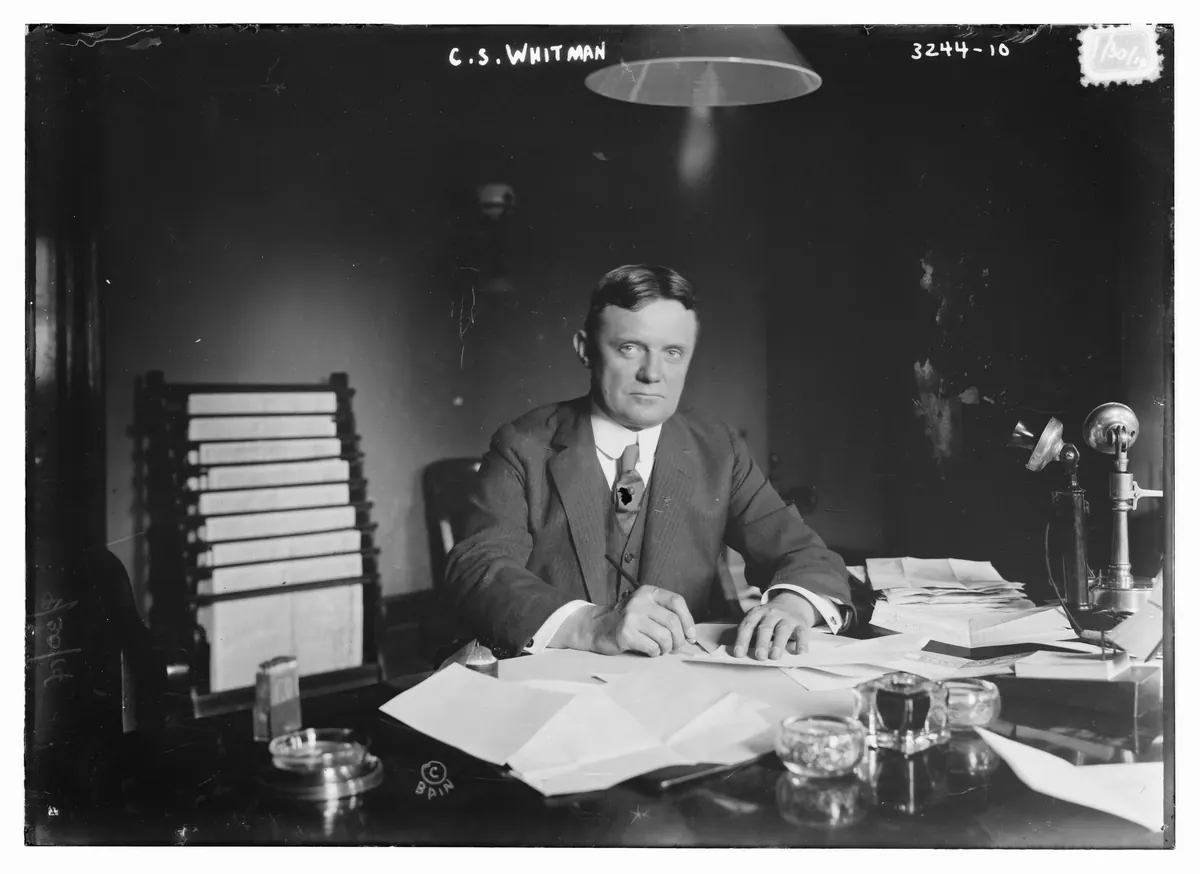
Stielow was sentenced to death three times over. The last reprieve, from a judge, came with forty minutes left, after his head and legs had been shaved. That winter the governor, Charles Whitman, cut the sentence to life, saying he still thought the man guilty but could no longer be sure.
In 1917 a state investigator, Charles Waite, and an expert from the optical firm Bausch and Lomb did what nobody had done in two years. They fired Stielow's own gun and compared its bullets with the fatal ones under a microscope. A barrel cuts its own pattern of lines into every bullet it fires, and the grooves did not match. Stielow's gun, thick with rust, had not been fired in years.
A state inquiry then found that a listening device had secretly recorded his talk in jail and caught not one word of guilt. Nothing backed the confession he was convicted on.
The payoff
The fatal bullets had come from some other gun. On that and the inquiry, Whitman freed him as an innocent man, and he walked out of Auburn prison in May 1918, three years gone.
The grid, solved
Afterwards
Another man confessed twice, and a grand jury declined to indict him; nobody was ever tried for the killings. Nelson Green, who had pleaded guilty to escape the death sentence, was freed too. Neither man was paid a penny.
Comparing a test bullet with the fatal one is now the first step in every firearms examination.
Go deeper
- Where the picture is kept
- Sources
- Convicting the Innocent vots.altervista.org
- Paper Blum csls.berkeley.edu
- Archived Firearms Examiner Training nij.ojp.gov
- Module 02 :: 1908-1915 archive.gfjc.fiu.edu
- Historic marker notes famous case of Charles Stielow, falsely accused of murder... orleanshub.com
- Waite, Charles E Encyclopedia.com
- Jim Fisher True Crime: Albert Hamilton: Courtroom Charlatan jimfishertruecrime.blogspot.com
- Charles Seymour Whitman nga.org
6 more sources
- Charles S Whitman empirestateplaza.ny.gov
- coloradohistoricnewspapers.org
- exonerationregistry.org
- Library of Congress
- Charles Frederick Stielow (1879-1942) Find a Grave
- Charles B. Phelps (1844-1915) Find a Grave
The Duc de Praslin
Faubourg Saint-Honoré, before dawn
Solved it? Open the case fileClose the case file
What happened
Fanny Sebastiani married the Duc de Praslin in 1824, when she was seventeen. By 1847 they had nine children, separate apartments on the same floor of the same house, and a marriage carried on in letters. He was a peer of France, so no ordinary court in the country could put him on trial. Their children were taught at home by a woman the duchess had spent years demanding he dismiss.
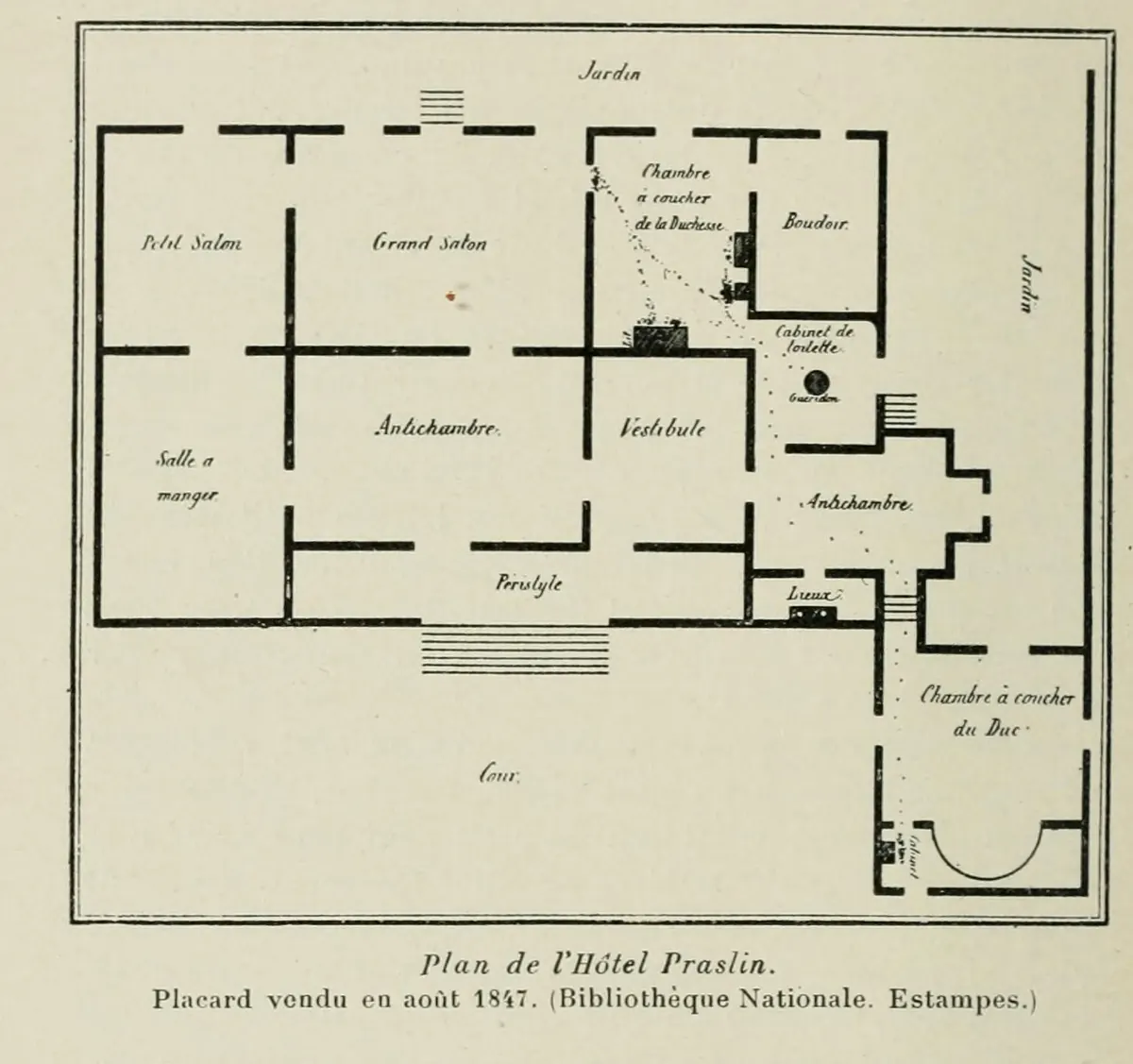
Before dawn on 18 August 1847 the servants heard her bell ring, then screams behind a locked door. When they got in she was dead on the floor. Her husband's rooms lay a few yards away across a shared hall, and he had fresh scratches on his hands.
He said he had heard nothing. The house itself kept a record of the night, from her room to his.
The record, filled in
What the servants and the magistrates found that morning, in the order they found it. Watch which room each trace leads back to.
The duchess's maid could not open the door, so the servants went into the garden and tried the windows of the bedroom and the boudoir beside it, her small private sitting room. The shutters were fastened and everything behind them was dark.
They reached her by a wooden stair on the far side of the house and through the antechamber, the shared hall between her rooms and his. The duke came in a moment later, very pale, and threw himself on her.
The duchess had been stabbed many times and beaten with a pistol butt. Her left hand was closed on a quantity of a man's hair, the color and length of the duke's, and his own pistol lay on her floor with skin and hair stuck to the butt. When a servant went into the duke's room for water, Praslin stopped him, saying the water in the pitcher was dirty. There was not a drop of clean water left.
In the fireplace of the duke's room lay a half-burnt handkerchief and the ash of papers. In a drawer of his desk the magistrates found the broken handle of a dagger, fresh blood on it and no blade. And for six years the duchess had written to him demanding he dismiss the governess, whom she believed to be his mistress.
As a peer the duke could be tried only by the upper house of parliament, so he was held at its palace, the Luxembourg. He died there on 24 August, six days after his wife. The autopsy found he had poisoned himself with arsenic.
The payoff
Every trace ran from her room to his: his hair in her hand, his pistol on her floor, a cloth half burnt in his grate, a bloody handle with no blade. He died before the peers could try him for her murder.
The grid, solved
Afterwards
The children's teacher, held after the killing, was released without charge in November and died in America in 1875. Six months after the killing the July Monarchy fell, partly over this.
Go deeper
- Where the picture is kept
- Sources
- L'assassinat de la duchesse de Praslin (1847) senat.fr
- Charles, Laure, Hugues, Théobald de Choiseul-Praslin www2.assemblee-nationale.fr
- 18 Aout 1847 Lassassinat De La Duchesse De Choiseul Praslin podcasts.institutdefrance.fr
- L'assassinat de la Duchesse de Praslin; d'après d'archives et les mémoires Internet Archive
- The Project Gutenberg's eBook of L'Assassinat de la Duchesse de Praslin, by... mirrorservice.org
- 17 Aout 1847 Evenement herodote.net
- Murder of Duchess De Choiseul Praslin geriwalton.com
- “A vile business clumsily done” parisianfields.com
7 more sources
- Strange Company: The Deadly Duke de Praslin strangeco.blogspot.com
- Grunge Classic Rock, Music History, Pop Culture & Strange News grunge.com
- Petit meurtre en famille chez le Duc de Choiseul chateau-blandy.fr
- Henriette Desportes Leaves the Scandals of Paris for a Stockbridge Minister newenglandhistoricalsociety.com
- Duchesse de Praslin (1807-1847) data.bnf.fr
- Choses vues/1847/Le duc de Praslin fr.wikisource.org
- Henriette Deluzy-Desportes Field (1813-1875) Find a Grave
Sir Lee Stack
Half past one, Cairo
Solved it? Open the case fileClose the case file
What happened
The commander in chief of the Egyptian army was being driven home through the middle of the city at half past one on 19 November 1924 when several gunmen fired into the car. He died the following night. His aide and his driver were wounded and survived.
Nobody who saw it would identify anybody to the British led investigation, and the local force asked to be relieved of the case. What the police had was three bullets whose tips had been cut into a cross so that they would open on impact.
Two brothers who fled toward Libya were caught with four pistols and denied everything. Had any of those guns fired in Cairo?
The record, filled in
The investigation in order, from the shooting to the trial. Watch what the expert, Sydney Smith, does before he will tell the court which gun it was.
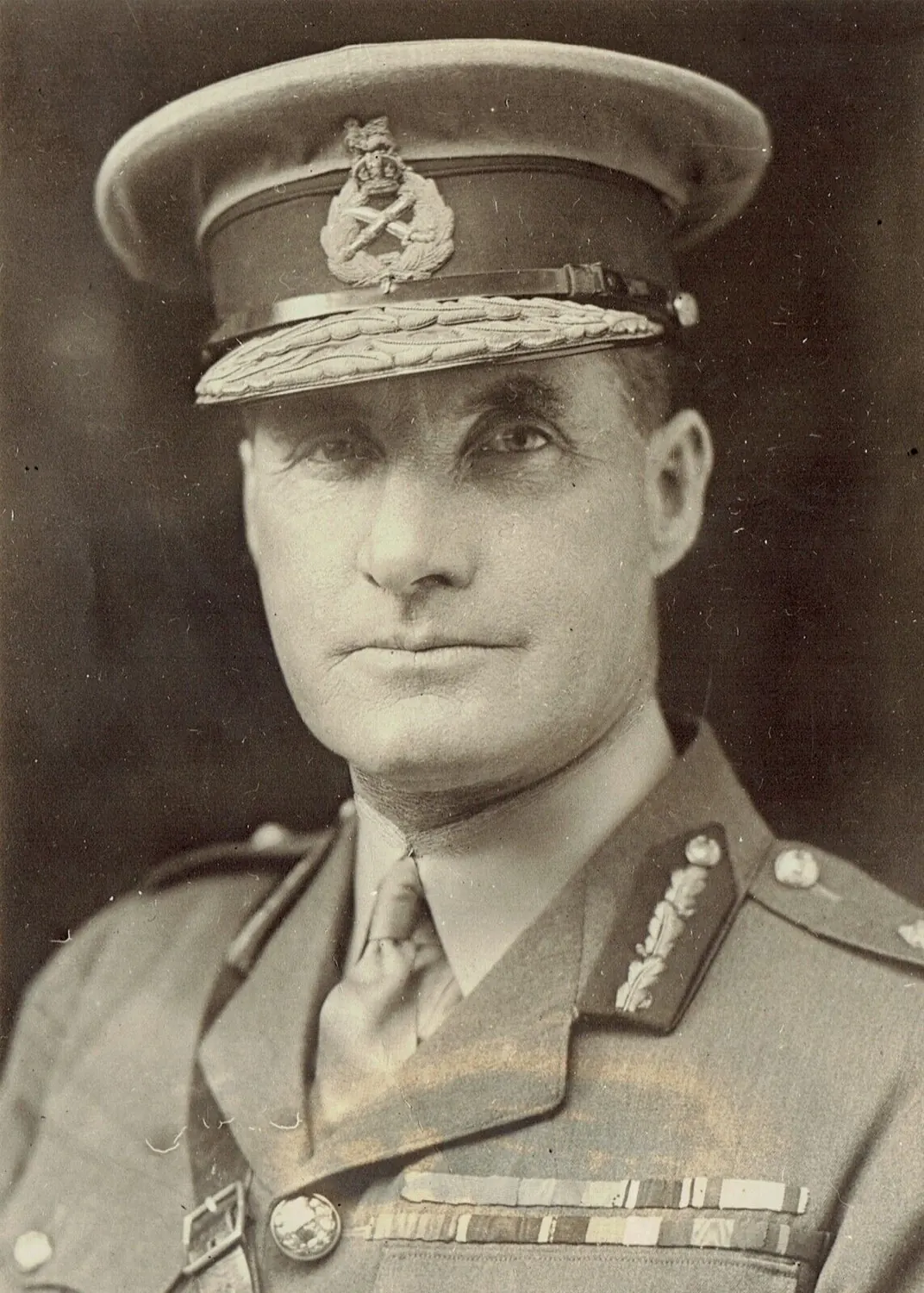
The dead man, Sir Lee Stack, was the commander in chief of the Egyptian army and Governor general of the Sudan, shot in his car in the middle of a Cairo afternoon. The bullets taken from him had been filed into a cross at the tip, the old dumdum trick: cut that way, an ordinary round spreads when it hits.
Two young brothers were among the suspects. They ran west for tripoli, were stopped near the Libyan frontier, and were found with four pistols hidden in a basket of fruit. They denied everything.
One of the four was a .32 Colt. Sydney Smith, the medical expert to the Egyptian government, fired it and compared its test bullets and spent cartridge cases with those from the scene. A fault at the mouth of its barrel left a broad scratch on every bullet it fired, and the bullet from the body carried the same scratch.
That scratch might still be something every gun of that make left behind. So Smith got twenty-four more of them and fired them all. None left the same mark, and only then would he tell the court that this was the gun.
Faced with the comparison, the brothers admitted their part and named the others. One of the men they named kept a workman's vise at home, and it still held metal filings that matched the cut bullets.
The payoff
All eight men were convicted. One scratch, tested against twenty-four identical guns, made this one of the first convictions anywhere on a bullet traced to a single factory-made pistol.
The grid, solved
Afterwards
Seven of the eight were hanged together in Cairo on 23 August 1925.
Sydney Smith went on to Edinburgh and taught the method to two generations of pathologists.
Go deeper
- Where the picture is kept
- Sources
- Paper Blum csls.berkeley.edu
- Sir Lee Stack Assassinated britishempire.co.uk
- oxfordindex.oup.com
- ukwhoswho.com
- Archived Firearms Examiner Training nij.ojp.gov
- 1925: The Egyptian assassins of British Gen. Lee Stack executedtoday.com
- EGYPT: Punished Time
- Sir Sydney Smith and Three Bones forensicfield.blog
6 more sources
- Sir Sydney Smith and the Development of Police Forensic Laboratories rcpe.ac.uk
- Alfred Lucas Chemist King Tut Treasures news.artnet.com
- Alfred Lucas tutankhamun.griffith.ox.ac.uk
- Lee Stack Wikipedia Wikipedia
- Sydney Smith (pathologist) Wikipedia
- Alfred Lucas (chemist) Wikipedia
Roland Molineux
Christmas Eve post
Solved it? Open the case fileClose the case file
What happened
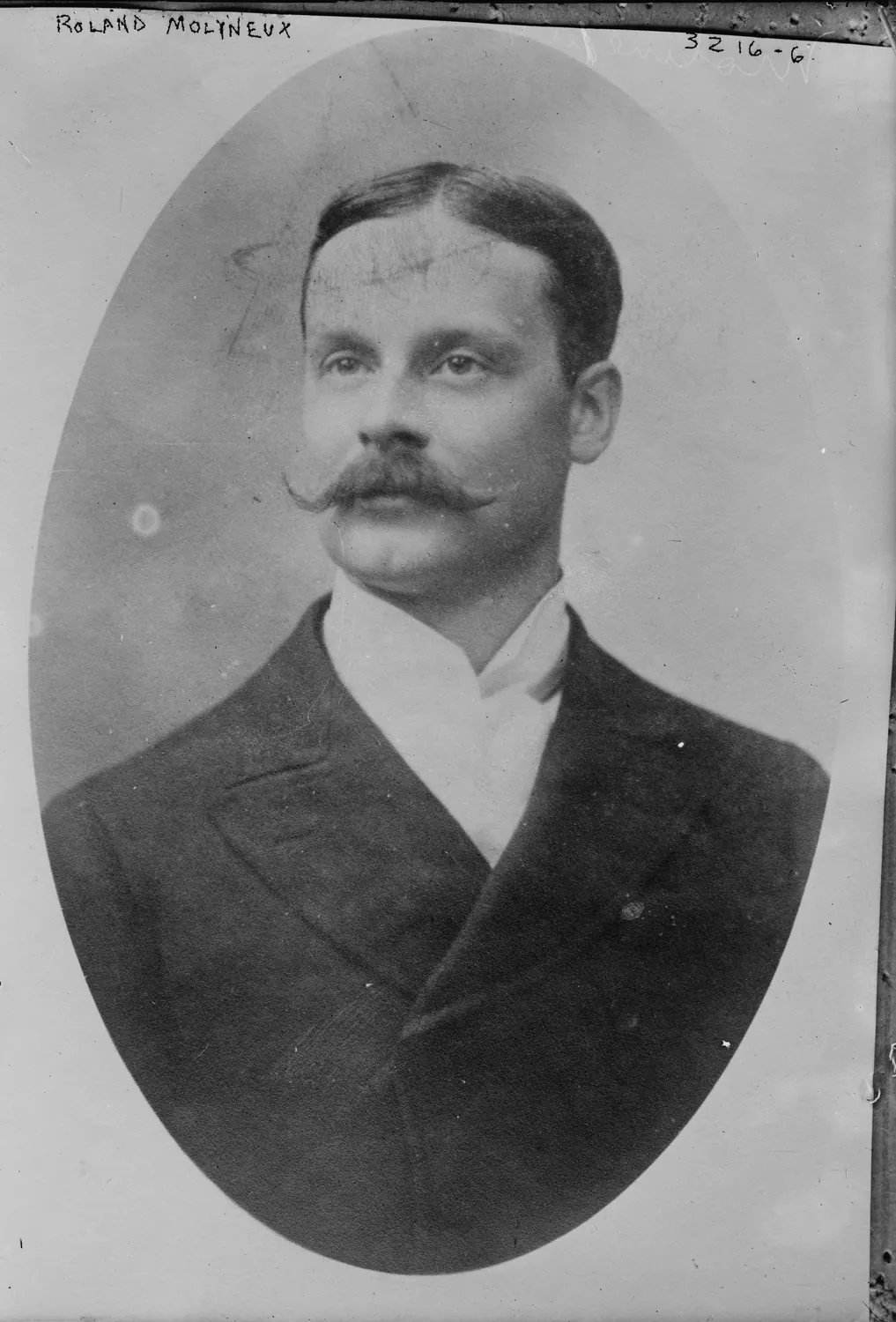
The Knickerbocker Athletic Club stood at Madison Avenue and Forty-Fifth Street in New York, and in the winter of 1898 two people tied to it died seven weeks apart. Henry Barnet, a stockbroker who lived at the club, took a dose of a patent salts that had reached him in the post, and died on 10 November. Nobody looked twice at it.
On 24 December a small parcel came for the club's athletic director. He carried it home unopened. Four days later he made up a headache dose from the bottle inside it for his landlady, Katherine Adams, and she was dead within the hour. Nothing in it said who sent it. Roland Molineux had resigned from the club a year earlier after a quarrel with that same director.
The parcel had no sender's name, and the man it was meant for never drank from it. Who had sent it, and could anyone prove it?
The record, filled in
How the case against Roland Molineux was built and then undone. Watch the earlier death at the club, and what the jury was told about it.
The bottle in the parcel held Bromo Seltzer, the drugstore headache remedy, laced with cyanide of mercury, a poison so rare that hardly anybody in the city had cause to keep it. Molineux, a chemist at a dye works in New Jersey, had fallen out with the director over a member's conduct and an amateur circus the club put on.
Inside the wrapper was a pale blue box, and in it the bottle and a silver holder to stand it in. A jeweler in Newark, New Jersey, had sold the holder to a well dressed man in his thirties who would not wait for it to be polished.
Someone had also written to patent medicine firms in other men's names, the director's and Henry Barnet's among them, asking for free samples to be sent to a letterbox rented on Broadway, a private mail drop. Barnet had lived at the clubhouse, and he had courted the woman Molineux married nineteen days after Barnet died.
At the trial for Katherine Adams's death, the prosecution set the parcel's address and those letters beside pages Molineux had to write out for the experts, and more than a dozen experts on handwriting said one man wrote them all. The prosecutor also put Barnet's death to the jury as a second killing by the same man, who had won his bride only once Barnet was dead. The jury convicted Molineux in February 1900, and he was sentenced to die.
In October 1901 the Court of Appeals threw the verdict out. Barnet's death, it held, should never have gone before that jury: a man may be convicted only on evidence of the crime he is on trial for.
The payoff
The writing pointed at Molineux, but the jury that convicted him had been told about a death he was never tried for. A second jury acquitted him in 1902, and nobody else was ever charged.
The grid, solved
Afterwards
The Molineux rule, as New York courts still call that ruling, limits when a jury may hear about other crimes. Molineux wrote a book about the death house at Sing Sing and died in 1917.
Go deeper
- Where the picture is kept
- Sources
- People v Molineux nycourts.gov
- People V Molineux CourtListener
- Roland Molineux Trials: 1899 law.jrank.org
- Roland Molineux Trials: 1899 law.jrank.org
- Chapter 89 The Devil's Gentleman: Privilege, Poison, and the Trial That Ushered... erenow.org
- The Knickerbocker murders chemistryworld.com
- Roland Burnham Molineux 1866 1917 ancestors.familysearch.org
- Blanche C. Chesebro 1874 1954 ancestors.familysearch.org
5 more sources
- C Hartdegen Newark English Sterling worthpoint.com
- The Room with the Little Door Internet Archive
- The Christmas Murders caasbrey.com
- Blanche Chesebrough Scott (1873-1954) Find a Grave
- wikitree.com
Valentine's Day Massacre
2122 North Clark Street
Solved it? Open the case fileClose the case file
What happened
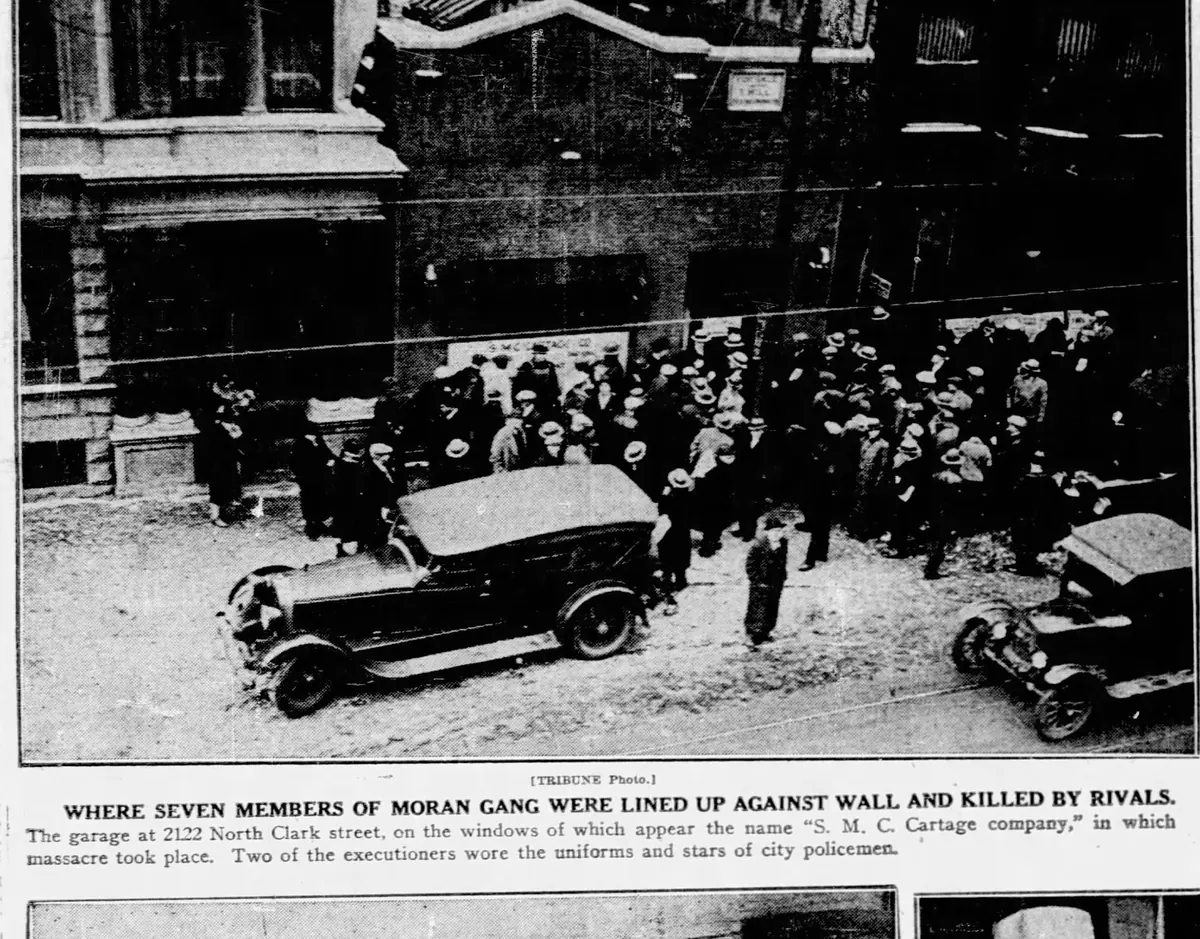
On the snowy morning of 14 February 1929, four men, two of them dressed as Chicago police officers, arrived at a bootleggers' delivery point on North Clark Street. They lined up seven men against a wall and shot them with two Thompson submachine guns. The papers called it the St Valentine's Day Massacre.
Because two of the killers wore convincing police uniforms, suspicion fell first on the real Chicago police. The killers left no names behind, only seventy spent cartridge cases.
Seven men were dead, the killers had vanished, and suspicion pointed at Chicago's own police. Whose guns had fired those shells?
The record, filled in
From Chicago to a house in Michigan. Watch what is done with the police's own guns first.
The dead were men of Bugs Moran's North Side gang. Other suspects included Moran's rival Al Capone and Capone's gunman Jack McGurn. Cook County Coroner Herman Bundesen kept the inquiry out of police hands. He called a coroner's jury of prominent citizens, and its foreman, a Colgate-Palmolive executive named Burt Massee, paid for a ballistics laboratory himself.
The laboratory's expert, Colonel Calvin Goddard, used a comparison microscope, which shows two fired shells side by side in one view, to match the tiny striations, the scratches a gun's own mechanism leaves on a shell. The seventy cases from the garage floor came from two Thompsons: fifty from one, twenty from the other.
To test the suspicion against the police, the colonel test-fired every Thompson in the Chicago police arsenal. None matched the shells from the scene, and the police were formally cleared.
Ten months after the massacre, across Lake Michigan in St Joseph, a patrolman was shot dead after a minor traffic accident. The man who shot him and fled was Fred Burke, a gunman living there under a false name. His wrecked car led police to his rented house, where two Thompsons lay.
The colonel test-fired both guns, and their marks matched the massacre shells. When Burke was caught in Missouri, Chicago wanted him for the massacre and Michigan for the St Joseph killing. Missouri judged Michigan's claim the stronger, and Michigan won his extradition.
The payoff
The microscope cleared the Chicago police and traced the massacre guns to Burke's house. He got life in Michigan for the officer's death, and nobody, Capone and McGurn included, was ever tried for killing the seven men.
The grid, solved
Afterwards
McGurn was shot dead in 1936, Burke died in prison in 1940, and Capone died in 1947. Both guns are still held by the sheriff of Berrien County, Michigan.
Go deeper
- Where the picture is kept
- Sources
- St. Valentine’s Day Massacre Wall themobmuseum.org
- 1929,St. Valentine’s Day Massacre chicagology.com
- The Massacre stvalentinemassacre.org
- Massacre Evidence themobmuseum.org
- The Evidence stvalentinemassacre.org
- Archived Firearms Examiner Training nij.ojp.gov
- Calvin Hooker Goddard forensicfield.blog
- Michigan and the St. Valentine's Day Massacre michiganology.org
15 more sources
- The Actual Tommy Guns Used in the St. Valentine’s Day Massacre themobmuseum.org
- Gun History berriencounty.org
- Al Capone: St. Valentine’s Day Massacre: Extraordinarily rare rrauction.com
- Hearst Networks EMEA aetv.com
- “Machine Gun” Jack McGurn americanmafiahistory.com
- Saint Valentine's Day Massacre: an Edgewater Connection edgewaterhistory.org
- Massacre Victim's Stats. myalcaponemuseum.com
- OD Notebook: Wait! An optometrist was a victim of the St. Valentine’s Day... optometricmanagement.com
- Get Capone St Valentines Day Massacre Jonathan Eig chicagomag.com
- Peter Gusenburg (1888-1929) Find a Grave
- Frank Gusenburg (1892-1929) Find a Grave
- Albert Kachellek (1887-1929) Find a Grave
- Adam “Frank” Heyer (1889-1929) Find a Grave
- Albert Weinshenker (1893-1929) Find a Grave
- Reinhart Schwimmer (1899-1929) Find a Grave
President Garfield
Doctors' orders
Solved it? Open the case fileClose the case file
What happened
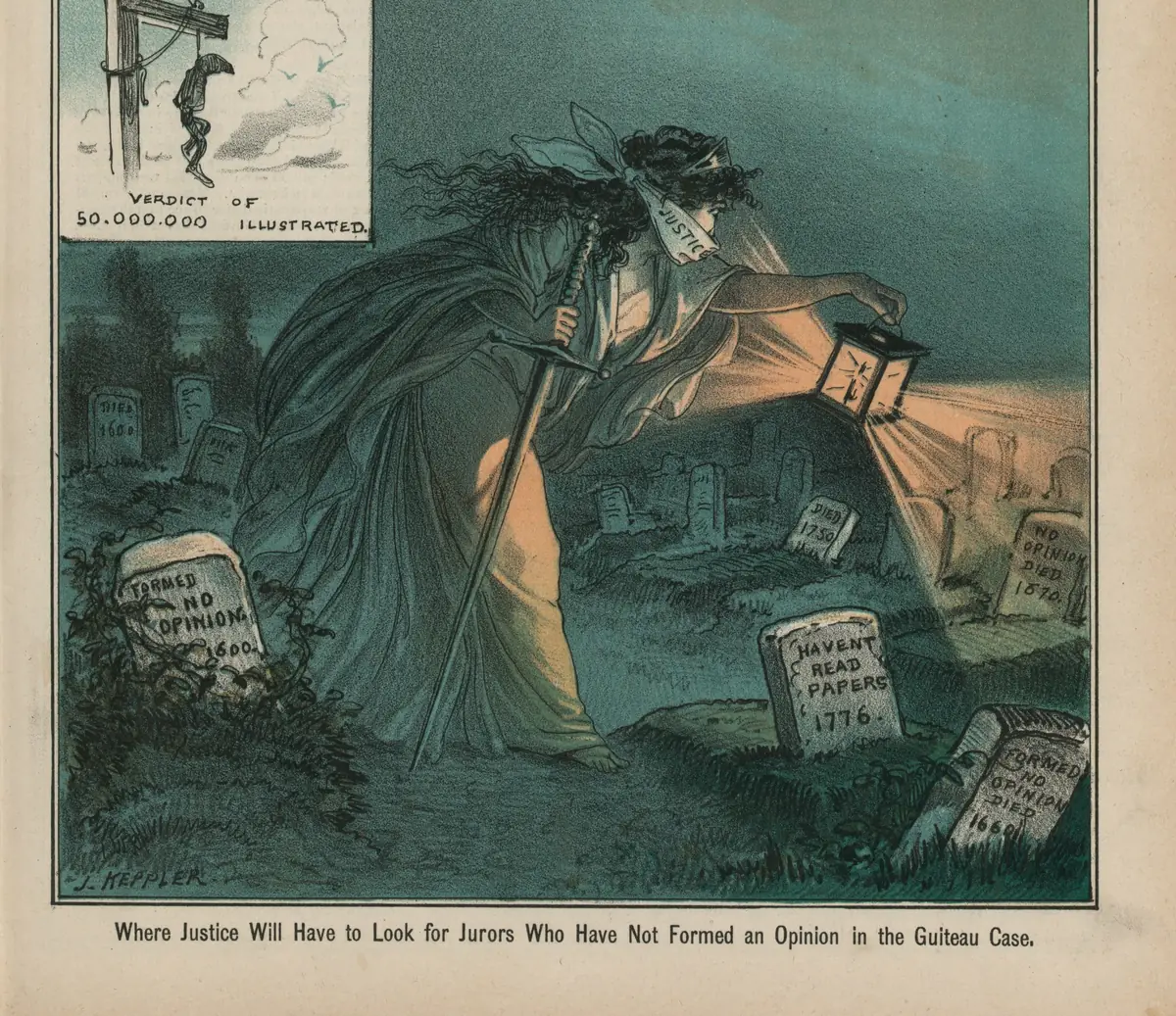
On 2 July 1881 Charles Guiteau, a disappointed office seeker, shot President James Garfield twice at a Washington railway station. One bullet grazed his arm; the other went deep into his back. His doctors were sure it lay on the right side, and probed there with unwashed fingers and instruments.
In late July, Alexander Graham Bell brought a new device built to find metal inside a living body. Dr Bliss, the lead physician, let Bell search only the right side, where Bliss was sure it lay, and the faint readings the device gave there could not be trusted.
Garfield died seventy-nine days after the shooting. Which side of his spine was the bullet on, and why had nobody found it?
The record, filled in
The autopsy report, signed the next day by the doctors who had been sure the ball lay on his right. Watch where it turns up. Suppurating: festering. Septic: infected.
By previous arrangement a post-mortem examination of the body of President Garfield was made this afternoon ... It was found that the ball, after fracturing the right eleventh rib, had passed through the spinal column in front of the spinal cord, fracturing the body of the first lumbar vertebra ... and lodging below the pancreas, about 2 1/2 inches to the left of the spine and behind the peritoneum, where it had become completely encysted.
The immediate cause of death was secondary hemorrhage from one of the mesenteric arteries adjoining the track of the ball ... An abscess cavity 6 inches by 4 in dimensions was found in the vicinity of the gall bladder, between the liver and the transverse colon ...
A long suppurating channel extended from the external wound, between the loin muscles and the right kidney, almost to the right groin. This channel, now known to be due to the burrowing of pus from the wound, was supposed during life to have been the track of the ball.
... the different suppurating surfaces, and especially the fractured, spongy tissue of the vertebrae, furnish a sufficient explanation of the septic condition which existed.
The payoff
The ball sat sealed off on the left. The channel down his right side, taken for its track, was infection from the doctors' unwashed probing. Their report blamed a burst artery; later doctors blamed the infection.
The grid, solved
Afterwards
Guiteau was hanged on 30 June 1882; his defense had argued that the doctors, not the bullet, killed the President. In October 1881 Bell's device found a bullet a Civil War veteran had carried for nineteen years, at the first try.
Go deeper
- The original record
Official Bulletin of the Autopsy on the Body of President Garfield, signed by D. W. Bliss, J. K. Barnes, J. J. Woodward, Robert Reyburn, Frank H. Hamilton, D. Hayes Agnew, Andrew H. Smith and D. S. Lamb, 20 September 1881. The American Presidency Project, University of California, Santa Barbara, presidency.ucsb.edu, retrieved 2026-09-07.
- Where the picture is kept
- Sources
- James A. Garfield: Death of the President millercenter.org
- President James A. Garfield Shot ebsco.com
- Official Bulletin of the Autopsy on the Body of President Garfield American Presidency Project
- “The President is somewhat restless…”: Enter Bell US National Library of Medicine
- “The President is Somewhat Restless…”: Aftermath US National Library of Medicine
- Garfield’s terrible doctors and Alexander Graham Bell’s metal detector thehistoryblog.com
- Alexander Graham Bell Tried to Save James Garfield With a Bullet-Deflecting... historynet.com
- How doctors killed President Garfield CBS News
6 more sources
- On the Shoulders of Giants: Primum non nocere, Hubris, and the Death of... facs.org
- Upon the electrical experiments to determine the location of the bullet in the... Internet Archive
- The Great Guiteau Trial: with life of the cowardly assassin. A full account! A... Internet Archive
- Doctor Willard Bliss -- Presidential Physician doctorzebra.com
- Almanac: The day telephones fell silent across North America CBS News
- President James Garfield dies History.com
Franz Muller
Made to order
Solved it? Open the case fileClose the case file
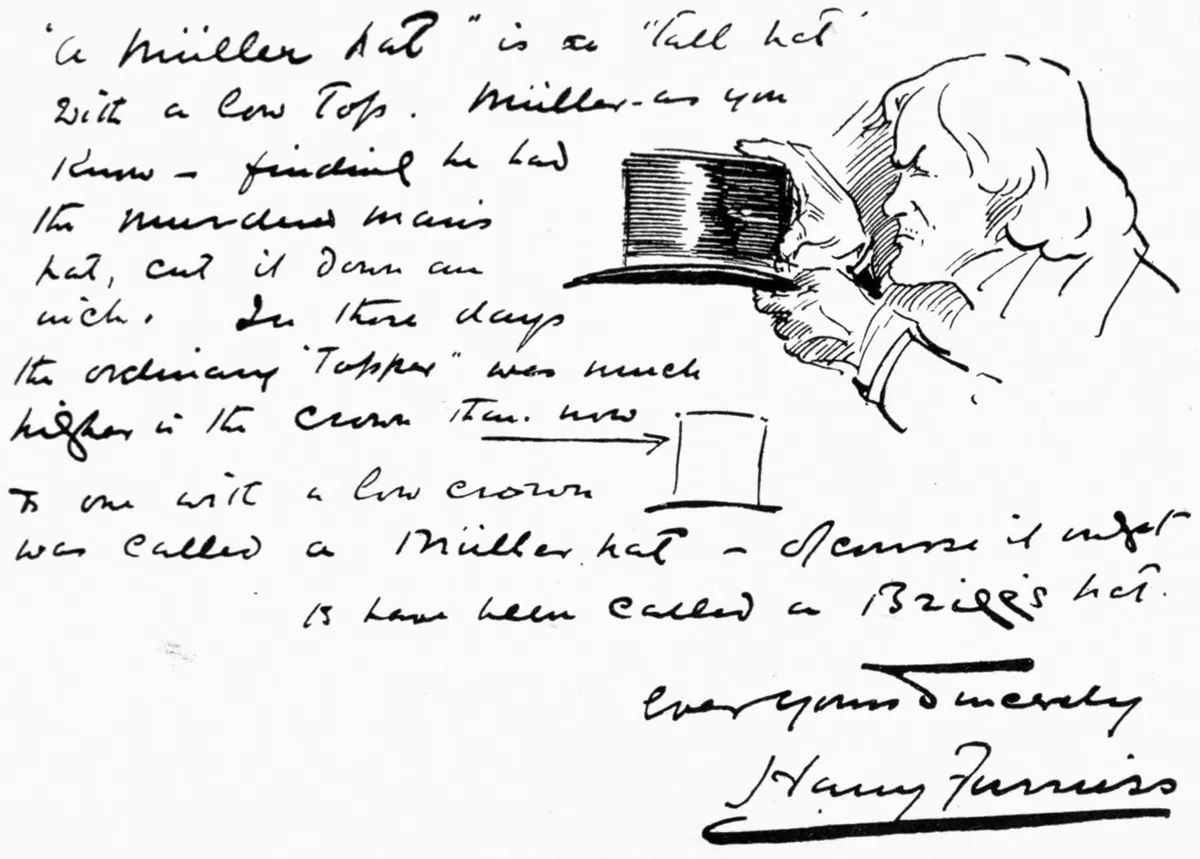
What happened
Thomas Briggs, sixty-nine, was chief clerk at a Lombard Street bank. On 9 July 1864 passengers boarding at Hackney found blood in an empty first class compartment of his evening train. Briggs lay on the track a mile back and died the next night without speaking.
His watch, his gold chain and his tall hat were gone, and on the seat lay a low black hat that was not his. Two days later a jeweler named Death took the chain in exchange, and a cabman knew the odd hat: he had bought it for a young German tailor, Franz Muller, by then at sea for New York. Detectives took a faster ship, beat him to the port, and opened his box: the gold watch, and a tall hat.
The tall hat in his box was lower than any Briggs wore, and the strip a hatter writes the name on was cut out. Whose was it?
The record, filled in
Daniel Digance made Briggs's hats for twenty-five years or more. At the Old Bailey he is shown the hat from Muller's box; the Solicitor-General prosecutes. Watch how he knows it.
Digance Mr. Briggs has been a customer of mine for at least twenty-five or thirty years; every hat he has had, has been made to order. By referring to my books ... according to the particulars in this book, this hat does not correspond. It is lower in the crown, but it corresponds in the shape of the crown ... It has been cut down. Mr. Briggs's hat was a little too easy in the head, and I placed a small piece of tissue paper round. That tissue paper is not here, but here are fragments of it remaining at the band of the hat.
Digance The hat has been cut down, I should say, from an inch to an inch and a half, and the bottom part of the leather has been cut off ... the piece has been removed from here, and brought over the band and stitched together, and the silk has been pasted down to hide the stitching.
Solicitor-General You say this hat has been cut down, has it been done in the way that a hatter would have cut it down in the course of his business?Digance Certainly not. It is an operation I have never seen ... If a hatter had to do it, he would secure it with gum, and put it on the block, and press it down with the hot iron. That process has certainly not been used here ... I should say that it was neatly sewn, and I should think it was done by a person who understood sewing. With the exception of the cutting down, there is no question about the hat corresponding with the one I made for Mr. Briggs.
The payoff
Except for the cutting down, it matched the hat Digance made for Briggs, scraps of tissue paper and all. Whoever cut off the name strip could sew but was no hatter. Muller was a tailor: guilty in fifteen minutes.
The grid, solved
Afterwards
Muller was hanged outside Newgate on 14 November 1864, and seconds before the drop told the minister beside him that he had done it. Railway carriages got a cord a passenger could pull to reach the guard, and for a generation a tall hat cut down in the crown was called a Muller.
Go deeper
- The original record
Daniel Digance, hatter, of 18 Royal Exchange, examined and questioned by the Solicitor-General, at the trial of Franz Muller for the murder of Thomas Briggs, Central Criminal Court (Old Bailey), session opening 24 October 1864. Old Bailey Proceedings Online (www.oldbaileyonline.org, ref. t18641024-920).
- Where the picture is kept
- Sources
- Trial t18641024-920 Old Bailey Online
- Trial of Franz Muller Internet Archive
- Franz Műller Capital Punishment UK
- The First Railway Murder in Britain btphg.org.uk
- Murder on the North London Railway (1864) mernick.org.uk
- The first murder on a British train romanroadlondon.com
Patrick Mahon
The ticket in his coat pocket
Solved it? Open the case fileClose the case file
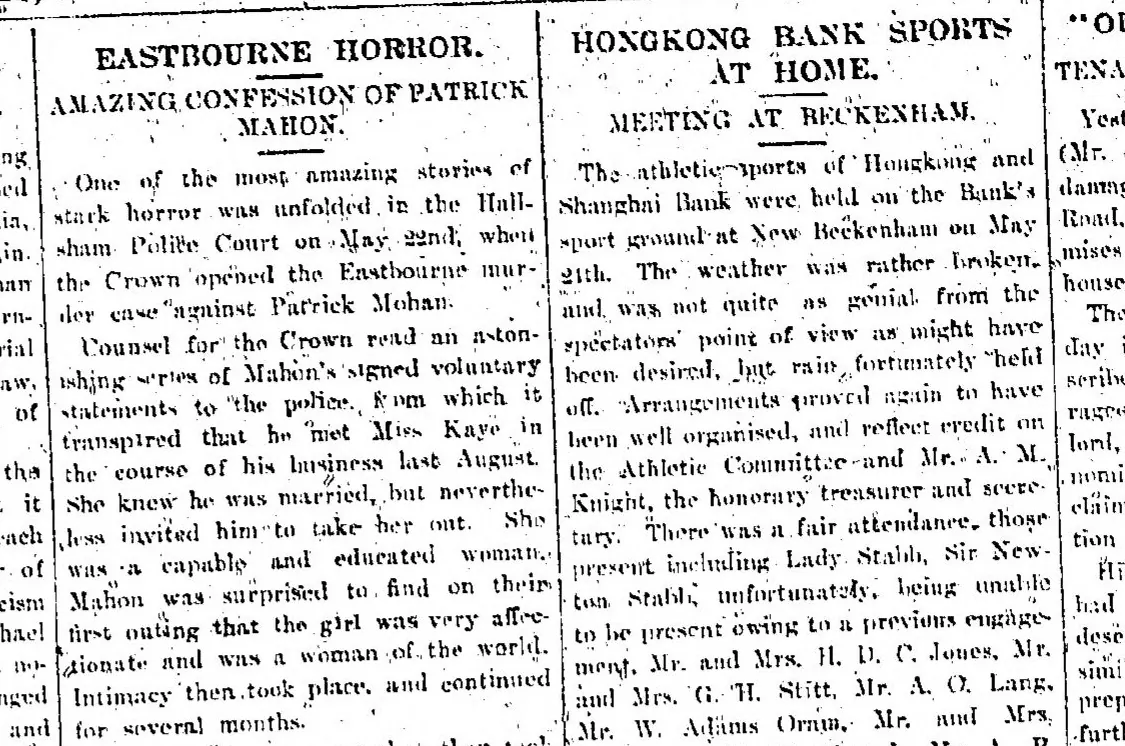
What happened
Emily Beilby Kaye was thirty-eight, a London typist who lived in a women's club off Russell Square. In the spring of 1924 she sold her shares, told friends she was engaged and bound for South Africa, and went to the Sussex coast to join Patrick Mahon, a married sales manager who had taken a house on the shingle at the Crumbles under a false name. Nobody heard from her after mid-April.
His wife had stopped believing his stories about business out of town. On 1 May she went through his suits and found a left luggage ticket. A friend of hers, once of the railway police, took it to a station counter in London, was handed a locked bag, and pulled at one end until he could see bloodstained clothing and a knife.
Detectives watched the counter. Mahon came for the bag and said it had held meat for his dogs. What had happened at the Crumbles?
The record, filled in
Her remains were found cut up at the house. The Crown read out Mahon's signed statements at the first hearing, then its own evidence. Watch the money and the dates.
Mahon's Statement It was at her request that they took the Crumbles bungalow. They went there on April 12th, and stayed a few days. On the evening of April 15th they quarreled over his refusal to agree to her suggestion that he should take her abroad.
Mahon We fought and struggled ... Her head struck an iron coal scuttle, which appeared to stun her. It was midnight. I attempted to revive her for hours, but found that she was dead ... on the following morning I went up to London and bought a knife and saw, and returned to Crumbles ... I returned to London, and left at the cloak room at Waterloo Station a bag containing bloodstained clothing.
The Crown The prosecution said that Miss Kaye gave accused four £100 notes. Three were cashed in a false name, the last one two days before her death ... Accused said that he went into a franc speculation with Miss Kaye, towards which he subscribed £100, but there was no trace of this transaction in Mahon's banking account.
The Crown It would be shown in evidence that Mahon bought the knife and saw on April 12th, not April 17th, as he stated.
The payoff
He blamed a fall against the scuttle, which the pathologist said could not have killed her. And he bought the knife and saw on 12 April, before they went to the coast: he came prepared. He was convicted of murder.
The grid, solved
Afterwards
Mahon was hanged at Wandsworth that September. The pathologist, Sir Bernard Spilsbury, had found detectives sorting remains with bare hands, and out of that afternoon came the murder bag, the kit of gloves, tweezers and jars Scotland Yard has carried to a scene ever since.
Go deeper
- The original record
Patrick Mahon's signed statements to the police, read by counsel for the Crown at the Hailsham Police Court, Sussex, 22 May 1924, as reported in "Eastbourne Horror: Amazing Confession of Patrick Mahon", The Hongkong Daily Press, Thursday 26 June 1924, page 4. Internet Archive, item NPDP19240626.
- Where the picture is kept
- Sources
- oxforddnb.com
- Patrick Herbert Mahon Capital Punishment UK
- The Suburban Lothario gutenberg.net.au
- Hong Kong Daily Press 1924-06-26 Internet Archive
- The Crumbles Murders: Emily Kaye 1923 crimesthroughtime.co.uk
- The ‘Murder Bag’ at the ‘Black Museum’ bubblingbiology.wordpress.com
- discovery.nationalarchives.gov.uk
- 1924: Patrick Mahon, for the Crumbles Murder executedtoday.com
1 more sources
- Bernard Spilsbury Wikipedia
Thomas Neill Cream
Too soon
Solved it? Open the case fileClose the case file
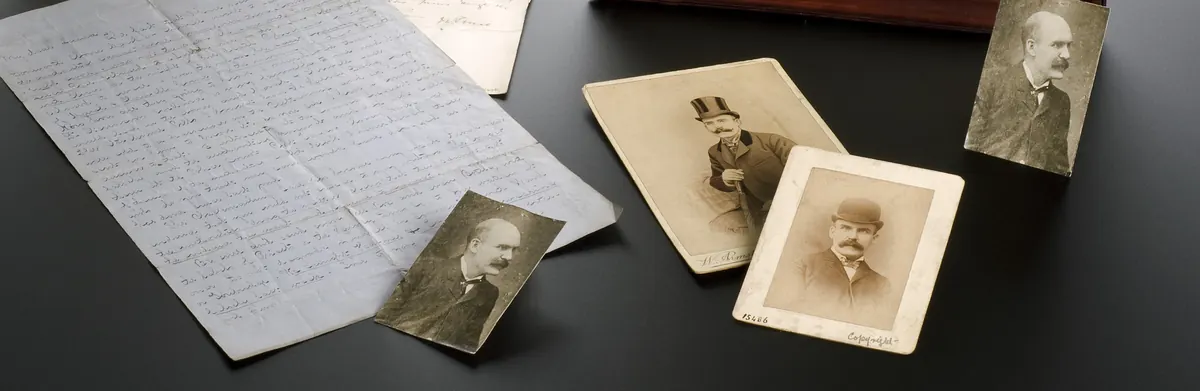
What happened
Thomas Neill Cream had already served ten years in an Illinois prison for poisoning a man with strychnine before he was paroled and crossed the Atlantic in 1891. In Lambeth, south London, he began calling on young women he barely knew, carrying pills he said were medicine.
Four of them died within six months, each death first written off as something else: drink, a bad supper, an ordinary fever. Before anyone had connected the deaths, letters reached a doctor and a coroner accusing named men of murders the writer could not otherwise have known about.
Matilda Clover was certified dead of drink and buried, yet one letter called her a poisoning victim. Could anyone prove it now?
The record, filled in
Clover had lain six months in her grave when the letter naming her got her dug up. Dr Thomas Stevenson, the Home Office analyst, tells Cream's jury what he found.
Stevenson On 6th May, in consequence of instructions from the Home Office, I went to the cemetery at Tooting ... I noticed on the coffin a plate with the name "M. Clover, 27 years." The coffin was opened in my presence ... for the most part the body was in a very good state of preservation.
Stevenson I detected strychnine in the stomach, liver, the fluid in the chest, and the brain ... I obtained ... an appreciable quantity of strychnine which I tested on a frog, injecting it beneath the skin of the ... back ... it had tetanic convulsions, was very rigid ... quite characteristic symptoms.
Stevenson I made, eventually, a quantitative analysis ... one-sixteenth of a grain. That one-sixteenth would represent nearly a full medicinal dose. One-twelfth is the maximum medicinal dose ... in my judgment, from the evidence I have heard in the case to-day about the woman vomiting frequently, and from my finding her stomach empty ... it points conclusively to a larger and fatal dose having been administered.
Stevenson Twitchings, convulsions and rigidity, with intermittence, I should say, would at once suggest the taking of strychnine ... in delirium tremens the mental faculties are obscured and perverted, in strychnine spasms they are often very acute and are not at all impaired.
The payoff
So the letter was right: Clover had been poisoned, and when it was written to blackmail a doctor, only her killer knew. A British Museum expert matched its hand to Cream's own, and he was found guilty of her murder.
The grid, solved
Afterwards
Cream was hanged at Newgate on 15 November 1892. The letter naming Clover had sat in a Scotland Yard file for months, put down as the work of an insane person.
Go deeper
- The original record
Thomas Stevenson, M.D., examined in chief 19 October 1892, at the trial of Thomas Neill for the murder of Matilda Clover, Central Criminal Court (Old Bailey), London. Old Bailey Proceedings Online, trial reference t18921017-962, oldbaileyonline.org, retrieved 2026-09-07.
- Where the picture is kept
- Sources
- Trial t18921017-962 Old Bailey Online
- The Evil Deeds of Dr. Cream canadashistory.ca
- Thomas Neill Cream vauxhallhistory.org
- Thomas Neill Cream Lambeth Poisoner and Serial Killer geriwalton.com
- Murder by Gaslight: The Lambeth Poisoner murderbygaslight.com
- The Digital Research Library of Illinois History Journal™ drloihjournal.blogspot.com
- "The Case Of The Murderous Dr. Cream" Excerpt buzzfeednews.com
- Crime Reads In Victorian London, Dr. Thomas Neill Cream Was a New Kind of Killer crimereads.com
2 more sources
- A Prescription for Murder: The Victorian Serial Killings of Dr. Thomas Neill... press.uchicago.edu
- Serial Poisoner Dr. Thomas Neill Cream agoodnightforamurder.com
The Sausage Vat Murder
The middle vat
Solved it? Open the case fileClose the case file
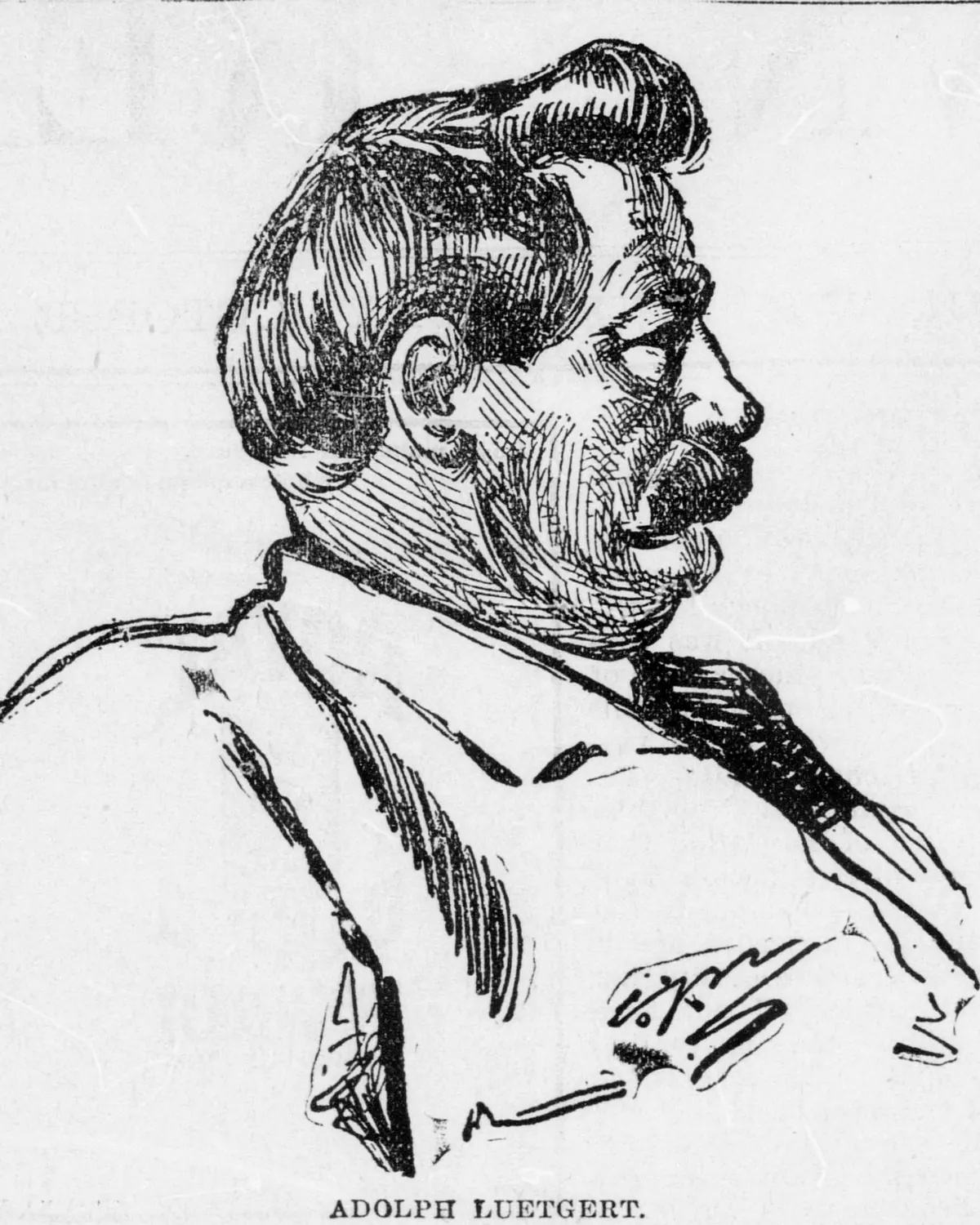
What happened
Louisa Luetgert left her house in Chicago on the evening of 1 May 1897 and was never seen again. Her husband Adolph, a German-born sausage maker, said she had gone away to visit her sister. Her brother did not believe it and went to the police.
The factory had stood shut for weeks, yet that Saturday night Luetgert sent his watchman out twice on errands and worked alone in the basement behind a locked door, with steam kept up to a vat until two in the morning. Two weeks later the police drained the middle vat. What had been in it?
No body was ever found. The indictment never said how she died, and the judge ruled that the state did not have to.
The record, filled in
The state said he dissolved his wife in the middle vat with a caustic he bought in March. His own lawyer, Lawrence Harmon, asks him about it, and about that Saturday.
Harmon You purchased a barrel of potash early in March? ... For what purpose?Luetgert To make soft soap.Harmon What arrangement, if any, had you made with reference to cleaning the factory?Luetgert ... there was a chance to sell the factory. ... I thought it was cheaper to make soap. When I used to work for Engel Bros., I learned the recipe for making soap.
Harmon ... Did you give any orders about that barrel?Luetgert Yes, I told Smokehouse Frank to break it up and told him it was bad stuff, that it would burn him, and that he should cover his face so he would not get hurt.
Harmon What time Saturday, May 1, did you return home?Luetgert ... It was late in the afternoon. ... At home I saw my wife sitting in the kitchen against the east wall and reading a paper. ... I could not find the tea and asked her where it was. ... I found the tea, in the basement pantry, and went up stairs again. ... I turned and left the house by the north door. Yes, that was the last time I saw my wife.
The payoff
Soap, he said. But the bottom of the middle vat held two gold rings, one engraved inside L. L., her initials, and bone an anthropologist swore was a woman's. A second jury convicted him of her murder.
The grid, solved
Afterwards
His first jury had split nine to three. He got life, and died at Joliet in July 1899, still saying he was innocent. Experts today doubt that fragments so small could be read that far.
Go deeper
- The original record
Adolph L. Luetgert, examined by his counsel Lawrence Harmon at his second trial, Criminal Court of Cook County, Chicago, 22 January 1898, printed as question and answer in The Saint Paul Globe, 23 January 1898, page 8. Ellipses mark cuts. No word is changed.
- Where the picture is kept
- Sources
- Did Chicago’s “Sausage King” really murder his wife? wttw.com
- The case of the sausage vat murder and the dissolved wife strangeremains.com
- 1897,Sausage Vat Murder chicagology.com
- Murder by Gaslight: The Sausage Vat Murder. murderbygaslight.com
- Alchemy of Bones: George Dorsey alchemyofbones.com
- George A Dorsey Britannica
- digital.janeaddams.ramapo.edu
- static.case.law
Oscar Slater
A pawn ticket for his own brooch
Solved it? Open the case fileClose the case file
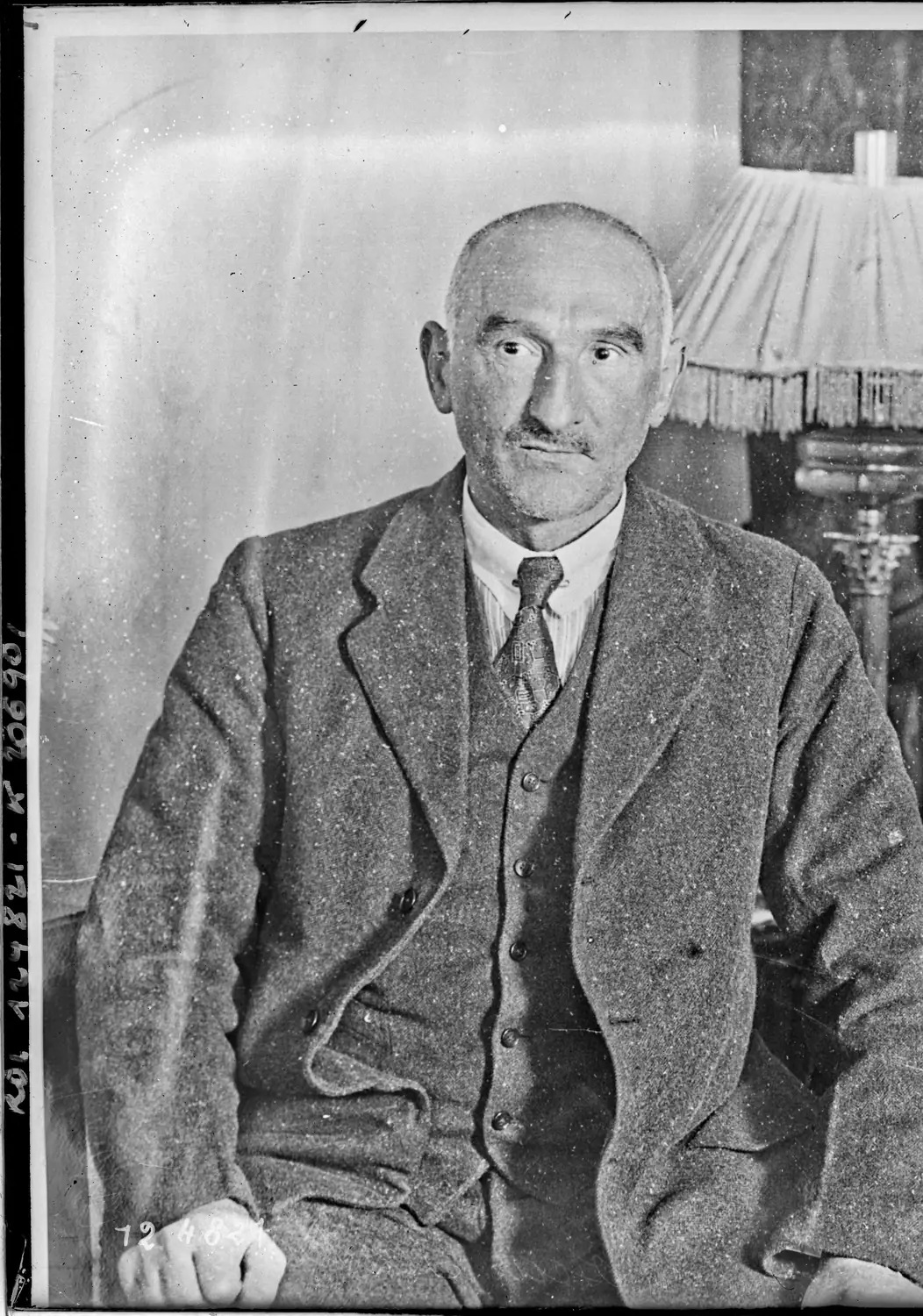
What happened
Marion Gilchrist, eighty-two and wealthy, was killed in her Glasgow flat on 21 December 1908 while her maid was out for ten minutes. A man walked out past the maid and a neighbor. Only a diamond brooch was taken.
Police traced Oscar Slater, who had tried to sell a pawn ticket for a diamond brooch. But it was his own, pledged a month before the murder. A witness, Mary Barrowman, picked him out as the man she saw running alone in a fawn coat and a Donegal hat. The prosecution said Slater lived off a prostitute; the judge told the jury such a man had less right to be presumed innocent. Nine of fifteen jurors voted guilty. Sentenced to hang, he was reprieved two days before the date.
The Crown listed one more witness, but nobody called her at the trial. What had she seen?
The record, filled in
She swore this before the trial; the jury never heard it. Compare what she saw with what Mary Barrowman saw.
Brown On Monday, 21st December, 1908, ... I left the house there to attend evening classes ... two men came rushing past me ... the one nearest me came against me in passing; he merely touched me. ... I did not see the face of either man ... The man furthest from me was of medium build, but seemed to be squarer than the other man. He had very dark hair, probably jet black, well groomed and glossy, and was bareheaded. He wore a navy blue overcoat with velvet collar, dark trousers, and black boots.
Brown, After The February Line-Up I adhere to the above statement as correct, and have to add that on Sunday, 21st February, I saw in the Central Police Office prisoner, Oscar Slater. ... I recognized him as one of the two men I had seen running away on the Monday night in question. ... the man who was with him was wearing a dark, close-fitting cap. ... I did not get a front view of his face, but I picked him out of a number of men, twelve to fourteen, as I think, in the police office, and I have not the slightest doubt about him. It was not only by his profile and back view but the shape of his neck and ears and square shoulders.
The payoff
Barrowman saw one man, in a hat. Brown saw two and named Slater as the hatless one. They could not both be right, and the jury never heard Brown. In 1928 the verdict was quashed; the murder was never solved.
The grid, solved
Afterwards
Freed in 1927 with the verdict still standing, he pressed for the appeal and was paid six thousand pounds. A detective who said in 1914 that police held evidence back was sacked.
Go deeper
- The original record
Deposition of Agnes Brown, sworn 31 December 1908 before Arthur Thomson Glegg, Sheriff-Substitute of Lanarkshire, with her re-examination added to the same exhibit, in William Roughead (ed.), The Trial of Oscar Slater, Notable Scottish Trials (Glasgow and Edinburgh: William Hodge and Company, 1910), Appendix IV, pages 318 to 319. Ellipses mark cuts; no word is changed.
- Where the picture is kept
- Sources
- Trial of Oscar Slater; Internet Archive
- The Trial of Oscar Slater gutenberg.net.au
- Murder of Marion Gilchrist policemuseum.org.uk
- The case of Oscar Slater nrscotland.gov.uk
- Voices from our Archives: Oscar Slater (1872-1948) blog.nrscotland.gov.uk
- The Case Of Oscar Slater freeread.de
- Slater v HM Advocate vlex.co.uk
- Our Legal Heritage: The trial of Oscar Slater scottishlegal.com
2 more sources
- Gallica
- Oscar Slater Wikipedia
The Steinheil Affair
Impasse Ronsin, 31 May 1908
Solved it? Open the case fileClose the case file
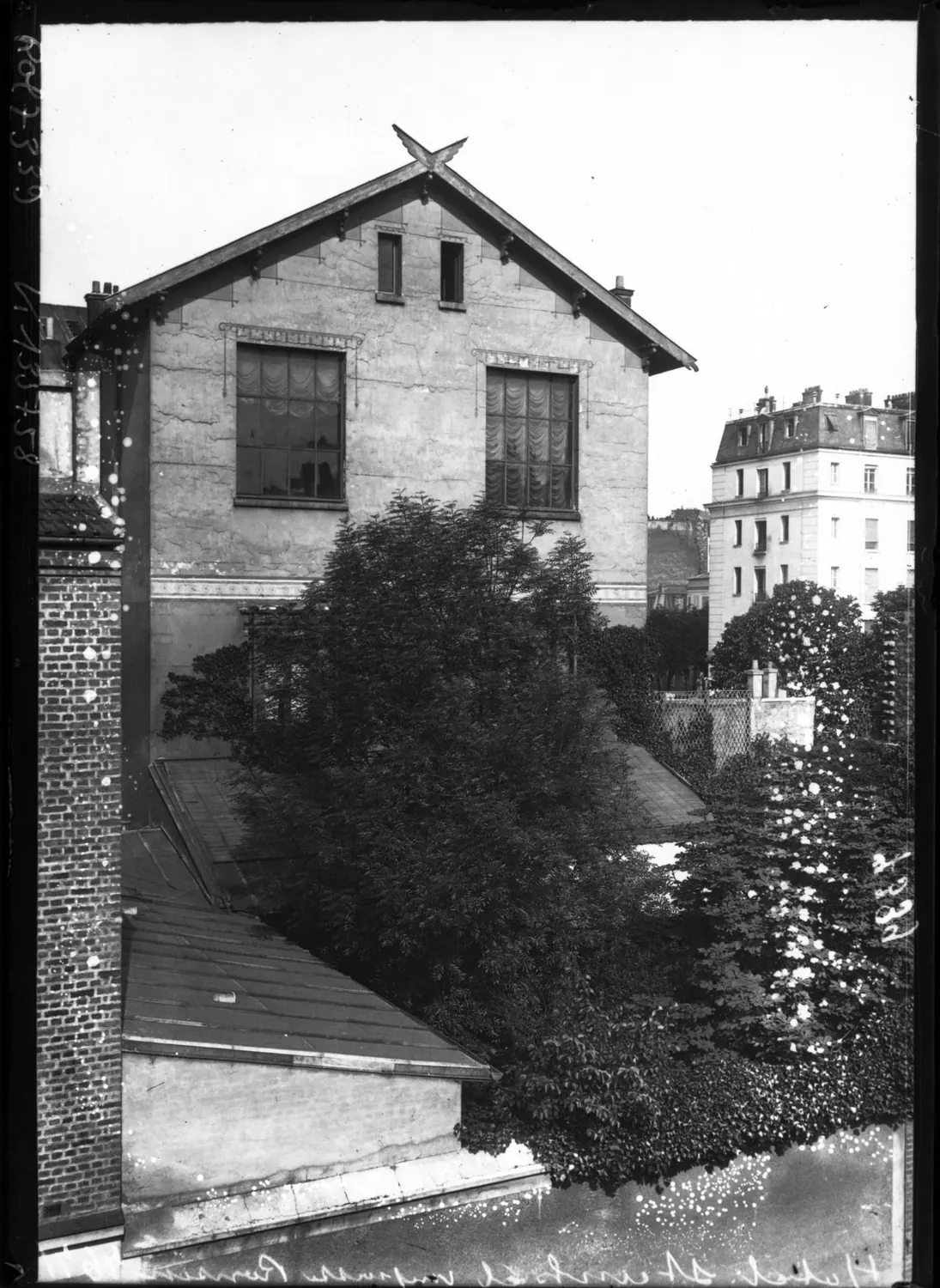
What happened
On the night of 31 May 1908, in Paris, the painter Adolphe Steinheil and his mother-in-law Emilie Japy were found dead in their home. His wife Marguerite was found tied to a bed nearby. She said masked strangers had broken in, killed them and made off with her jewels.
Police could find no sign of a break-in, and her story shifted with each telling. Then, that November, one of the jewels she said the strangers had taken turned up again. Where had it been all along?
No weapon was ever found, and no stranger who matched her description. The only witness to that night was the widow herself.
The record, filled in
What the police and the press turned up over the next eighteen months, in order. Keep your eye on the jewels she said were stolen.
Marguerite told police that four masked intruders, three men and a woman, had left her bound and gagged and carried off her jewels. The papers hunted for a political plot: she had been the mistress of Felix Faure, the French President who died in 1899.
In November a pearl that she said came from one of the stolen rings was found in the wallet of her manservant. He was arrested that night, suspected of murder and robbery.
Then her jeweler saw the pearl pictured in a newspaper and went to the police. She had brought him the ring it came from to be reset in June, weeks after the night it was supposedly stolen. A ring in his shop in June had not been taken in May.
So the pearl had been hers all along, and she admitted slipping it among his things herself. Next she named her cook's son, who could prove where he had been that night. When she admitted he was innocent too, she was arrested for her lies.
Tried for both deaths in November 1909, she was cleared after a jury deliberation of two and a half hours.
The payoff
The pearl proved she had lied about the theft and framed her own servant, an innocent man. It could not prove she had killed anyone, and her acquittal left the night of 31 May unexplained.
The grid, solved
Afterwards
She moved to England, became Lady Abinger by marriage in 1917, and died in Hove in 1954. Some writers still argue she was guilty; the court never said so.
Go deeper
- Where the picture is kept
- Sources
- Internet Archive
- Internet Archive
- My memoirs Steinheil, Marguerite, 1869-1954 Internet Archive
- resources.depaul.edu
- The Nitty Gritty: The Steinheil Affair and the Press sarahehorowitz.com
- Post 6: November 1908 sarahehorowitz.com
- Marguerite Steinheil Murderpedia
- Marguerite Steinheil Wikipedia
Adolf Beck
I am sure it is the man
Solved it? Open the case fileClose the case file
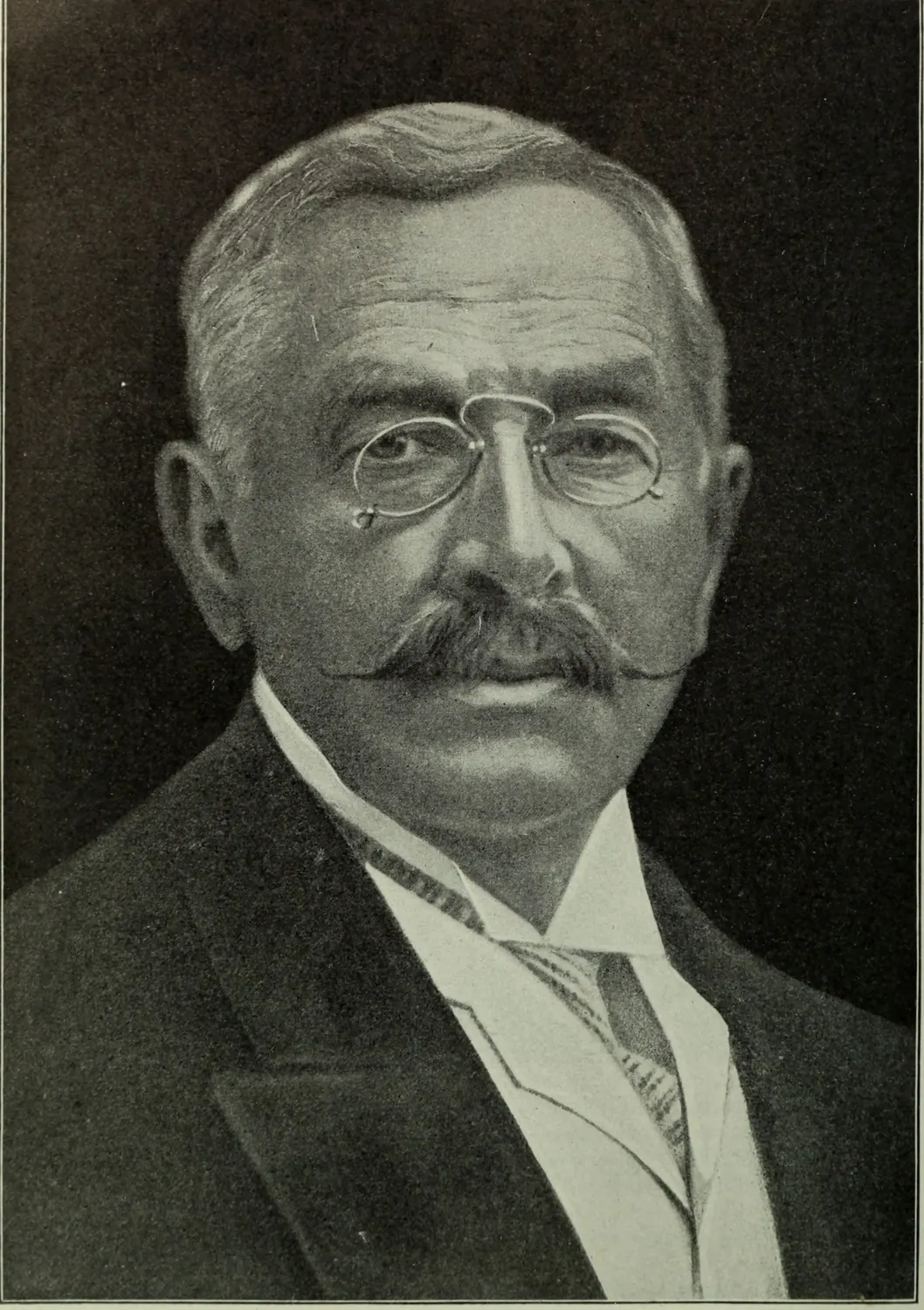
What happened
London, 1895. A well-dressed stranger stopped women in the street, promised them travel, dresses and jewels, and vanished with whatever they lent him. Police arrested Adolf Beck, a Norwegian, and decided he was the 'John Smith' jailed for the same trick in 1877.
One woman after another picked him out, and he was convicted in 1896. Released in 1901, he was arrested again when the trick broke out anew in 1904, picked out again, and convicted a second time. How could so many be so sure?
Beck swore he was never John Smith and had been in South America in 1877. The women swore he was their man.
The record, filled in
A music teacher, she swore this at the police court. Her word and other women's put Beck in prison in 1896. Notice how sure she is.
I met the prisoner on the 26th November. ... In passing through Victoria Street I met the prisoner. I did not know him before. He passed and turned back and said, "Pardon me, are you not Lady Everton or Egerton?" ... He told me that he had an estate in Lincolnshire and kept ten gardeners.
He asked me to join him in going to the Riviera. ... He also gave me the check ... for £40, to pay for the dresses, boots and shoes, bonnets and hats he was going to buy me.
He said he was a cousin of Lord Salisbury's ... I gave him an old-fashioned ring to have one made for me from it. He asked me to give him my diamond ring; it was too small, he would have it made larger. ... He said he would send them back the next day by a porter with one arm, and would send some jewels for me to choose.
Three minutes after he left I missed an antique enameled watch about the size of a shilling from the table. ... I went to the Union Bank in Trafalgar Square, and found he had no account there. ... Yesterday, at ten minutes to five, I saw him standing at the door of a house in Victoria Street. ... I gave him into custody just opposite the clock at Victoria station. I am sure it is the man. I noticed his right cheek was drawn and his left cheek fuller. He took a pocketbook out at my house, and wrote in it about dresses, silk stockings, and gloves.
The payoff
She was sure, and wrong. In July 1904, with Beck in a cell, a man was caught pawning rings two actresses had lent him. An inspector from both trials knew him: the real John Smith. He pleaded guilty; Beck was pardoned.
The grid, solved
Afterwards
The real swindler, William Augustus Wyatt, got five years. Beck was paid £5,000.
Go deeper
- The original record
Deposition of Ottilie Meissonier, sworn 17 December 1895 before Mr J. Sheil, Westminster Police Court, in Eric R. Watson (ed.), Adolf Beck (1877-1904), Notable British Trials series (Edinburgh and London: William Hodge and Company, 1924), Appendix IV, pages 166 to 167.
- Where the picture is kept
- Sources
- Adolf Beck (1877-1904). Internet Archive
- Adolf_Beck historybytheyard.co.uk
- Adolph (Adolf) Beck case courthouselibrary.ca
- Case of Adolf Beck,Mistaken Identity. (Hansard, 25 July 1904) api.parliament.uk
- Appleton's magazine Internet Archive
- Last studies in criminology Internet Archive
The Rathenau Murder
Saaleck
Solved it? Open the case fileClose the case file
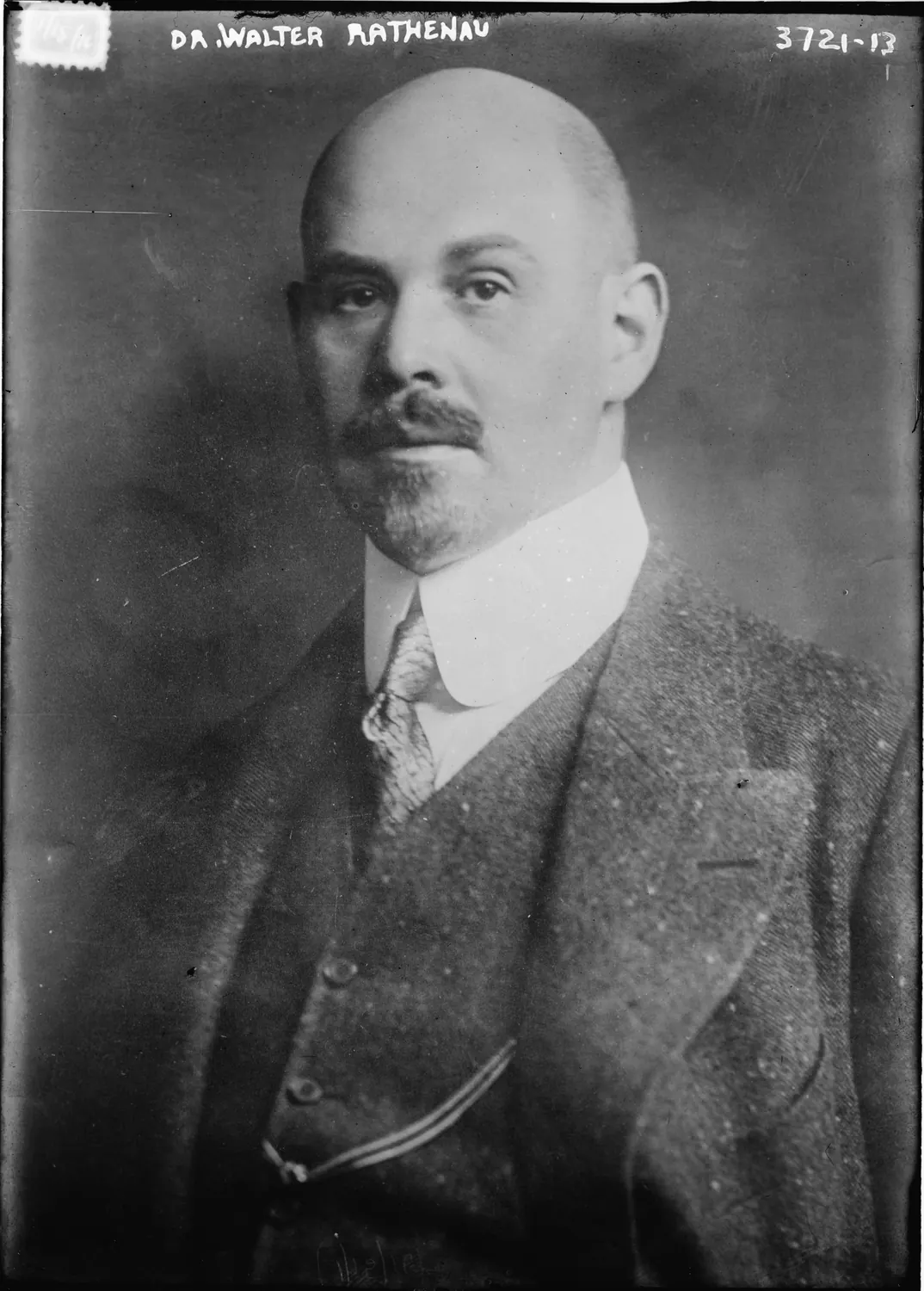
What happened
Walther Rathenau was the Weimar Republic's foreign minister, an industrialist the nationalist press had spent a year naming as the enemy inside the government. On the morning of 24 June 1922 a second car drew level with his open car in Berlin, and the men in it shot him and threw a grenade. He died within minutes.
Their car and their war-surplus submachine gun were both rare in civilian hands, which pointed to former soldiers. But which three men had been in that car?
The car and the gun told the police what sort of men to look for. They could not say which ones, or where.
The record, filled in
How the three men in the car were found, step by step, from the morning of the shooting to the trial that October.
The car had been brought in from Saxony for the job. It pulled level with Rathenau's on the Koenigsallee, in the Grunewald district, and afterwards was hidden in a garage lent by a sympathizer in nearby Schmargendorf.
The break came from a man on the edge of the plot who could not keep it to himself. His loose talk betrayed him, and once arrested he told police everything. His statement named the man at the wheel, Ernst Werner Techow, and the two gunmen, Erwin Kern and Hermann Fischer.
Five days after the shooting Techow was taken at a relative's estate east of Berlin. Kern and Fischer, both veterans of the war, had fled.
After a manhunt of more than two weeks police cornered them on 17 July at Saaleck, an old castle in Thuringia. The siege ended with Kern shot dead by an officer and Fischer dead by his own hand.
Of the three men in the car, only Techow lived to be tried. In October 1922 he was convicted as an accessory to murder and given fifteen years, later cut short by an act of clemency.
The payoff
The car and the gun only said what kind of men to look for. A plotter who could not keep quiet gave the names, and by 17 July all three men in the car were caught or dead.
The grid, solved
Afterwards
Techow left prison in January 1930 and was killed fighting near Dresden on 9 May 1945. Whether anyone higher up the network ordered the murder was never settled.
Go deeper
- Where the picture is kept
- Sources
- Vor 90 Jahren Der Mord an Walther Rathenau Deutscher Bundestag
- Rathenaumord-Prozess lexikon-der-politischen-strafprozesse.de
- The murder of Walter Rathenau marywcraig.com
- Making sure you're not a bot! encyclopedia.1914-1918-online.net
- Ernst-Werner Techow archivportal-d.de
- Deutsche Biographie deutsche-biographie.de
- Attentat auf Walther Rathenau: Dahinter stand ein rechter Geheimbund berliner-zeitung.de
- Ernst Werner Techow military-history.fandom.com
1 more sources
- Ernst Werner Techow Wikipedia
The Phoenix Park Murders
Mr Power
Solved it? Open the case fileClose the case file
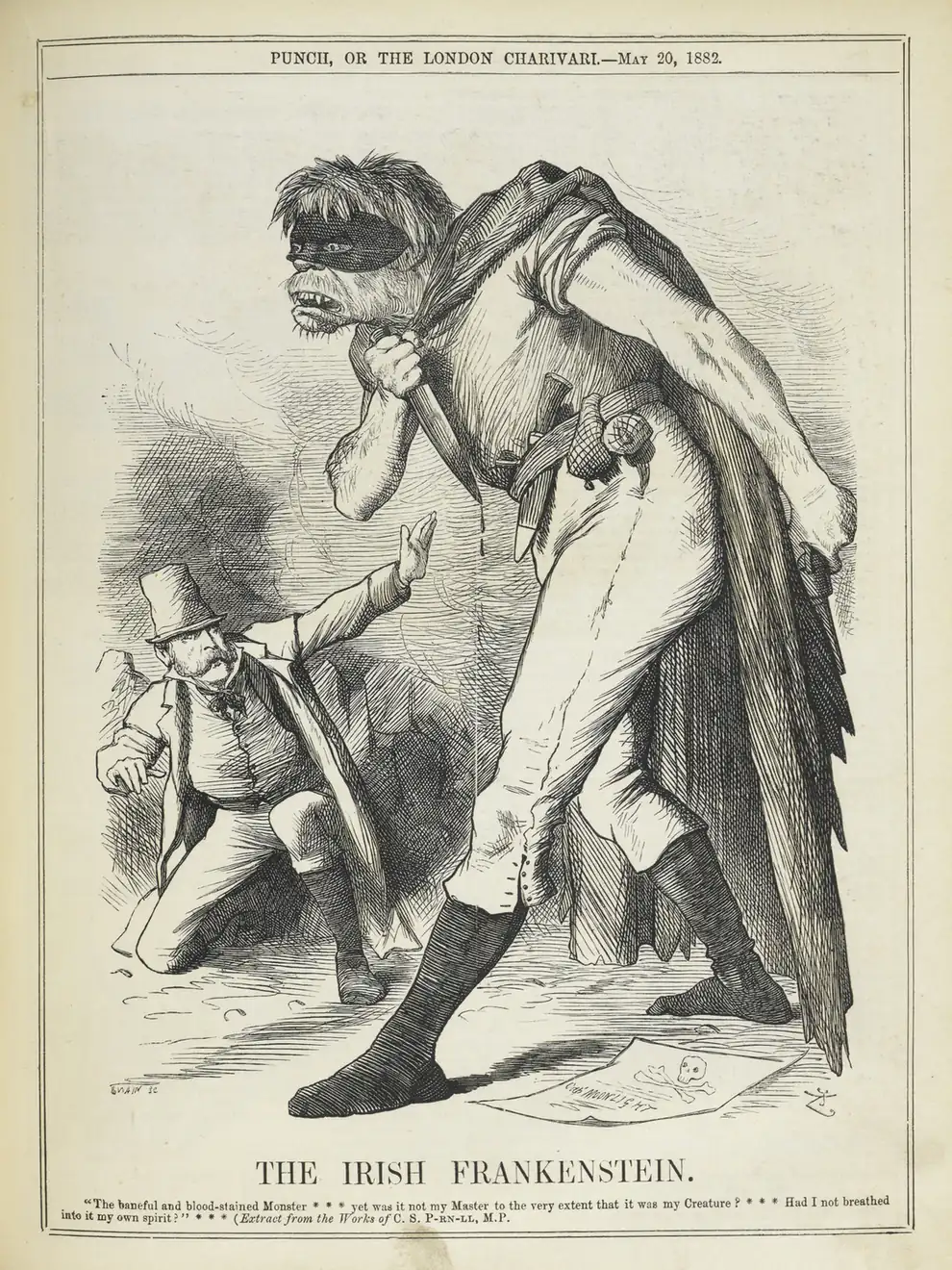
What happened
On the evening of 6 May 1882, in Dublin's Phoenix Park, two men were stabbed to death in view of people nearby: Lord Frederick Cavendish, sworn in as Chief Secretary for Ireland that same afternoon, and Thomas Henry Burke, the permanent Under-Secretary and the real target.
A secret society calling itself the Invincibles claimed the killings. Months went by without a charge. In January 1883 police rounded up a group of suspects. Which of them would talk?
The society's oath bound every member to silence. The way in had to be through one of its own.
The record, filled in
What came of the January 1883 round-up, and what talking cost the man who did it.
The man who talked was James Carey, a Dublin town councillor, respected in city politics, who had secretly been directing the Invincibles as one of their leaders. Facing the gallows beside his own men, he turned informer in February to save his life.
His evidence unmasked the society: who had planned the attack, who had struck, and who was the driver who carried the killers off. Five of his accomplices were hanged at Kilmainham Gaol that May and June.
Carey was given a new alias, Power, and sent with his family to start again in South Africa. On the voyage out he made friends with a fellow passenger, an Irish bricklayer named Patrick O'Donnell.
At Cape Town, where they changed to a coastal steamer, the Melrose, O'Donnell was told that his friend Power was James Carey. On 29 July 1883 he shot Carey dead on board. Whether O'Donnell had been sent to find him has never been settled.
The payoff
The society could only be broken from inside, and its own leader broke it: Carey's word sent five men to the gallows. His new name lasted barely three weeks at sea.
The grid, solved
Afterwards
O'Donnell was hanged at Newgate in December 1883. A 2021 study of the long-sealed Home Office file argues his judge misreported a question from the jury and steered them away from a lesser verdict. No court has tested that claim.
Go deeper
- Where the picture is kept
- Sources
- The Invincibles and the Phoenix Park killings theirishstory.com
- The Fate of an Infamous Informer historyireland.com
- Fenian James Carey Killed by Patrick O’Donnell seamusdubhghaill.com
- Dictionary of Irish Biography
- 1883: Patrick O’Donnell, avenger executedtoday.com
- On 6 May 1882, 139 years ago today, the Phoenix Park murders by the Invincibles... linkedin.com
- New evidence suggests Irishman hanged in historic high-profile murder case was... irishpost.com
- Four Courts Press fourcourtspress.ie
3 more sources
- The Irish National Invincibles and their times Internet Archive
- BOOKS: Startling truth behind the slaying of informer who betrayed the... belfastmedia.com
- Phoenix Park Murders Wikipedia
Giacomo Matteotti
Circling the night before
Solved it? Open the case fileClose the case file
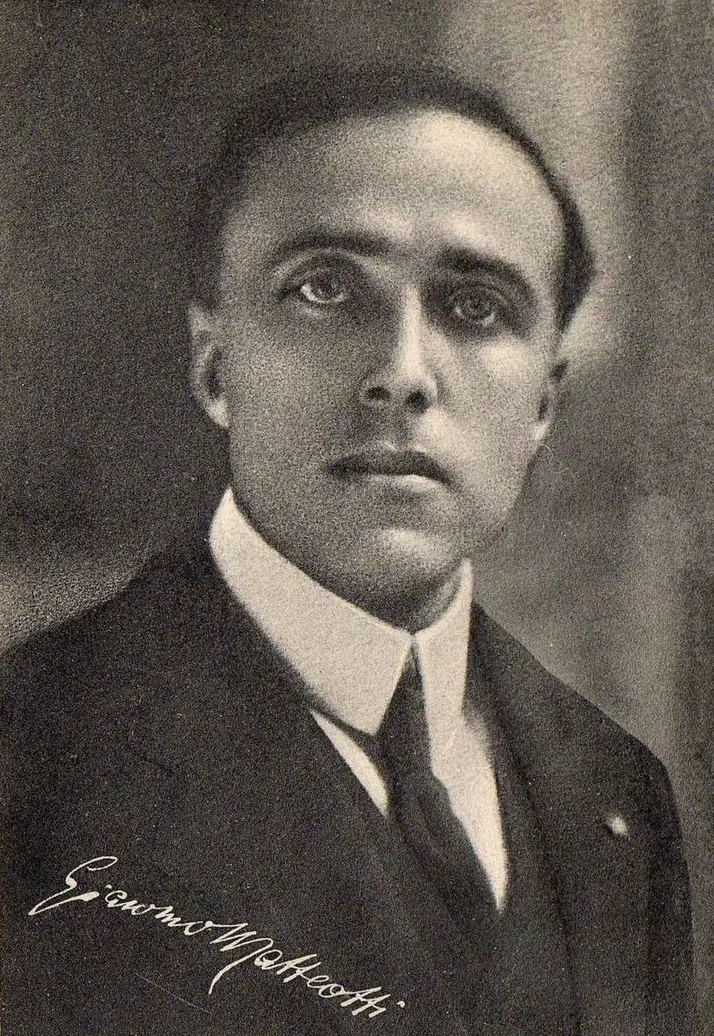
What happened
Giacomo Matteotti was a socialist member of the Italian parliament who had just accused Mussolini's government, in a speech to the chamber, of winning the last election by fraud and violence. On the afternoon of 10 June 1924, walking along the Tiber in Rome, he was dragged into a car by five men and never again seen alive.
Passersby saw the struggle but could tell police little about the men. Their car, though, had been seen in the area the night before. Had anyone taken note of it?
For two months there was no body and no confession. All the police had was a car and the names it led to.
The record, filled in
From the car to the courts, in order. The case took twenty-three years to close, and the reason is in the last step.
The five men used a big black Lancia. The night before, it had been driving round the neighborhood, and a concierge in a building nearby found it suspicious enough to write down its number. That note let police trace the car within two days. The editor of a pro-government newspaper had rented it and handed it to the leader of the five, Amerigo Dumini.
Dumini was arrested at Rome's main station on 12 June, two days after the kidnapping. But there was still no body, and nobody confessed.
On 12 August a road worker found a bloodstained jacket in a drainage ditch beside a country road north of Rome. Matteotti's widow said at once that it was her husband's.
Four days later his body was found in scrubland nearby. After two months in the open it could only be identified through dental records.
In 1926 a court at Chieti, held under the regime's tight control, found Dumini and two others guilty of manslaughter alone and acquitted the other two. Amnesties soon freed the three. Only in November 1946, with Fascism gone, did Italy's highest court overturn that verdict as one reached under the regime's pressure. At the retrial in 1947 Dumini and two others, one of them acquitted in 1926, got life.
The payoff
One number, jotted down the night before, gave police the car, the newspaperman who hired it and Dumini within two days. Punishing the killers took twenty-three years and the fall of the regime that shielded them.
The grid, solved
Afterwards
The life sentences were later cut to thirty years. Dumini left prison for good in 1956 and died in 1967. Whether Mussolini himself ordered the killing has never been proven either way.
Go deeper
- Where the picture is kept
- Sources
- Murder, investigations, trials museovirtualematteotti.it
- The murder of Giacomo Matteotti The Conversation
- La Corte di Cassazione nel sistema processuale italiano e nel processo Matteotti giustiziainsieme.it
- ITALY: The Man Who Knew Too Much Time
- the murder and legacy of Giacomo Matteotti blogs.lse.ac.uk
- Il Delitto Matteotti | storiain.net
- DUMINI, Amerigo treccani.it
- Giacomo Matteotti Wikipedia
2 more sources
- Delitto Matteotti it.wikipedia.org
- Amleto Poveromo it.wikipedia.org
The Pigott Forgeries
Parnellism and Crime
Solved it? Open the case fileClose the case file
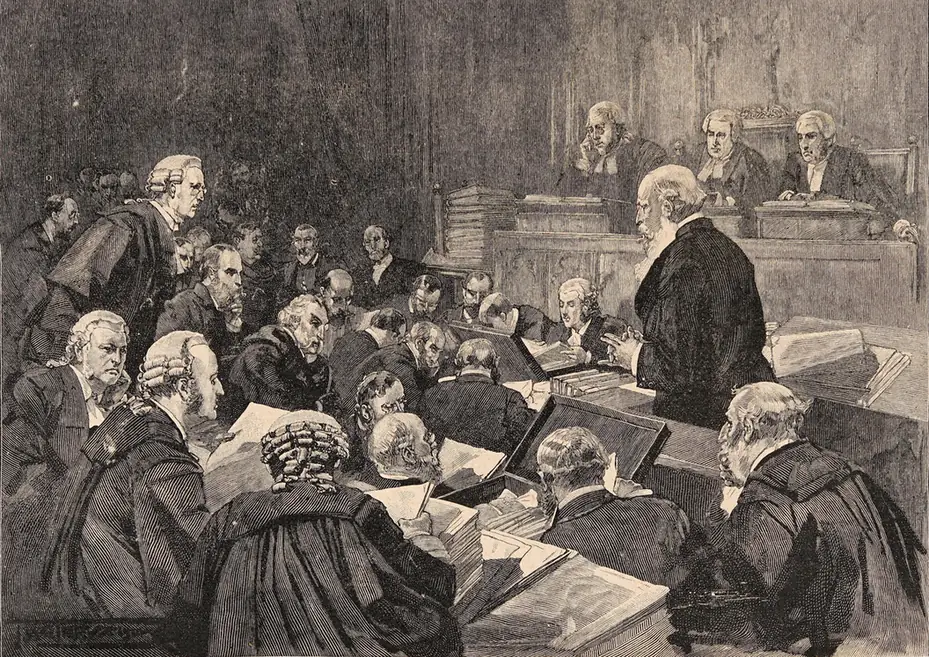
What happened
Charles Stewart Parnell led the Irish members of the House of Commons. On 18 April 1887 The Times printed a letter over his name, shown as a picture so readers could see the handwriting. Five years earlier a chief secretary for Ireland and his under-secretary had been stabbed to death in a Dublin park, and the letter had Parnell saying one of them got no more than he deserved.
He told the Commons it was villainous and false. In 1888 the paper read out more such letters in a libel case, and Parliament set up a Special Commission, three judges to weigh the charges, sitting for more than a year. Every letter had come from Richard Pigott, an Irish journalist, paid through a middleman. In February 1889 Parnell's counsel rose to cross-examine him.
The handwriting looked like Parnell's and the paper stood by every word. If he had not written the letters, who had?
The record, filled in
Parnell's counsel, Sir Charles Russell, cross-examines Pigott over two days. Another letter Pigott sold, dated 9 January 1882, misspelled one word. Watch that word.
Sir Charles Russell stood bolt upright. He had a clean sheet of paper in his hand ... and he asked Pigott to write down a few words from his dictation ... Pigott screwed his eyeglass into his right eye, took the sheet of paper and a quill ...Russell Write: livelihood, likelihood, and your own name ...
Then Sir Charles, leaning his back against the bench, helping himself to a pinch of snuff ... asked Pigott how he would forge supposing ... he wanted to.Russell ... Would you ... put delicate tissue paper over the letter ... trace it?Pigott I suppose so.Russell ... Would you think it a difficult or an easy signature to imitate?Pigott Considering its peculiarities, I should say difficult.
Russell Among the words you wrote down yesterday at my request is the word hesitancy. Is that a word you are accustomed to use?Pigott I often have used it.Russell ... You spelled it with an e instead of an a. H-e-s-i-t-e-n-c-y is not the recognized spelling, I think. Now, have you noticed that the writer of the body of the letter of the 9th of January, 1882, makes the same mistake?
Pigott replied that the mis-spelling in the alleged forgery had, in consequence of the public discussion on the subject, got into his brain. But then, the self-same mis-spelling occurred in a genuine letter of Pigott's of June, 1881.
The payoff
Pigott's genuine 1881 letter had the same slip, years before any forged letter was printed, so the slip was his own. Next day he confessed he had forged every letter, the murder letter too. Parnell was cleared.
The grid, solved
Afterwards
Pigott fled to Madrid and shot himself on 1 March, as the police came for him. The Times paid Parnell £5,000 to settle his libel suit.
Go deeper
- The original record
John Macdonald, Diary of the Parnell Commission, Revised from "The Daily News" (London: T. Fisher Unwin, 1890), pages 154 and 159 to 160. The fifty-fourth and fifty-fifth days of the Special Commission, 21 and 22 February 1889.
- Where the picture is kept
- Sources
- Diary of the Parnell commission Internet Archive
- The Parnell Commission. The opening speech for the defence Internet Archive
- The Life Of Lord Russell Of Killowen Internet Archive
- Dictionary of Irish Biography
- Richard Pigott npg.org.uk
- Charles Stewart Parnell Britannica
- Charles Russell Baron Russell of Killowen Britannica
- SPECIAL COMMISSION (1888) REPORT. (Hansard, 4 March 1890) api.parliament.uk
8 more sources
- The Project Gutenberg eBook of The Life of Henry Labouchere, by Algar... Project Gutenberg
- The Pigott Forgeries cartlann.org
- Parnellism and Crime and the Home Rule Bill libraryireland.com
- discovery.nationalarchives.gov.uk
- Richard Pigott ricorso.net
- Hesitancy Definition and Meaning wordnik.com
- Dictionary of National Biography, 1885-1900/Parnell, Charles Stewart Wikisource
- Dictionary of National Biography, 1927 supplement/Webster, Richard Everard Wikisource
The Wigwam Murder
The Wigwam Girl
Solved it? Open the case fileClose the case file

What happened
Joan Pearl Wolfe was nineteen and pregnant when she vanished from Hankley Common, an army training ground near Godalming, Surrey, in September 1942. She had been living rough there in shelters built for her by her boyfriend, a soldier in the Canadian army named August Sangret.
Three weeks later her body was found buried on the common. She had been stabbed and then struck down, and her skull was in pieces. Sangret admitted knowing her and living beside her, and gave police a statement so long it took days to write out.
He denied killing her, and nothing yet tied him to the wounds. What had made them, and where was it now?
The record, filled in
The investigation as the trial heard it. The pathologist Keith Simpson rebuilt her skull; watch what the wounds told him about the blade.
Two Royal Marines on a field exercise found her on 7 October, badly decomposed, at the top of a rise. She had been dragged there and concealed in a shallow grave of sand; nearby lay a heavy wooden stake with some of her hair caught on it.
Simpson wired her broken skull back together from its fragments: the stake had struck the blows that killed her. But she had been stabbed first, and the stab wounds on her body and arms showed a blade whose point bent over like a parrot's beak.
Wolfe had told Sangret, a Private in the Canadian army, that she was carrying his child. He had built her shelters of cut branches and heather from the common, and in his long statement he denied killing her.
In November a knife with exactly that kind of point was found in a blocked drain at the camp where Sangret was billeted. The knife was Sangret's, and its point matched the wounds Simpson had described.
At his trial the rebuilt skull was produced as evidence, the first time a victim's skull had been shown in a British court, and the jury were allowed to handle it. They added a strong recommendation to mercy to their verdict.
The payoff
The wounds had described an unusual blade weeks before it was found, and it turned up hidden at Sangret's own camp. That knife tied him to her death, and the jury found him guilty of murder.
The grid, solved
Afterwards
His appeal was dismissed, and he was hanged at Wandsworth Prison on 29 April 1943, despite the jury's plea.
Go deeper
- Where the picture is kept
- Sources
- The Surrey 'Wigwam Murder' that is unique in British legal history getsurrey.co.uk
- British Executions
- The trial of August Sangret (Notable British trials) Internet Archive
- British Executions
- 75 Years on After ‘wigwam’ Murder haslemereherald.com
- Barefoot blonde threeisacollection.org
- August Sangret Wikipedia
- August Sangret Murderpedia
Harry Gleeson
Raising the alarm
Solved it? Open the case fileClose the case file
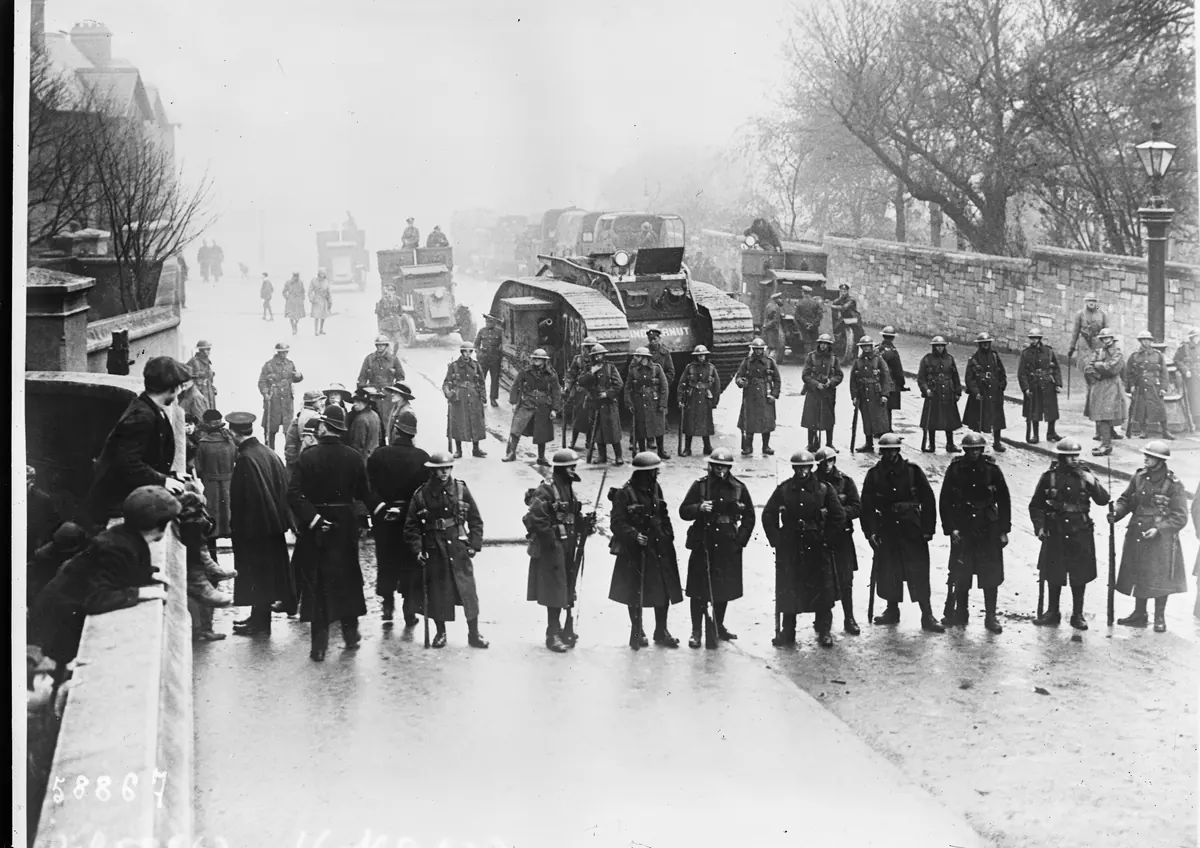
What happened
In late November 1940 a mother of seven named Mary McCarthy, known locally as Moll, was shot dead in a field near her home outside New Inn. On 21 November Harry Gleeson, a neighboring farmer, found her body while out after his uncle's sheep, and reported it himself.
Gleeson was arrested within days and charged with her murder. The case against him rested on two things: ammunition that investigators tried to tie to his uncle's farm, and an estimate of when she died that placed him, rather than anyone else, in that field.
Gleeson swore he had been elsewhere. Everything hung on the hour of her death, and on whether the gun evidence would hold.
The record, filled in
A timeline from his trial to the case's reopening. Watch when she was said to have died, and what the doctors' own notes said about it.
February 1941. At the trial the prosecution put the killing on the evening of 20 November, when Gleeson could not account for all of his time. The prosecution also said the shots matched ammunition of the same caliber his uncle had bought that October. Gleeson was convicted on 27 February.
23 April 1941. Gleeson was hanged at Mountjoy Prison in Dublin, still saying he had no part in it.
2013. A Boston pathologist, Peter Cummings, went back to the 1940 medical notes. The body's temperature, taken at the scene, meant she had died on the morning of 21 November, not the night before, and at that hour Gleeson was at home with people to vouch for him: an alibi.
2015. A review for the Attorney General found a discrepancy in the case: the local shotgun register did not back the claim about his uncle's ammunition, and the register had been withheld from the jury.
The same year the Irish Innocence Project set out how gardaí, the Irish police, had encouraged witnesses in the case to submit statements that were falsified, and had beaten one of them during questioning.
The payoff
The 1940 notes put her death at an hour Gleeson could account for, the register undercut the gun evidence, and the witness evidence was tainted. In December 2015 the Irish State pardoned him, its first such pardon.
The grid, solved
Afterwards
Nobody else was ever charged with Moll McCarthy's murder. In 2024 Gleeson's remains were identified in the grounds of Mountjoy and buried at Holycross, County Tipperary, with his family there.
Go deeper
- Where the picture is kept
- Sources
- Irish Legal Heritage: The Innocent Man, Henry ‘Harry’ Gleeson irishlegal.com
- Irish Mysteries: The Murder of Moll McCarthy irishmysteries.blogspot.com
- What led to this Irishman's exoneration, 74 years after he was executed? thejournal.ie
- Review by leading US pathologist may clear Irish farmer hanged over killing in... irishcentral.com
- Harry Gleeson innocenceproject.ie
- Leaving Mountjoy, 83 years on: Gleeson's remains are brought home rte.ie
- Posthumous pardon for man hanged 74 years ago catholicireland.net
The Urschel Kidnapping
Bridge on the sun porch
Solved it? Open the case fileClose the case file
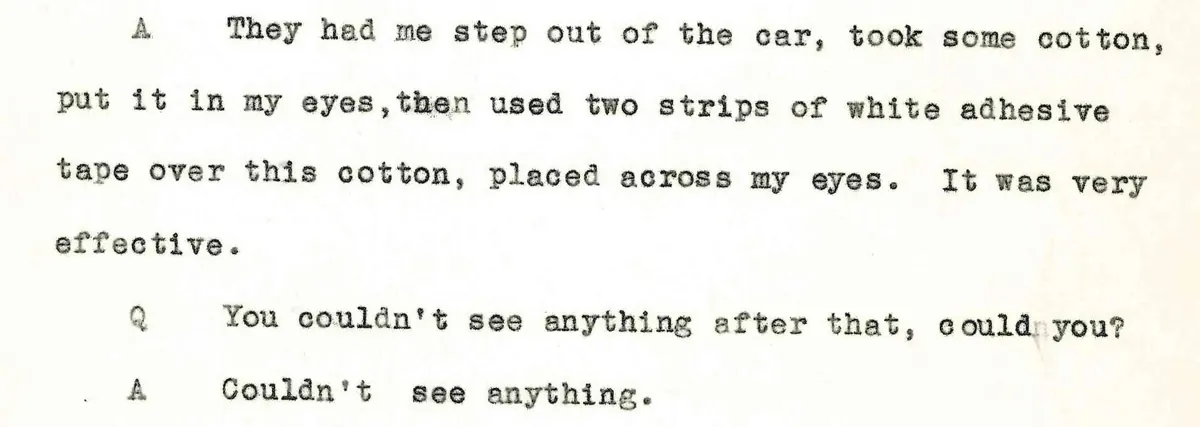
What happened
Late on 22 July 1933 two armed men walked onto the sun porch of a house in Oklahoma City, where the oil man Charles Urschel was playing bridge with his wife and two friends, and drove off with him.
Nine days later, after $200,000 changed hands in Kansas City, he was let out of a car near Norman, Oklahoma. He had been kept blindfolded with tape almost the whole time, told that if he saw or heard anything he would never come home.
His captors had driven him most of a day on dirt roads to wherever they held him.
He had seen nothing of the place where they kept him, and it could have been anywhere. How could anyone find it?
The record, filled in
The investigation once Urschel was home. Watch for two times of day, one wet Sunday, and the water he was given to drink.
Blindfolded, Urschel listened. Twice a day an airplane passed over the house, and he fixed the times: about 9:45 each morning and 5:45 each evening. Only once did the morning flight fail to come: Sunday 30 July, when a heavy storm broke. His drinking water came up from a well by rope and bucket, was served in an old tin cup that had lost its handle, and tasted like mineral water.
Federal agents checked every airline schedule within hundreds of miles. American Airways flights between Fort Worth and Amarillo crossed near the town of Paradise, Texas, at just those times, and on 30 July bad weather had held the morning flight back and pushed it far to the north. The Weather Bureau had logged rain at Paradise that day. And a tip from Fort Worth had already pointed the agents at a bootlegger named George Kelly, whose wife's mother and stepfather farmed near Paradise.
An agent who called at the farm under a pretext found the house and the well just as Urschel had described them. At dawn on 12 August agents raided it. An escaped bank robber lay asleep in the yard on a cot, a narrow camp bed, with $700 of the ransom money on him, and Urschel, who had come along, knew the place at once, down to the child's high chair he had been chained to at night.
The payoff
Every detail he remembered fitted that one farm, which proved where he had been held. Kelly was caught in Memphis that September, convicted in October 1933 and sentenced to life.
The grid, solved
Afterwards
Kelly spent the rest of his life in federal prisons, among the first men sent to Alcatraz, and died at Leavenworth in 1954.
Go deeper
- Sources
- Internet Archive
- Crimes Paradise Internet Archive
- catalog.archives.gov
- catalog.archives.gov
- okhistory.org
- okgazette.com
- Machine Gun Kelly Memphis Public Enemy memphismagazine.com
- catalog.archives.gov
3 more sources
- catalog.archives.gov
- catalog.archives.gov
- Charles F Urschel Find a Grave
President McKinley
By the last of the light
Solved it? Open the case fileClose the case file
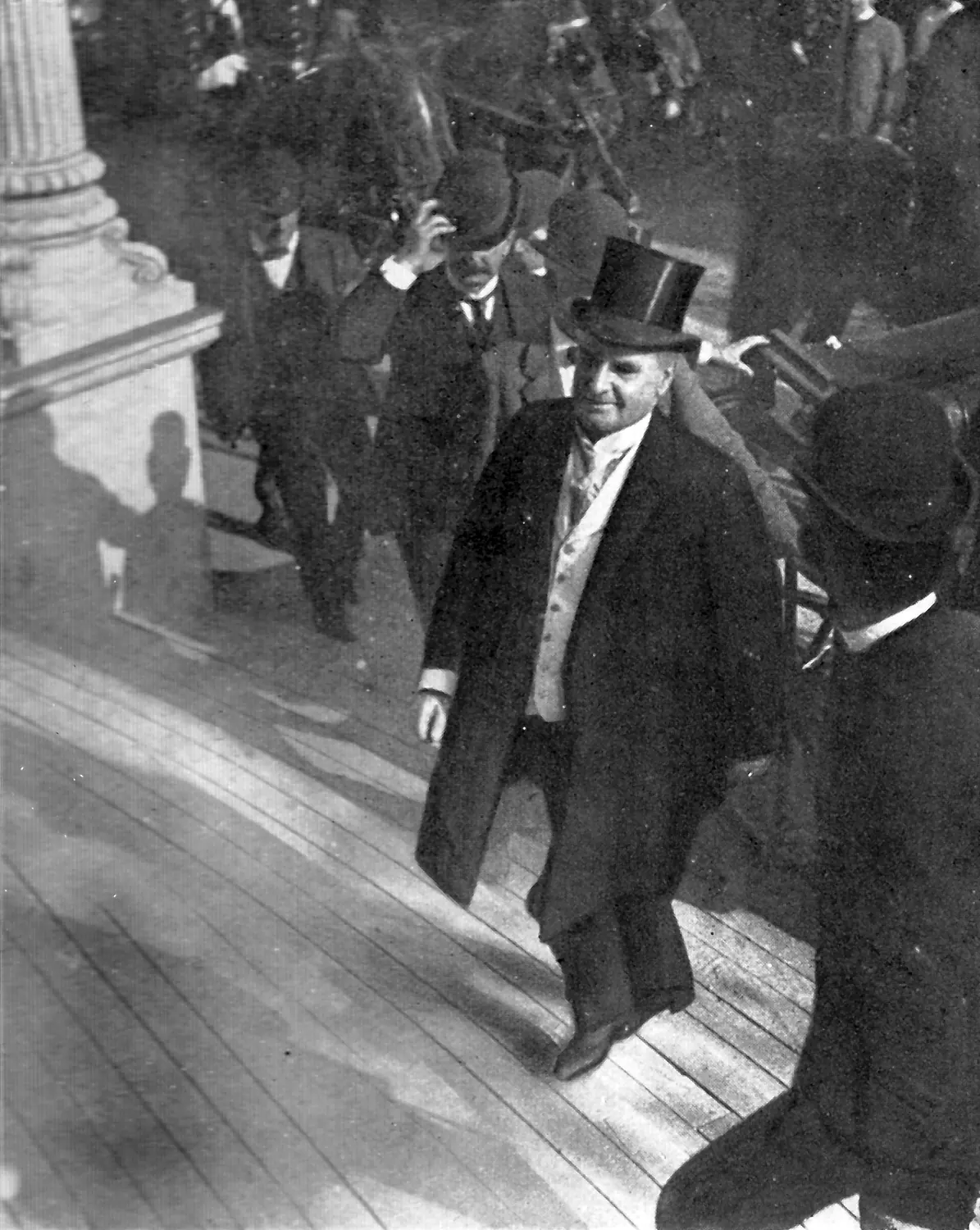
What happened
William McKinley was shaking hands in a receiving line at a world's fair in Buffalo, New York, on 6 September 1901 when a man in the line drew a pistol wrapped in a handkerchief and fired twice, hitting him in the chest and the abdomen.
He was carried to the fairground's own small emergency hospital. The surgeon on duty had built his career delivering babies, and the city's leading surgeon was busy at Niagara Falls and could not be reached in time.
Evening was coming on by the time the operation began, and the room had no electric lamp to work by.
Once the wound was closed, the bullet was still somewhere inside him. Where had it gone, and what was it doing?
The record, filled in
From the operating table to the examination after his death, in order. Watch what the surgeons could not see, and what could have shown them.
6 September 1901, evening. The crowd had seized the gunman, Leon Czolgosz. McKinley was carried into a hospital built for the exposition itself and operated on by Matthew Mann, a gynecologist with no known experience of gunshot wounds. With no electric lamp in the room, the team held up a hand mirror to throw the last daylight down onto the table.
The same evening. The bullet had gone through both walls of the stomach and on into the fat behind it. Mann sewed up the holes, but in so heavy a man he could not follow its track, and he closed the incision without a drain, a tube that lets pooling fluid out before it can turn to infection. An X-ray apparatus, a fluoroscope that shows the shadow of metal inside a living body, stood on public show a short walk away, and was never sent for.
The days after. Thomas Edison read about the shooting in a newspaper and sent a stronger X-ray machine north by train with his own technician. It reached Buffalo and was never used on the President either.
14 September. For most of a week the physicians had told reporters he was recovering. He died in the early hours, eight days after the shooting. The autopsy found gangrene along the bullet's track, through both walls of his stomach and into the pancreas.
The payoff
Infection spreading from the bullet's track killed him. Even then the bullet was never found, and two machines that could have shown where it lay had stood unused. Why they were never tried is still argued over.
The grid, solved
Afterwards
Czolgosz was convicted of first degree murder by a jury that took under half an hour, and was executed on 29 October 1901.
Go deeper
- Where the picture is kept
- Sources
- William McKinley: Death of the President millercenter.org
- Formal Record of President McKinley's Death for the Bureau of Vital Statistics American Presidency Project
- Public Announcement by the Physicians of the Death of President McKinley American Presidency Project
- President McKinley dies of infection from gunshot wounds History.com
- President William McKinley’s assassin is executed History.com
- Presidents under the knife: William McKinley bjsacademy.com
- Assassination Medicine (September 1992, Volume 43, Issue 5) n:57645 American Heritage
- Would McKinley have survived an assassin's bullet if he had a different doctor? PBS
8 more sources
- William McKinley: Autopsy Report doctorzebra.com
- Visible Proofs: Forensic Views of the Body: Galleries: Cases: Could X-rays Have... US National Library of Medicine
- Clarence Dally Smithsonian Magazine
- Nikola Tesla, Thomas Edison, and the Assassination of President William McKinley davidjkent-writer.com
- The trial, execution, autopsy and mental status of Leon F. Czolgosz, alias Fred... Internet Archive
- The Shot Fired in Buffalo urologichistory.museum
- William McKinley: Autopsy Report sickpresidents.com
- One day in September roswellpark.org
John Dillinger
Biograph
Solved it? Open the case fileClose the case file
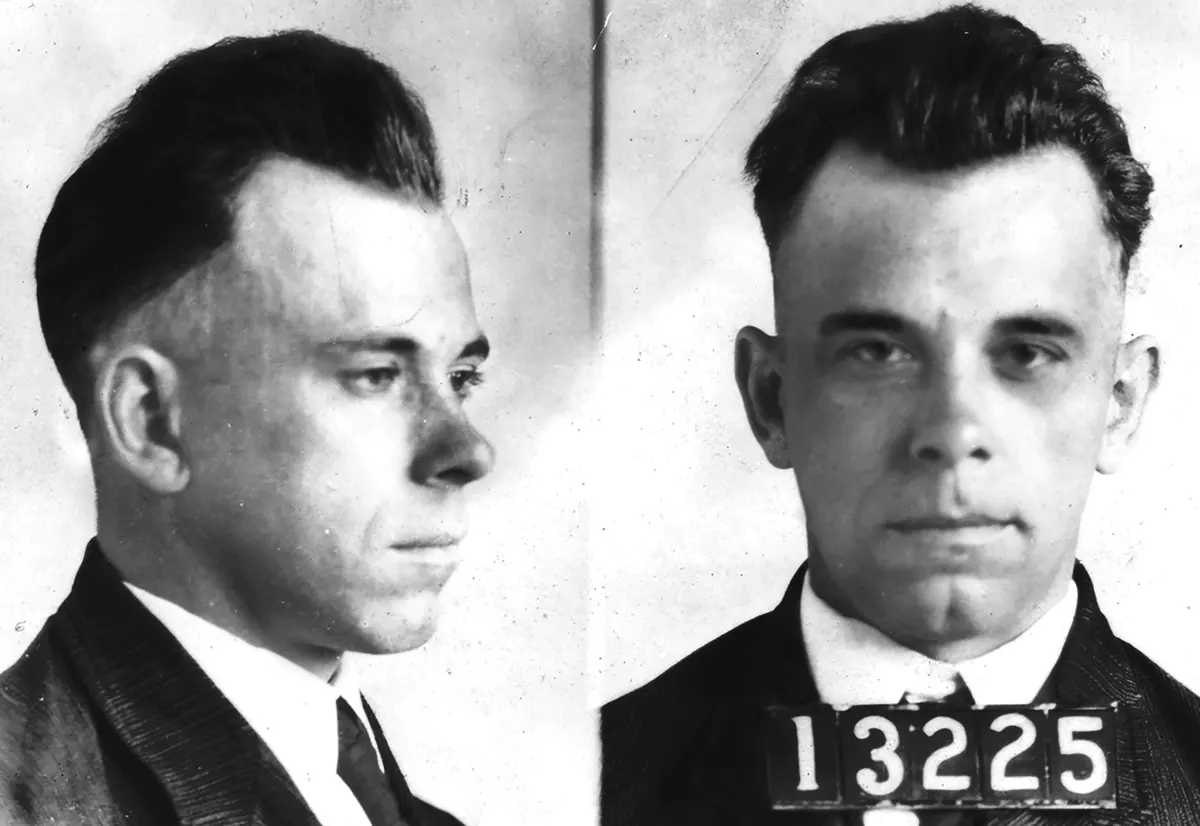
What happened
By 1934 John Dillinger was the FBI's most wanted man, blamed for a string of Midwest bank robberies, two jail escapes, and the deaths of a sheriff and several police officers.
That May he paid a Chicago doctor to change how he looked. The surgeon reshaped his face and treated his fingertips with a chemical meant to destroy the pattern that had marked him for a decade.
That July agents shot a man outside a Chicago movie theater. With his face and fingertips changed, could anyone prove it was him?
The record, filled in
Our report on the disguise and on how the dead man was identified. Watch what the surgeon set out to erase, and what came back.
In May 1934 the doctor smoothed out a scar, took a mole off Dillinger's forehead above the eyebrows, and filled out his cheeks and chin with tendons, the tough cords that tie muscle to bone, taken from a kangaroo. On the same visit he burned Dillinger's fingertips with acid to destroy the ridges, the fine raised lines of skin that leave a fingerprint.
In July a woman traveling with Dillinger, known afterward as the woman in red, became an FBI informant. She told agents which movie theater he would go to on the night of 22 July, and they kept it under surveillance until he came out.
Agents shot him outside the Biograph Theater and he was pronounced dead minutes later. At the Cook County morgue a fresh set of prints was rolled from what was left of his fingers.
The burns had taken away the center of each print, but around the edges the lines had grown back in the same circular swirls, or whorls. Examiners set what had grown back beside his old booking prints and found the patterns identical.
The payoff
The fingertips he had paid to erase still named him. The man shot outside the Biograph was John Dillinger, and the hunt for the most wanted man in America was over.
The grid, solved
Afterwards
There was no trial: the one murder charge against him, for the killing of an East Chicago patrolman, was never heard. In 2019 two relatives asked to exhume him, saying the body did not match; the cemetery refused, and a judge upheld it.
Go deeper
- Where the picture is kept
- Sources
- John Dillinger FBI
- 1934,John Dillinger & Melvin Purvis chicagology.com
- Leave no trace themobmuseum.org
- When the Mob Turned to Plastic Surgeons to Erase Their Fingerprints Mental Floss
- Dillinger descendants say they have ‘evidence’ gangster was not killed outside... chicago.suntimes.com
- Sheriff Jess L. Sarber, Allen County Sheriff's Department, Ohio odmp.org
- Patrolman William Patrick O'Malley, East Chicago Police Department, Indiana odmp.org
- Patrolman Howard C. Wagner, South Bend Police Department, Indiana odmp.org
9 more sources
- Sergeant William T. Shanley, Chicago Police Department, Illinois odmp.org
- Patrolman Francis Lloyd Mulvihill, East Chicago Police Department, Indiana odmp.org
- Patrolman Martin J. O'Brien, East Chicago Police Department, Indiana odmp.org
- John Dillinger Timeline PBS
- IARA: Dillinger Collection in.gov
- John Dillinger Relatives Doubt Body In Grave Is The Gangster wfyi.org
- John Dillinger's nephew can't exhume gangster's remains without Indiana... foxnews.com
- Sergeant William Thomas Shanley Star 760 cpdmemorial.org
- William Patrick O'Malley (1888-1934) Find a Grave
Bonnie and Clyde
Only a joke
Solved it? Open the case fileClose the case file
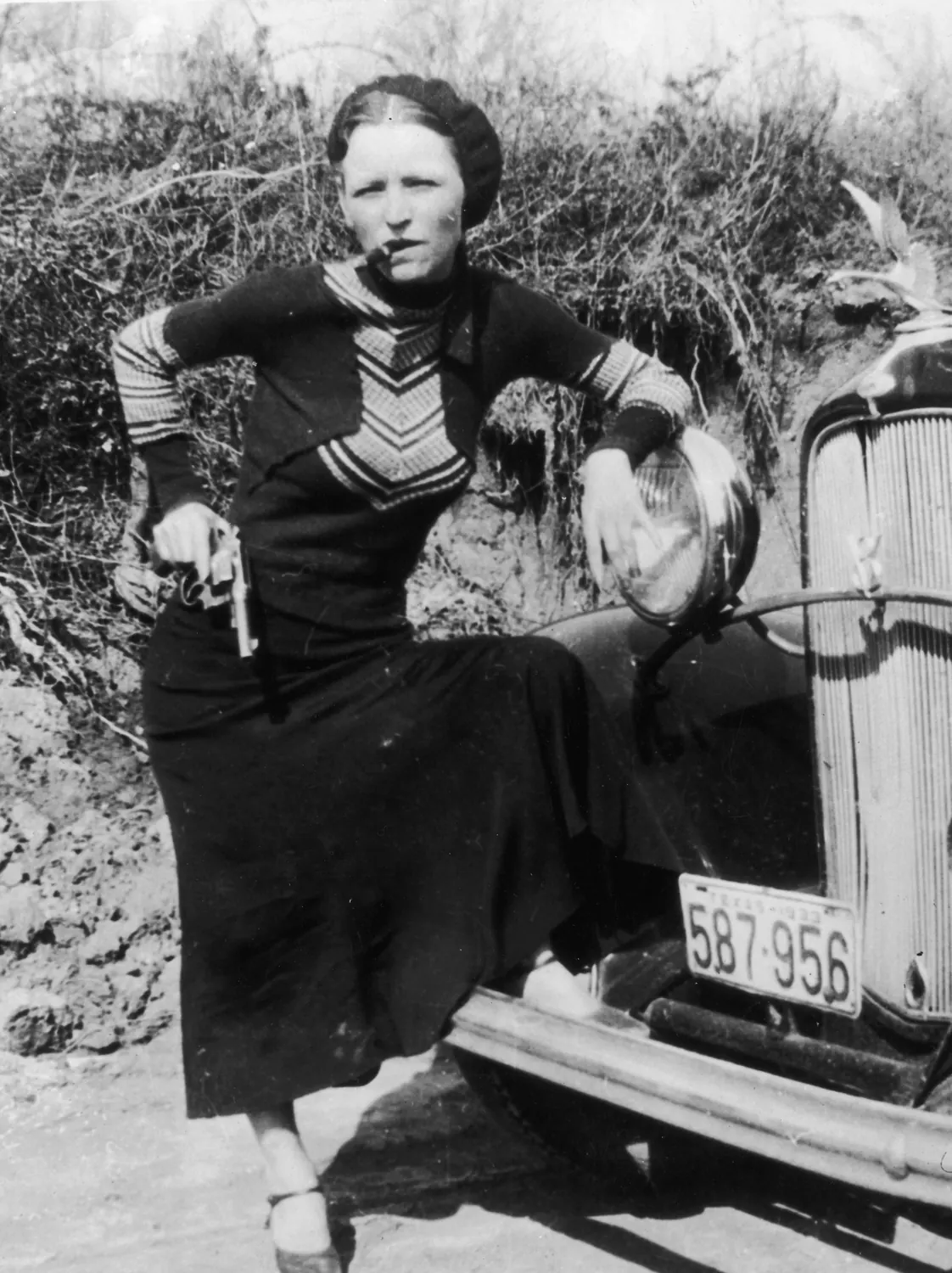
What happened
On 13 April 1933 two officers went to check on a rented garage apartment in Joplin, Missouri, after reports about the men living there. Both officers were shot dead.
The five inside fought their way out and drove off: Clyde Barrow, his brother Buck, their partners Bonnie Parker and Blanche Barrow, and a younger gang member. In the rush they left most of their belongings behind.
Police had the gang's names, but few people knew their faces. Something left in that apartment changed that within days.
The record, filled in
A timeline from the raid to the front pages. Watch what the gang left behind, and what a local paper did with it.
13 April 1933. Police had come believing the men inside were bootleggers, men selling illegal liquor, in a garage apartment the gang was using as a hideout. In the rooms they had abandoned lay a camera with film still in it.
After the raid. The film went to the Joplin Globe, the town's daily paper, which had it developed. Frame after frame showed the fugitives themselves, among them Bonnie Parker posing with a pistol, one foot on the car's bumper and a cigar clamped in her teeth.
The pose was a joke, staged by the younger gang member who took the picture. Bonnie smoked cigarettes; he had handed her his own to hold.
15 April 1933. The Globe printed the pictures, made from the negatives, and sent them out over the newswire to papers across the country. Within days Bonnie and Clyde, two fugitives few people could have picked out of a crowd, were celebrities.
The payoff
Clyde Barrow's gang had killed the two officers, and now the country knew their faces. Clyde and Bonnie never stood trial: police shot them dead in an ambush in Louisiana on 23 May 1934.
The grid, solved
Afterwards
Buck Barrow died of wounds from a later shootout in Iowa in July 1933; Blanche was captured there, and she and the younger gang member both went to prison. Bonnie was reportedly upset that the joke picture was ever published; the legend of her as a hard-bitten tough grew from that one frame.
Go deeper
- Where the picture is kept
- Sources
- Detective Harry L. McGinnis, Joplin Police Department, Missouri odmp.org
- Constable John Wesley "Wes" Harryman, Shoal Creek Township Constable's Office... odmp.org
- Missouri Law Enforcement Memorial missourimemorial.com
- Bonnie & Clyde Garage Apartment Historical Marker hmdb.org
- Globe Photos of Bonnie and Clyde Helped Make Them Celebrities joplinglobe.com
- The Irresistible Bonnie Parker Smithsonian Magazine
- Bonnie and Clyde: 9 Surprising Facts About the Outlaw Duo biography.com
- Parker, Bonnie tshaonline.org
7 more sources
- 1933 Shootout in Dexfield Park with the Barrow Gang teachingiowahistory.org
- Sold at Auction: Bonnie Parker & Clyde Barrow, Bonnie & Clyde, Two Vintage... invaluable.com
- Capture of Bonnie and Clyde 64parishes.org
- Detective Harry Leonard McGinnis (1879-1933) Find a Grave
- John Wesley “Wes” Harryman Sr. (1891-1933) Find a Grave
- Marvin Ivan “Buck” Barrow Sr. (1903-1933) Find a Grave
- William Daniel “W.D.” Jones (1916-1974) Find a Grave
The Stratton Brothers
The mark on the tray
Solved it? Open the case fileClose the case file
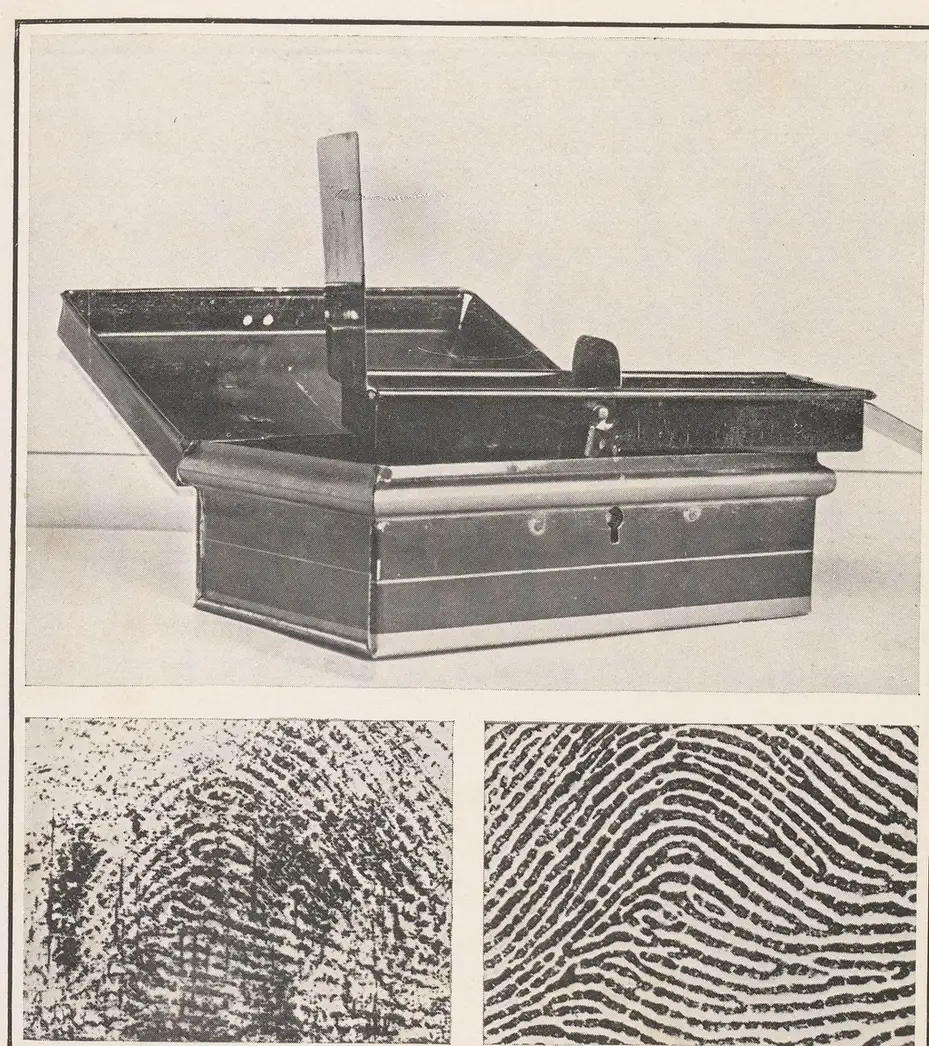
What happened
Thomas Farrow, who was about seventy one, managed an oil and color shop, a hardware and paint merchant, and lived above it with his wife Ann.
On the morning of 27 March 1905 the errand boy found the shop still shuttered. Farrow was dead in the parlor, his wife unconscious upstairs, and an emptied cash box lay on the bedroom floor. Ann Farrow died four days later without ever waking. A greasy mark on the box's tray went to Scotland Yard's new Fingerprint Bureau, where Detective Inspector Charles Collins matched it to Alfred Stratton, arrested the following week with his brother Albert. At the Old Bailey the defense set out to break the match.
No British jury had yet convicted a man of murder on a fingerprint, and the smudge did not look quite like Alfred's inked print.
The record, filled in
Characteristics are ridge details, such as forks. The defense says the box mark's lines run straighter than in Alfred's inked print, and calls its own expert, Garson.
Collins, Asked By The Prosecution In my experience, the highest number of characteristics which we have ever found to agree in the impressions of two different fingers is three ... we have never found as many as four ... I found that Alfred's right thumb corresponded with the mark on the cash box ... I have indicated by red lines and figures eleven characteristics in which those two prints agree.
Collins, Asked By The Defense It is simply perspiration in the mark on the cash box and in the other the finger is evenly coated with ink. Pressure would give you a straight line from one and a curve from the other, but the patterns are the same ... These vertical lines are scratches which were on the cash box. You can see them on it now ... If you take a soft rubber stamp and push it down with pressure you get a more or less blurred mark and the same with the finger.
Garson, Asked By The Prosecution I accept the statement that one of those prints is the finger ... of Alfred Stratton and I am prepared to swear before the jury that the one above is not ... you can read the letter that I wrote to the solicitor for the defense ... on the same day I wrote to the Director of the Public Prosecutions, offering to give evidence on his behalf ... I am an independent witness.
Garson, Asked By The Judge I offered to give the result of my examination ... I meant I wanted to see the finger prints ... although I did not say so in either of the letters.
The payoff
The jury believed Collins over an expert who had offered himself to both sides in one day. Both brothers hanged on 23 May 1905, Albert convicted on other evidence: Britain's first murder conviction won on a fingerprint.
The grid, solved
Afterwards
The weapon was never established. Nothing here has been seriously disputed since.
Go deeper
- The original record
Charles Collins, examined and cross-examined, and John George Garson, cross-examined and questioned by the Court, at the trial of Alfred Stratton and Albert Ernest Stratton, Central Criminal Court (Old Bailey), session opening 2 May 1905. Old Bailey Proceedings Online (www.oldbaileyonline.org, ref. t19050502-415).
- Where the picture is kept
- Sources
- Trial t19050502-415 Old Bailey Online
- Capital Punishment UK
- Stratton Brothers: First Murder Case Solved by Fingerprints simplyforensic.com
- Scotland Yard's Murder Squad by Dick Kirby (Ebook) everand.com
- Stratton Brothers case Wikipedia
- Melville Macnaghten Wikipedia
The Dreyfus Affair
Devil's Island
Solved it? Open the case fileClose the case file
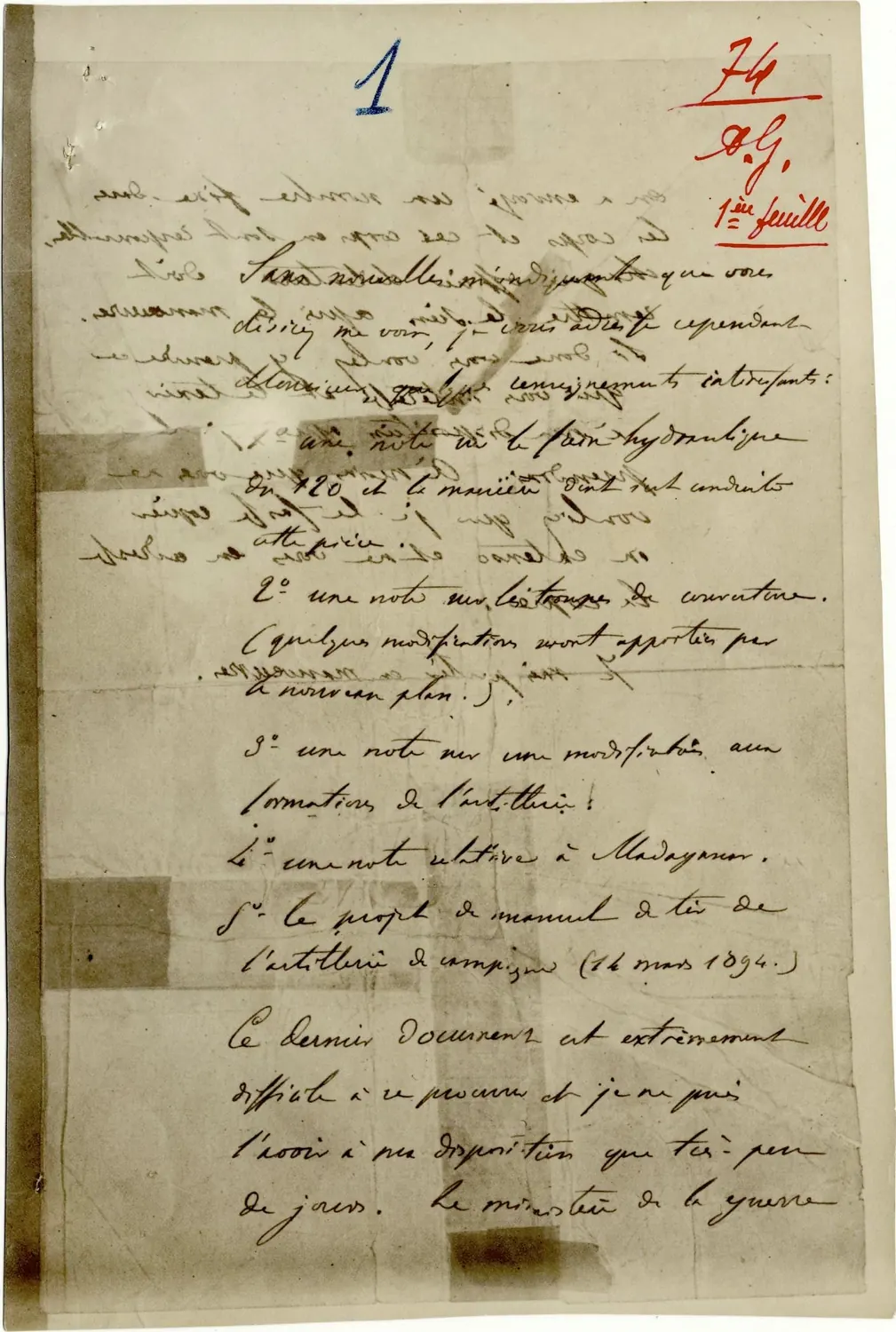
What happened
A cleaner at the German embassy in Paris emptied the military attache's wastebasket and took the contents to French army intelligence instead of burning them. In September 1894 her delivery held one sheet of thin paper torn into six pieces, which fitted together into an unsigned note offering the Germans five military documents.
It dealt in guns and gunnery manuals, so the army looked at the officers who trained through every department and stopped on the only Jewish one, Captain Alfred Dreyfus. Nothing else came: no motive, no witness. It came down to the writing, the four experts consulted split two against two, and a court martial convicted him in December.
He was shipped to a hut on Devil's Island, off South America, and the army called it closed. But whose writing was on that page?
The record, filled in
How the case came apart, step by step, from 1896. Watch the new head of army intelligence, Colonel Georges Picquart, and a second letter from the same wastebasket.
March 1896. The embassy's charwoman was still bringing in the wastebasket of the military attache, and in it was a letter he had torn up unsent, on the blue paper Paris sent through tubes of compressed air, the pneumatic post. The Germans were writing to a French officer: the envelope carried the home address and rank of Major Ferdinand Walsin Esterhazy.
Weeks later. Picquart set letters Esterhazy had written to the army beside the torn sheet of 1894. Same hand, and not even disguised. Back in 1894 the experts had split two against two, and the tie went against Dreyfus on the word of Alphonse Bertillon, head of the Paris police identification bureau, who had no training in graphology, the expert study of a person's writing.
That autumn. Told to drop it, Picquart pressed on, and was moved out of the office on open-ended inspection tours: France, then Algeria and Tunisia, far from the files.
1898. Esterhazy was court-martialed and acquitted. The secret dossier shown to the judges in 1894, and never to the defense, was reviewed at last. The exhibit the army now leaned on hardest was two sheets joined into one, the ruled lines on the halves not even the same color, and its maker, an officer of the intelligence office, confessed to forging it.
1899. Brought back from Devil's Island, Dreyfus was convicted again by a second court martial, by five votes to two, then pardoned by the President: free, but still convicted.
The payoff
The torn page of 1894 was Esterhazy's, never Dreyfus's. On 12 July 1906 France's highest court annulled the conviction and ordered no new trial, and Parliament reinstated Dreyfus in the army.
The grid, solved
Afterwards
Esterhazy's acquittal was never overturned; he left France and died in England in 1923. The army did not say plainly that Dreyfus had been innocent until 1995.
Go deeper
- Where the picture is kept
- Sources
- Famous Trials
- Famous Trials
- Pages Histoire francearchives.gouv.fr
- webhomes.maths.ed.ac.uk
- Poincare and Dreyfus webhomes.maths.ed.ac.uk
- Le Bordereau Internet Archive
- The handwriting analysis that convicted Alfred Dreyfus is for sale forward.com
- The Dreyfus Affair: A Torn Document, A Wrong Man deadlycurious.com
13 more sources
- Alfred Dreyfus Britannica
- Ferdinand Walsin Esterhazy Britannica
- Alphonse Bertillon Britannica
- Marie Bastian dicoaffairedreyfus.com
- France Promotes Jewish Soldier Dreyfus 130 Years After... france24.com
- French lawmakers unanimously back posthumous promotion for Captain Alfred... lemonde.fr
- Dreyfus Affair ebsco.com
- Georges Picquart cheminsdememoire.gouv.fr
- Alfred Dreyfus and the "Dreyfus Affair" encyclopedia.ushmm.org
- After 101 Years, French Army Admits Innocence of Dreyfus jta.org
- Le système Bertillon police-scientifique.com
- Dreyfus affair Wikipedia
- Alphonse Bertillon Wikipedia
The Mannings
Sixpence worth of lime
Solved it? Open the case fileClose the case file
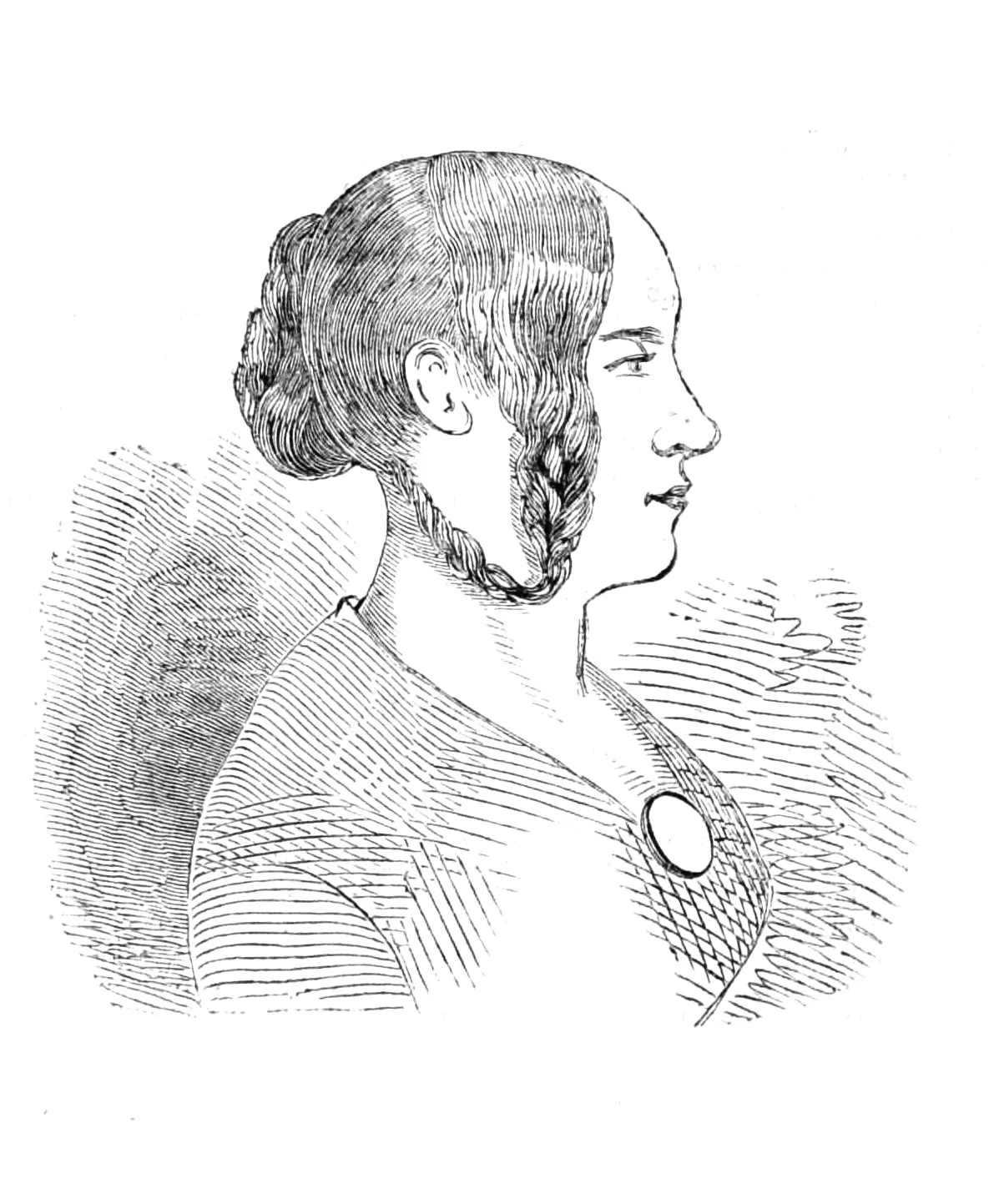
What happened
At their house in Bermondsey, Frederick and Maria Manning had a regular dinner guest, a Customs officer of about fifty named Patrick O'Connor. On 9 August 1849 O'Connor called for dinner and was never seen alive again. A fortnight earlier, Frederick had ordered lime from a builder's house nearby, for the garden, he said.
Within days the Mannings sold their furniture, and Frederick left for Jersey while Maria took a train to Edinburgh. O'Connor's colleagues told the police he was missing, and officers searched the house on 14 August without finding anything wrong.
Three days later a constable went back to the shut-up house, and something about the back kitchen floor caught his eye.
The record, filled in
Some lime burns flesh away. Watch what Manning asked for and where he had it emptied. The last witness is shown false teeth taken from the body.
Barnes, Constable In the back kitchen my attention was attracted by a damp mark between the edges of two of the flagstones ... I removed the stones; there was mortar first under the stones, and then earth ... the body was embedded in slack lime.
Wells, Builder's Daughter I know the male prisoner; I remember his coming to our house at the latter end of July, for 6d. worth of lime; he said he wanted it to kill slugs in the garden; I asked whether he would have white or gray lime, and he said he wanted that which would burn the quickest; I said we had no white, and he said he would have the gray.
Welsh, Builder's Man On 25th July I took some lime to Miniver-place; I saw who ordered it, it was Mr Manning, the prisoner ... I carried it in a basket on my shoulder; it was a bushel ... I went into the back-kitchen at his direction, and he showed me where to empty it.
The Judge, To Lockwood You say it must have been under ground a week or more, from what appearances do you come to that conclusion?Lockwood, Surgeon ... The skin becomes decomposed earlier when lime is poured on it ... the effect of lime would be to destroy the features very rapidly, if there was a sufficient quantity; they were not so far destroyed, but that a person very intimately acquainted with him might have identified him.
Comley, Dentist I knew Patrick O'Connor, the deceased, as a patient; I sold this set of false teeth to him.
The payoff
Manning had the fastest-burning lime tipped in his kitchen, not the garden, yet it had not destroyed the face or the false teeth: the body was O'Connor's. Both Mannings were hanged for the murder on 13 November 1849.
The grid, solved
Afterwards
Charles Dickens watched the hanging and wrote to The Times against public executions.
Go deeper
- The original record
Old Bailey Proceedings Online (www.oldbaileyonline.org, version 9.0), trial of Frederick George Manning and Maria Manning, reference t18491029-1890, Central Criminal Court, 1849. Testimony of Henry Barnes, Mary Wells, Richard Welsh, Samuel Meggitt Lockwood (questioned by the Court), and William Comley.
- Where the picture is kept
- Sources
- Trial t18491029-1890 Old Bailey Online
- Internet Archive (saved copy)
- The Bermondsey murder Internet Archive
- Methods of executing the death penalty Britannica
- 'The Bermondsey Horror' drangelabuckley.substack.com
The Somerton Man
Tamam Shud
Solved it? Open the case fileClose the case file
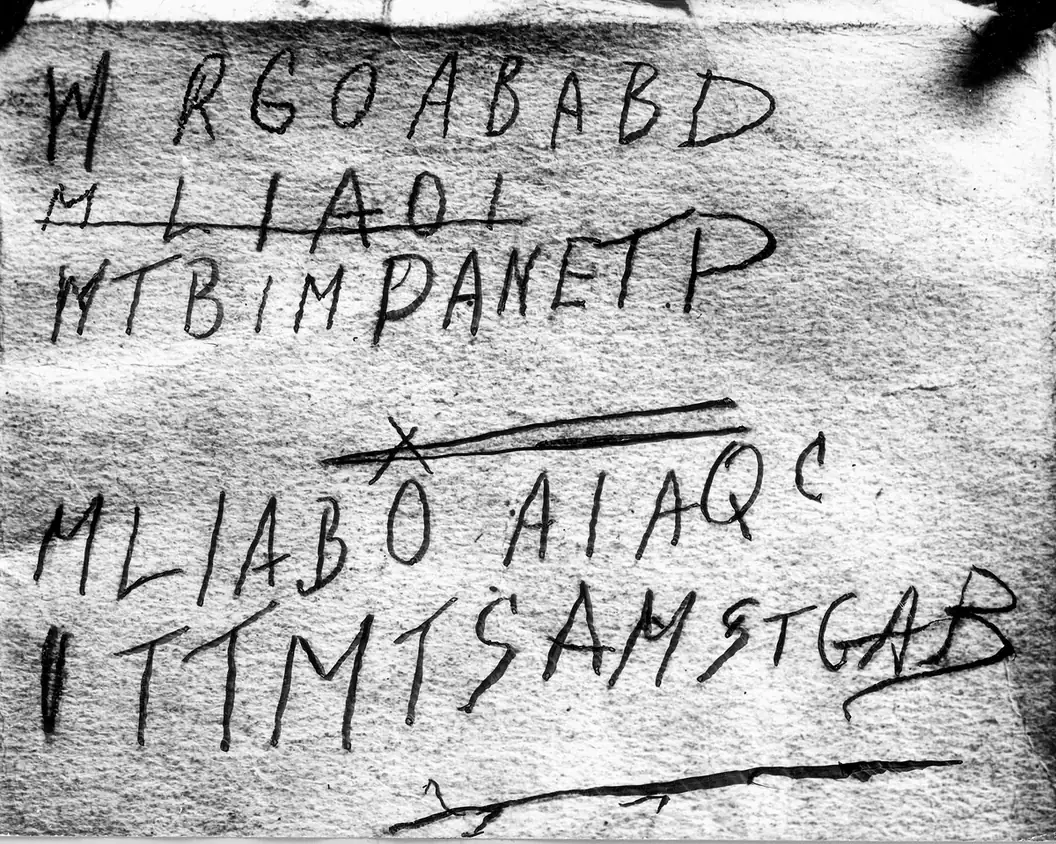
What happened
On the morning of 1 December 1948 a well-dressed man was found dead on a beach south of Adelaide, Australia, slumped against the seawall. He carried no wallet, and every maker's label had been cut from his clothes. His fingerprints matched nobody on file, and his teeth matched no missing man anyone could name.
A later search of his trousers found a tiny pocket sewn into the waistband. In it was a printed scrap reading "Tamam Shud", Persian for "it is finished", torn from the last page of a book of verse, the Rubaiyat of Omar Khayyam.
Police went looking for the book the scrap was torn from, still without the one thing they needed most: his name.
The record, filled in
From the inquest to 2022: the book, the pencil marks in it, and something saved from the man before he was buried.
17 June 1949. The coroner believed the man had been poisoned but could not say with what. He closed the inquest with two questions unresolved: who the man was, and how he died. Before the burial a plaster cast had been made of the man's face, and a few of his hairs had stuck in it.
23 July 1949. A newspaper appeal brought in the book the scrap had come from: a copy of the Rubaiyat whose last page was missing those words, and the torn edges matched. A local man had found it months before on the back seat of his car, parked near the beach. Inside its back cover, in faint pencil, were five lines of capital letters, taken for a code that has never been convincingly deciphered.
26 July 2022. Derek Abbott of the University of Adelaide and the American genealogist Colleen Fitzpatrick announced a name. They had drawn the man's DNA from the hairs in the cast. Using genetic genealogy, which traces ancestors through DNA, they matched it to distant living relatives and rebuilt his family tree. The tree led to the Webbs of Victoria. Every brother and sister there had a recorded death but one: Carl Webb, an electrical engineer born in 1905.
The payoff
After seventy years, the hairs in that cast gave the man on the beach a name: Carl Webb. South Australia Police have not confirmed it, so officially his case stays open.
The grid, solved
Afterwards
The inquest was never reopened, and for decades his grave in Adelaide's West Terrace Cemetery carried no name.
Go deeper
- Where the picture is kept
- Sources
- Making sure you're not a bot! Trove
- Australia Somerton Man Identified Carl Webb upi.com
- Australia's Mysterious Somerton Man Identified as Carl Webb Smithsonian Magazine
- The Somerton Man biographics.org
- The Taman Shud Case Coronial Inquest eleceng.adelaide.edu.au
- Australia Somerton Man Mystery Solved Claim Intl Hnk Dst edition.cnn.com
- The Somerton Man Has Been Identified By DNA Researchers 73 Years After His... Mental Floss
- DNA leads to ID of Australia’s ‘Somerton Man,’ researchers say 93qcountry.com
2 more sources
- Semester A Progress Report 2012 eleceng.adelaide.edu.au
- Somerton Man Wikipedia
The Bocarme Poisoning
A stroke, they said
Solved it? Open the case fileClose the case file
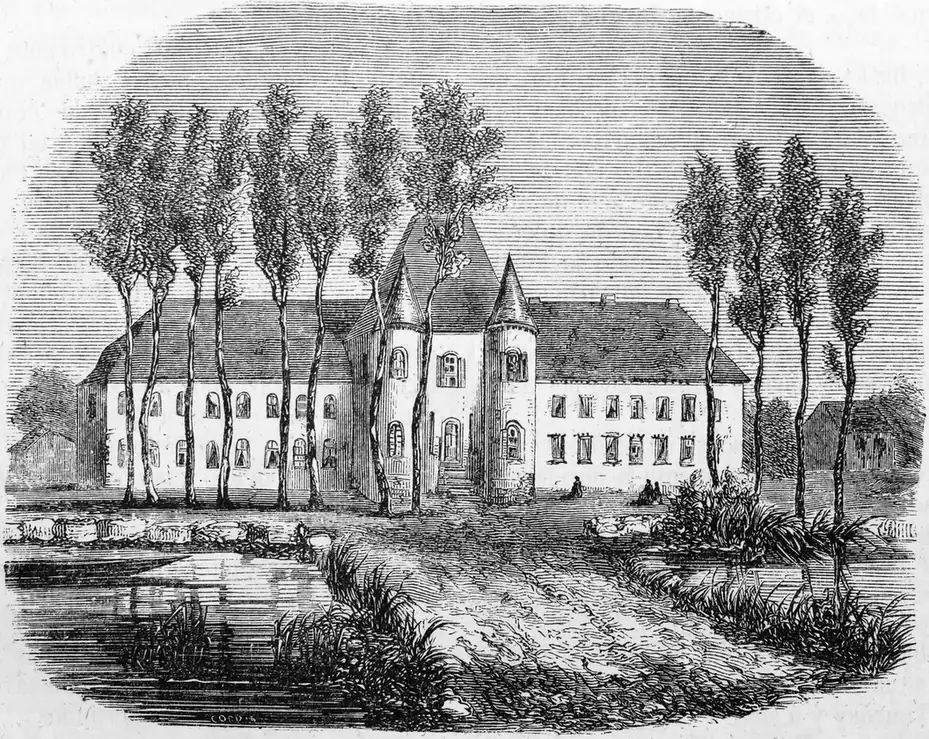
What happened
Gustave Fougnies came out to his sister's house, the chateau of Bitremont, for dinner on 20 November 1850, and was dead within minutes of sitting down. Her husband, a count deep in debt, was relying on Gustave's money, and Gustave was soon to marry, which would put it out of reach. The count said it was a stroke.
The servants had been sent out of the room, and what they saw afterward did not fit. The body was washed down before any doctor came, the dead man's clothes went into hot water, and the count spent the small hours on his knees on the dining room floor. A magistrate heard all of it, and had the body examined. The doctors could not name a cause of death.
Mineral poisons could be shown in a dead body by 1850. A poison made from a plant had never once been proved inside one.
The record, filled in
The investigation in our words: what the servants told the magistrate, what a chemist did with the dead man's organs, and what the court made of it.
A gardener told the magistrate that all through the summer the count had been buying tobacco leaves by the cartload, and had fitted out the chateau's washhouse as a workroom, saying he meant to make perfume there, though nothing a lady could wear had ever come out of it.
The other servants described the night. Sour vinegar had been poured over the dead man to drive off a smell nobody could place, his clothes had gone into a copper of hot water, and the count had knelt at the boards until the dining room floor was scraped bare.
The organs went to the capital, Brussels, to Jean Servais Stas, the best analyst in the country. He kept them three months and had to invent his method as he went, because nobody had one to lend him.
Stas soaked the tissue in alcohol, which curdled the flesh and drew any poison out into the alcohol. He let the alcohol dry off, dissolved what was left in a little water, and shook the water with ether, a light spirit that floats on water without mixing. The spirit rose to the top carrying the poison, and he poured the spirit off. As the spirit dried away, the poison stayed behind as an oily film that smelled of stale tobacco smoke: nicotine.
He found the poison in the dead man's organs, and in a plank from the floor beside Gustave's chair, where neither washing nor scraping had reached. The body held more poison, he told the court, than would kill a very strong man.
The payoff
At the count's trial Mathieu Orfila of Paris, who had written that a plant poison could never be found in a body, challenged the finding. The court believed the man who had just found one, and the count was guillotined.
The grid, solved
Afterwards
He was guillotined at Mons on 19 July 1851, the last execution on the square there. His wife, tried beside him, said she had acted in terror of him and was acquitted. Stas published the method; refined by Friedrich Otto, it is still where a search for a plant poison starts.
Go deeper
- Where the picture is kept
- Sources
- On poisons in relation to medical jurisprudence and medicine Internet Archive
- US National Library of Medicine
- JEAN-SERVAIS STAS Atomic mass of the elements, phlorizin, and toxicology redalyc.org
- Murder by Tobacco lindastratmann.com
- Nicotine and the Chemistry of Murder caasbrey.com
- Killer poison: Nicotine as a murder weapon? CBS News
- Le crime du château de Bitremont rtbf.be
- Château de Bitremont (Bury) histoire-peruwelz.jimdofree.com
4 more sources
- Stas Jean EN kvcv.be
- Jean Servais Stas Encyclopedia.com
- Visible Proofs: Forensic Views of the Body: Galleries: Biographies: Mathieu... US National Library of Medicine
- Anales dramáticos del crimen ó Causas célebres españolas y estranjeras [sic] T.... Internet Archive
The Acid Bath Murders
No body, no murder
Solved it? Open the case fileClose the case file
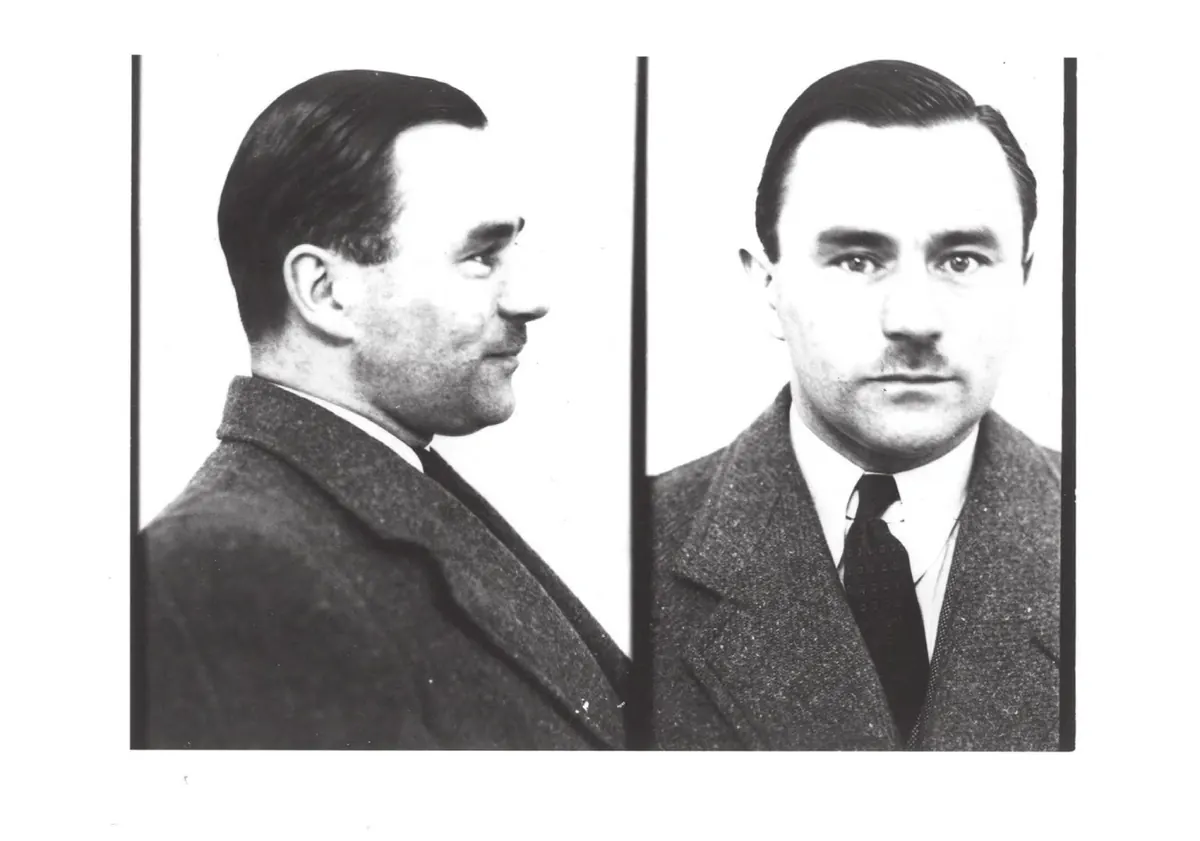
What happened
John George Haigh, an unemployed engineer turned conman, killed at least six people between 1944 and 1949, dissolving each body in sulfuric acid in a drum at his premises in Crawley, Sussex. He believed English law needed a body to prove a murder, and that acid left him nothing for a court to use.
His last victim, Olive Durand-Deacon, 69, a widow he had befriended at his hotel, went missing on 18 February 1949. Her friend reported it to police, who searched his premises and found a thick, greasy residue tipped out of the drum into the yard.
It looked like nothing anyone could use, and Haigh had already told detectives there was no body left anywhere for them to find.
The record, filled in
How the pathologist searched the yard, step by step. Watch for anything the acid could not destroy, and for what could put a name to it.
In the yard behind Haigh's workshop in Crawley lay the greasy sludge he had tipped out of the drum. The Home Office pathologist Keith Simpson had all of it dug up and sieved.
The sieve caught what the acid had not destroyed: a human gallstone, a small stone the acid could not dissolve, then 28 pounds of human body fat, pieces of bone, part of a foot, and part of a denture, the plate that holds a set of false teeth.
Things Mrs Durand-Deacon had carried came out of the same yard: her handbag, and a lipstick case of the kind a woman kept in one. Still, nothing yet said for certain whose remains these were.
Then her own dentist matched that plate to her dental chart and to a mold taken of her mouth. The remains had a name, so the police could charge murder though no whole body was ever found.
The payoff
That stone showed the acid had not dissolved everything, and the false teeth put her name to what was left. The jury took only minutes to convict, and Haigh was hanged at Wandsworth on 10 August 1949.
The grid, solved
Afterwards
His defense had pleaded insanity, built partly on his own claim that he drank his victims' blood. He confessed to nine killings in all; six could be confirmed, and this book counts only those six.
Go deeper
- Where the picture is kept
- Sources
- The Acid Bath Murderer Dissolved His Victims in Sulfuric Acid missedhistory.com
- John George Haigh murderuk.com
- John George Haigh murdersdatabase.co.uk
- John George Haigh Acid Bath Murderer openmindnow.co
- John Haigh Wikipedia Wikipedia
The Dickman Train Murder
The word written down
Solved it? Open the case fileClose the case file
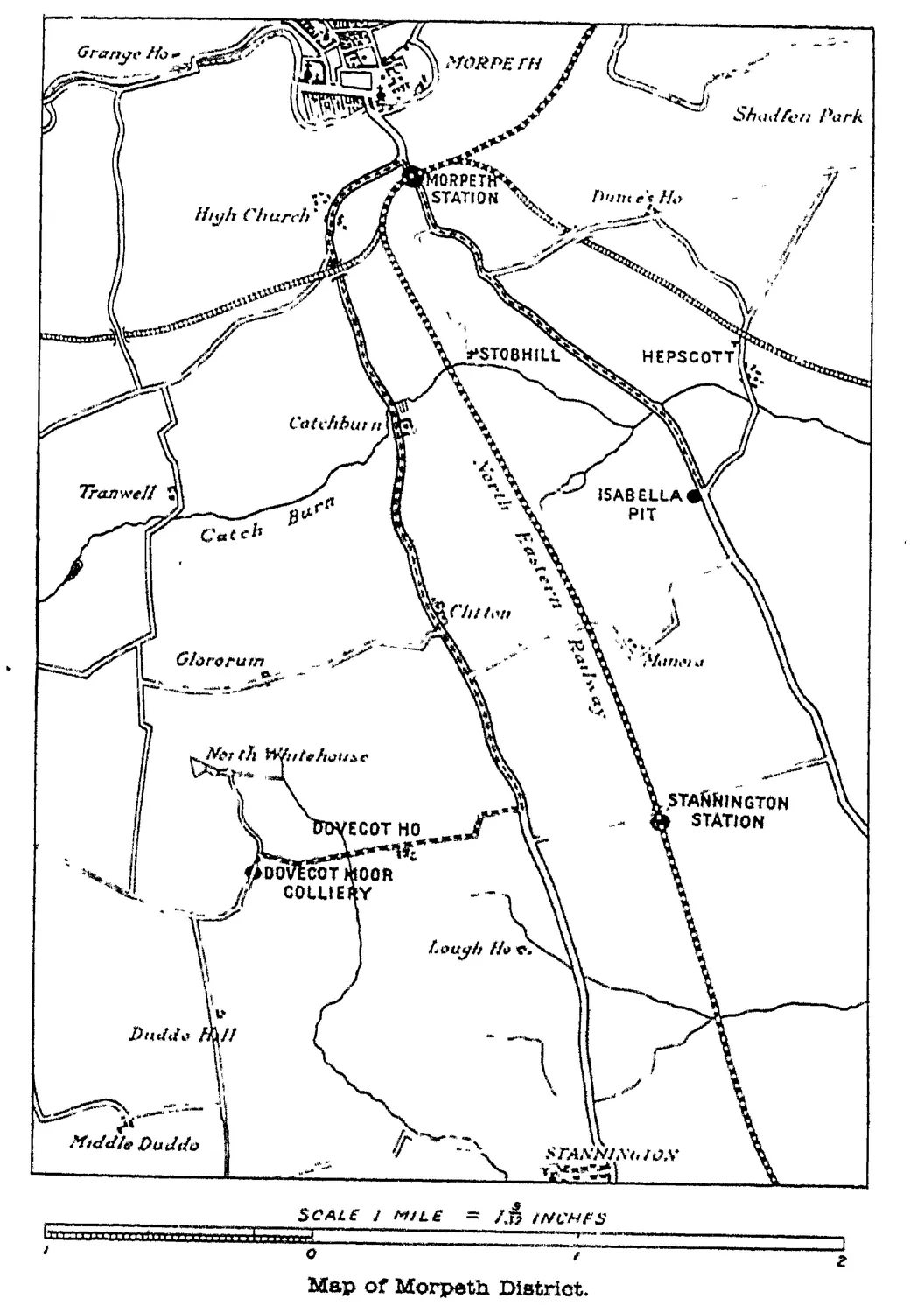
What happened
John Innes Nisbet, a colliery clerk, carried the miners' wages north from Newcastle every other Friday in a locked leather bag. On 18 March 1910 he was found shot dead on his train when it reached Alnmouth, and the bag was gone.
John Alexander Dickman, who knew him, admitted riding the same train as far as Morpeth but said he never saw Nisbet after Newcastle. Witnesses had seen a man with Nisbet at the station. In June the bag turned up, cut open, at the foot of an air shaft at a pit near Morpeth.
Nisbet's widow saw the man in his compartment only side-on, from the platform, and could not say who he was. At trial she swore it was Dickman. Why?
The record, filled in
In April, before the magistrates, she collapsed. At the trial in July she explains why.
Mrs Nisbet ... I noticed there was a man in the same compartment ... I only saw his profile; he had his collar turned up and he never moved. ...
Mrs Nisbet ... I think my evidence was taken down in writing. ... I was carried from the witness-box after giving my evidence, because I fainted after the last question. The reason I did so was that I recognized the man that I saw in the train ... This was the first time I had seen his face exactly in the same position as I saw it on the morning of the 18th of March. Up to that time I had not been able to identify the man distinctly, but I am now certain that the man I saw in that carriage is the man I now see in the dock, the man Dickman.
Defense You are more certain to-day than you ever were before the magistrates?Mrs Nisbet Yes, I am certain.Defense ... you said, 'All I can say is that he resembled the man sitting behind.' You pointed to Dickman sitting behind?Mrs Nisbet Yes.Defense ... That is all you could say?Mrs Nisbet Yes, I recognized him distinctly.
Prosecution ... the word 'resembled' is found in the depositions, that it is in the evidence as written down that you gave before the magistrates?Mrs Nisbet Yes.Prosecution Do you remember whether the word 'resembled' was yours, or whether it was the word of the person who was examining you?Mrs Nisbet Well, I do not remember saying that. I was so perfectly sure ...
The payoff
A man who had known Dickman for twenty years put him beside Nisbet at the station. The widow, who in April had only said he resembled the man, swore in July it was him; the jury believed her, and he was hanged.
The grid, solved
Afterwards
His appeal was refused. The money from the bag was never found.
Go deeper
- The original record
S. O. Rowan-Hamilton (ed.), Trial of John Alexander Dickman, Notable British Trials (Edinburgh and London: William Hodge & Company, 1911), testimony of Wilson Hepple and Mrs Cicely Elizabeth Nisbet, Second Day of the trial, 5 July 1910. Internet Archive scan, Digital Library of India, identifier in.ernet.dli.2015.155121.
- Where the picture is kept
- Sources
- Murder on the North Eastern Express heatonhistorygroup.org
Tunnel 13 Train Robbery
The stain that was not grease
Solved it? Open the case fileClose the case file
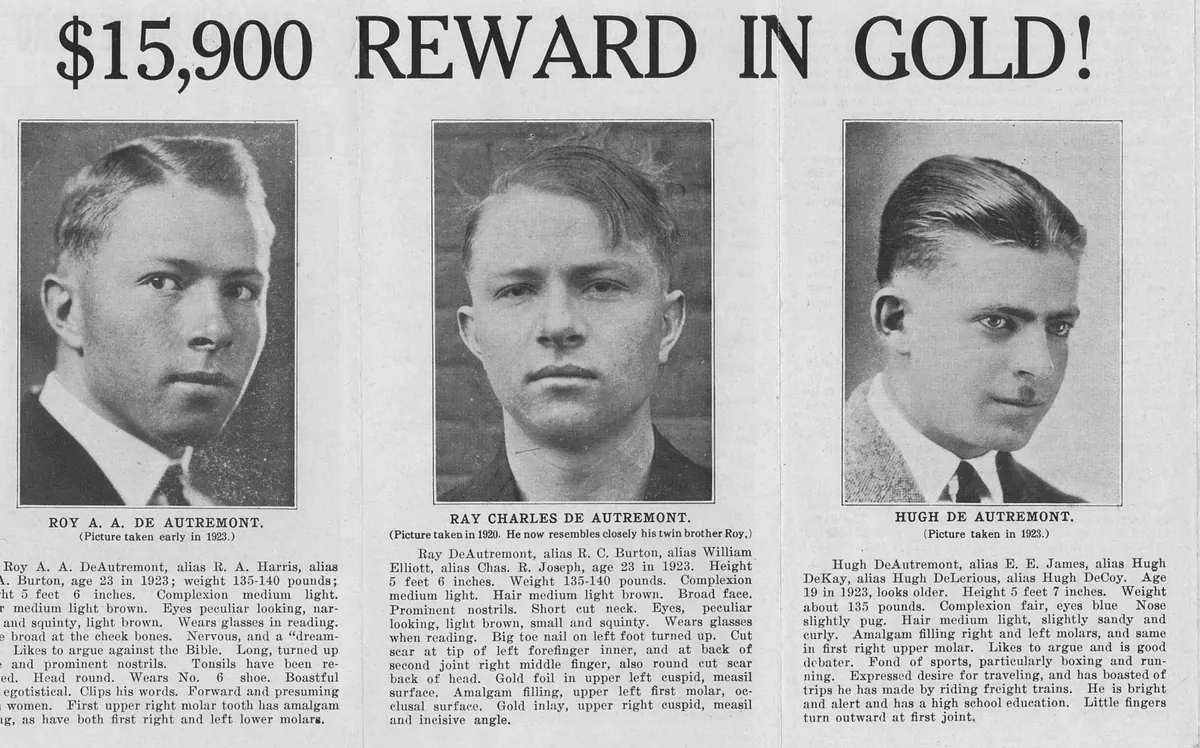
What happened
On 11 October 1923 three men boarded a Southern Pacific train as it slowed inside Tunnel 13 in Oregon's Siskiyou Mountains, expecting gold in the mail car. When the clerk would not open it, they blew the door off with too much dynamite, killing him and starting a fire.
To avoid being identified they shot the engineer, the fireman and a brakeman who came to look. They hid from a posse, army planes and National Guard patrols in the timber above the tunnel for two weeks, then slipped away, leaving a stained set of work clothes behind.
No one who saw the robbers up close lived. The best lead was the stained work clothes, taken for a mechanic's. What did they say?
The record, filled in
A report of what Edward Heinrich, a chemist at Berkeley, read from the work clothes and where it led. Watch the stain first, then the pockets.
Railroad and postal investigators had sent Heinrich the stained overalls found near the hideout, which they took for a mechanic's. He found the stain was pitch, the sticky sap of the Douglas fir, and nothing like engine grease.
The pockets on one side were the most worn, fir sawdust had collected in one of them, and the strap on that side sat higher. That was the side of the working hand, so the wearer was left-handed, unlike most men. The stain and the dust made the wearer a lumberjack from a fir or spruce camp; hair and nail clippings put him in his early twenties.
In the slim pocket on the bib where a workman keeps his pencil, missed on the first look, Heinrich found a wad of paper balled tight. He worked it free with a crochet hook and steamed it flat. It was a receipt for a registered letter: Roy DeAutremont of Eugene had mailed $50 to his brother Hugh.
Within a month the Post Office had a wanted poster out naming Roy, his twin Ray and their brother Hugh, and over the next years it went out by the million. In 1927 a soldier who had served with Hugh knew his face from it, and Hugh was arrested across the Pacific in the Philippines, a private in the Army under a false name.
The payoff
So the stain made the mechanic a logger, and the receipt named Roy, who had worked at an Oregon logging camp with his brothers. Hugh's capture led to the twins' arrest, and all three confessed and got life.
The grid, solved
Afterwards
They pleaded guilty rather than risk a death sentence, were sentenced at Salem on 24 June 1927, and all three were paroled decades later. Heinrich's fame grew from this case, though historians have since questioned methods he used in other cases.
Go deeper
- The original record
US Post Office Department reward circular for Roy, Ray and Hugh DeAutremont, Case No. 57883-D, Smithsonian National Postal Museum, object npm_1990.0563.3.
- Where the picture is kept
- Sources
- DeAutremont Brothers Train Hold-up at Tunnel 13 oregonencyclopedia.org
- Tunnel 13 Train Robbery History altaonline.com
- Csi Southern Pacific Smithsonian
- Floral Arraignment sciencehistory.org
- Tunnel 13: How Forensic Science Helped Solve America's Last Great Train Robbery ijpr.org
- Tunnel 13: How Forensic Science Helped Solve America's Last Great Train Robbery ijpr.org
- How a botched train robbery led to the birth of modern American criminology chemistry.berkeley.edu
- How a Botched Oregon Heist Led to the Birth of FBI Forensics pdxmonthly.com
17 more sources
- Last Great Train Robbery Was Brutal Clumsy Fiasco mckenzieriverreflectionsnewspaper.com
- Tunnel 13 victims honored Wednesday at Eastwood Cemetery in Medford rv-times.com
- DeAutremont, Ray research.sohs.org
- DeAutremont Brothers legendsofamerica.com
- Tragedy at Tunnel 13 postaltimes.com
- Deautremont Brothers Train Hold Up at Tunnel 13 oregonencyclopedia.org
- Smithsonian
- cdnc.ucr.edu
- Edward Oscar Heinrich papers, 1888-1953, bulk 1909-1953 oac.cdlib.org
- Gale Institution Finder go.gale.com
- Meet 'America's Sherlock Holmes,' The Guy Who Developed And Honed Most Modern... kut.org
- DeAutremont Brothers Train Hold-up at Tunnel 13 Internet Archive (saved copy)
- wikitree.com
- wikitree.com
- wikitree.com
- DeAutremont Brothers Wikipedia
- Edward O. Heinrich Wikipedia
The LA Times Bombing
Ink Alley
Solved it? Open the case fileClose the case file
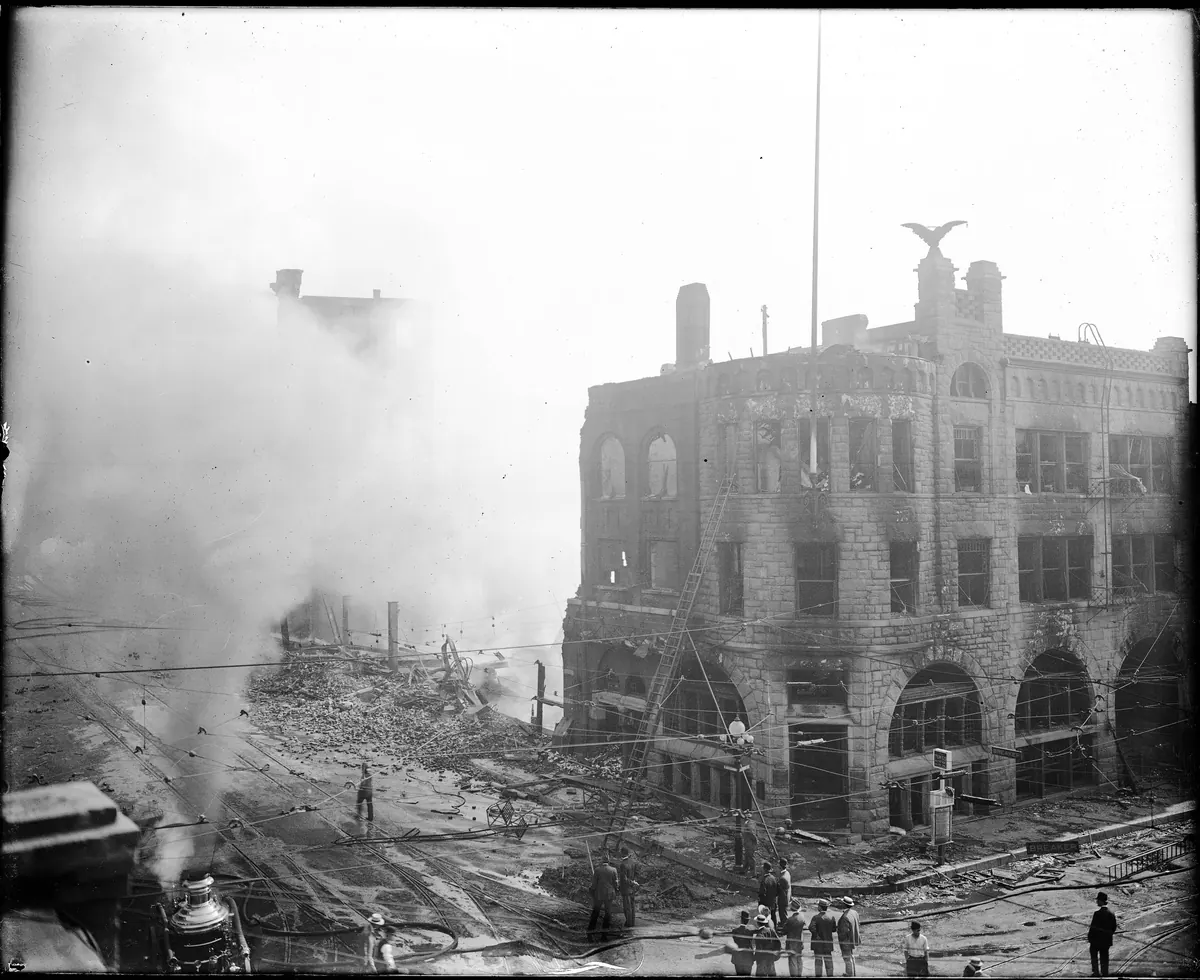
What happened
Just after one in the morning on 1 October 1910, a suitcase of dynamite went off in an alley beside the Los Angeles Times building, a paper that fought the unions. The blast broke a gas main, and the fire killed about twenty night workers.
Two more suitcases turned up that night, at the publisher's house and at the house of an employers' leader. The first went off as police moved it, hurting no one. The second never went off, and inside it was dynamite, a dry cell and an alarm clock with a brass tab soldered to its key.
The bomb that killed burned with the building, but the dud was whole. Detective William J. Burns studied its clock. Who built it?
The record, filled in
A fellow organizer tells him of a timer another union man invented: the key that winds the alarm turns a brass tab onto a wired one, firing the cap. Then his Peoria bomb.
He told me at that time of the invention by one of the union men of a clockwork device by which an explosion could be set at any hour to take place at any time within twelve hours. This, he said, gave the man ample time to get hundreds of miles away from the scene before the explosion occurred. This was the celebrated clock machine which J. B. McNamara used in destroying the Los Angeles Times building and killing twenty men working there. Both J. B. and I used these machines exclusively after their invention.
The clock used was a small Tattoo alarm, from which the alarm clapper and the silencer was removed. To the winding key of the alarm was soldered a small L-shaped piece of brass. The clock was attached to a light board or cardboard. To this board was also affixed a dry battery. ... when the alarm key unwound as the alarm went off, the brass soldered to the key came in contact with the brass fixed to the wire, thus making a circuit.
I set two ten-quart cans in a pile of material in the railroad yards with the clock timed for an explosion at 10:30 p. m. ... After an interval one of the charges at the railroad yards exploded but the other did not and was found the next day.
The payoff
The Los Angeles dud matched the Peoria one, down to the brass tab. The Peoria bomber had gone by 'McGraw'; Burns's men tailed him, found he was McManigal, and took him with J. B. McNamara, who pleaded guilty.
The grid, solved
Afterwards
J. B. got life; his brother John got fifteen years for a separate bombing. The pleas, arranged by their own lawyer, Clarence Darrow, split the labor movement and sank a labor-backed candidate for mayor four days later. Whether the dead numbered twenty or twenty-one is still disputed.
Go deeper
- The original record
Ortie E. McManigal, The National Dynamite Plot (Los Angeles: The Neale Company, 1913), pages 37 to 38 and 66 to 67.
- Where the picture is kept
- Sources
- Read the Plaque readtheplaque.com
- Postcard view of Los Angeles Times Building bombing calisphere.org
- 1910 Oct 1, Los Angeles Trade Unionist Bomb and Fire, LA Times bldg., L.A., CA usdeadlyevents.com
- Infernal Machines: The Bombing of the Los Angeles Times and L.A.'s First 'Crime... pbssocal.org
- When LA Unions Fought For Right to Strike, One Weapon Was Dynamite historynet.com
- 1910 Los Angeles Times Bombing: McNamara Plot, Darrow’s Defense, and a City... davedoeshistory.org
- Red Flags Over Los Angeles, Part 2: Bombs, Betrayal, and the Election of 1911 pbssocal.org
- William J Burns FBI
6 more sources
- Clarence Darrow Britannica
- The national dynamite plot Internet Archive
- The masked war; the story of a peril that threatened the United States, by the... Internet Archive
- Victims of the 1910 Los Angeles Times bombing Find a Grave
- Howard Edward Courdway (1892-1910) Find a Grave
- William John Burns (1860-1932) Find a Grave
The Chicken Run Murder
One body, two readings
Solved it? Open the case fileClose the case file
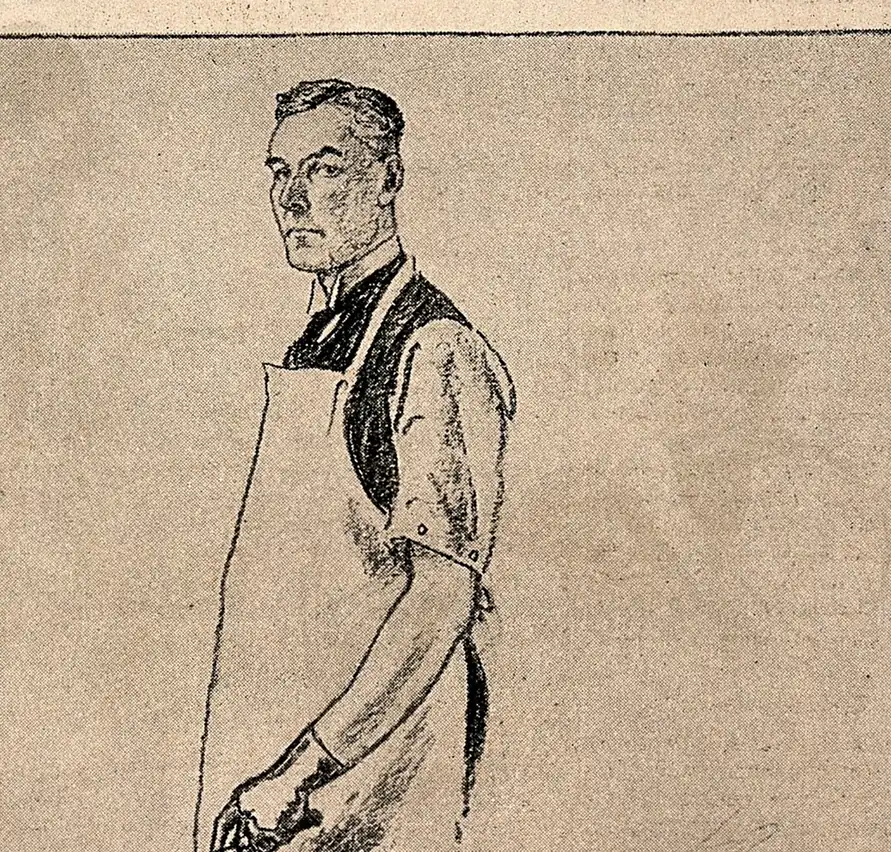
What happened
Norman Thorne ran a struggling chicken farm at Crowborough, Sussex, and was engaged to Elsie Cameron, a London typist. He had fallen for another woman, and Cameron, believing herself pregnant, pressed for a wedding. On 5 December 1924 she was seen walking toward the farm. Thorne told police she never came.
Six weeks later police dug up her attaché case on the farm, then her body, cut in pieces, under the chicken run. Thorne changed his story: they had quarreled, he went out, and on his return he found her hanging in his hut. He had panicked, cut her up and buried her.
Thorne said she hanged herself and he panicked. Was it suicide, or murder? Only her body could answer.
The record, filled in
What the doctors found, first for the prosecution and then for the defense, and what the jury at Lewes made of it in March 1925.
Sir Bernard Spilsbury, the Home Office pathologist, did the postmortem on 17 January. On the surface the body showed little, but when he cut beneath the skin he found eight bruises from blows to the head, face, back and legs, all made shortly before death. He found nothing on the neck to show a rope had held her. In Spilsbury's reading she had been beaten, not hanged.
Thorne said she had hanged herself with his washing line from a beam in the hut. A month later the body was dug up again for the defense, and its pathologist, Dr Robert Bronte, read grooves on the neck as the marks of that line. Spilsbury, recalled to the witness box, said they were the natural creases found on most women's necks.
The jury had more than the doctors to weigh: Thorne's two stories, first that she never came and then, once her case was dug up, that she had hanged herself, and his own word that on finding her he sent for no doctor, took her for dead and hid the body.
The payoff
The jury took under thirty minutes to side with Spilsbury's beating over Bronte's rope. Thorne was found guilty on 16 March 1925 and hanged at Wandsworth on 22 April.
The grid, solved
Afterwards
The appeal court refused to have the medical evidence weighed again, and the Law Journal warned against treating Spilsbury as infallible. In 2019 two barristers reviewed the case for a BBC series and found the conviction probably sound.
Go deeper
- Where the picture is kept
- Sources
- Div Class Title Bruised Witness Bernard Spilsbury and the Performance of Early... cambridge.org
- Crowborough’s chicken run murder crowborough.news
- Bruised Witness: Bernard Spilsbury and the Performance of Early... doi.org
- Forensic medicine and Sir Bernard Spilsbury hekint.org
- Notorious interwar murders (part 2) interwarlondon.com
- Norman Thorne Wikipedia
- Norman Thorne Murderpedia
- Bernard Spilsbury Wikipedia
Herbert Rowse Armstrong
Dandelions
Solved it? Open the case fileClose the case file
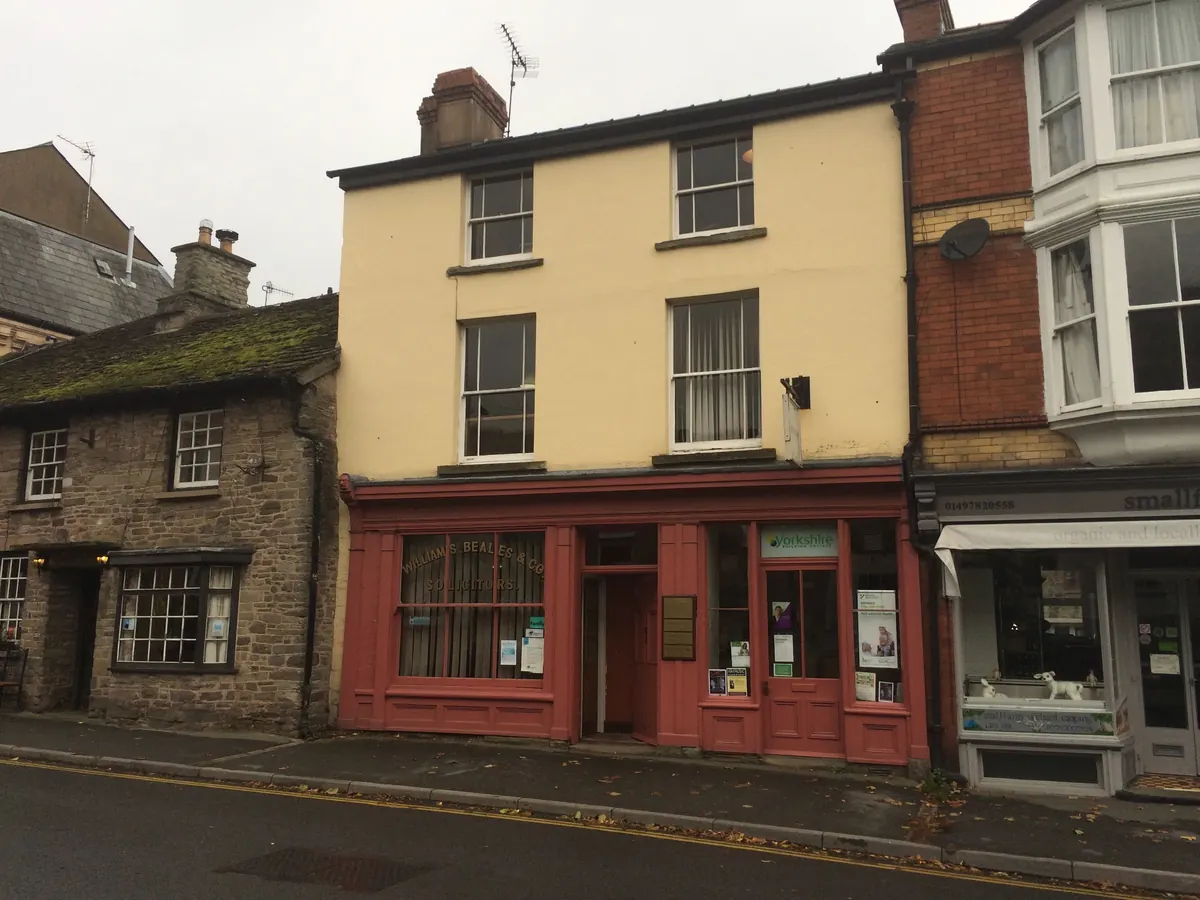
What happened
Herbert Rowse Armstrong had for years been the only solicitor in Hay-on-Wye, and was clerk to its justices. His wife Katharine was buried in February 1921 after a long illness. That October a rival solicitor, Oswald Martin, fell violently ill hours after tea at Armstrong's house. Martin recovered, but a sample sent away quietly showed arsenic.
Scotland Yard arrested Armstrong at his office on 31 December 1921 for the attempt on Martin, after he signed a statement accounting for the arsenic he had bought, all of it, he said, to kill weeds. Katharine's body was then dug up and found to hold arsenic, and it was for her murder that he stood trial.
His signed statement accounted for all his arsenic. Then the police had him empty his pockets onto his desk.
The record, filled in
His statement put all his arsenic on weeds. A detective tells how a packet turned up among his pocket things; then Armstrong explains his twenty packets for weeds.
Detective ... He emptied his pockets on to a blotting pad on his desk ... Mr. Armstrong asked if he might sit at his desk and examine some business letters that were there ... after a few minutes I heard a cracking of paper. I immediately turned round and found the defendant ... had got the brown paper open, and was looking through some letters that were in the parcel. ... Among the letters ... I found a small packet containing a white powder.
Prosecutor ... You realized that that packet being found in your pocket raised an awkward situation for you, did you not?Armstrong Yes, I have been a magistrates' clerk for sixteen years.
The Judge ... as to the rest you had made it up into twenty little packets?Armstrong Yes, my lord.The Judge And with regard to nineteen of them you gave separate doses to nineteen dandelions?Armstrong Yes. I noticed that these dandelions died afterwards.The Judge That was very interesting, was it not?Armstrong It was at the time, but it had passed from my mind.The Judge ... Why make up twenty little packets, each a fatal dose for a human being, and put them in your pocket?Armstrong At the time it seemed to me the most convenient way of doing it. I cannot give any other explanation.
The payoff
A court clerk of sixteen years, he knew how that packet looked: a fatal dose of white arsenic. His dandelion story did not survive the judge, and he was hanged on 31 May 1922 for Katharine's murder.
The grid, solved
Afterwards
Armstrong remains the only solicitor ever hanged for murder. Modern writers have argued the case against Armstrong was weaker than the jury was shown; nothing has reopened it.
Go deeper
- The original record
Filson Young, ed., The Trial of Herbert Rowse Armstrong, Notable British Trials (Edinburgh and London: William Hodge and Company, 1927), the evidence of Chief Inspector Alfred Crutchett, the cross-examination of the prisoner by the Attorney-General, and his questioning by Mr Justice Darling (pages 238 to 239). Shire Hall, Hereford, April 1922.
- Where the picture is kept
- Sources
- Trial of Herbert Rowse Armstrong Internet Archive
- The Trial of Herbert Rowse Armstrong Internet Archive
- Herbert Armstrong gutenberg.net.au
- Account Suspended history-room.co.uk
- The incredible true story of the only solicitor ever to hang for murder legalcheek.com
- Herbert Rowse Armstrong Wikipedia
Harry Dobkin
Tea on Good Friday
Solved it? Open the case fileClose the case file
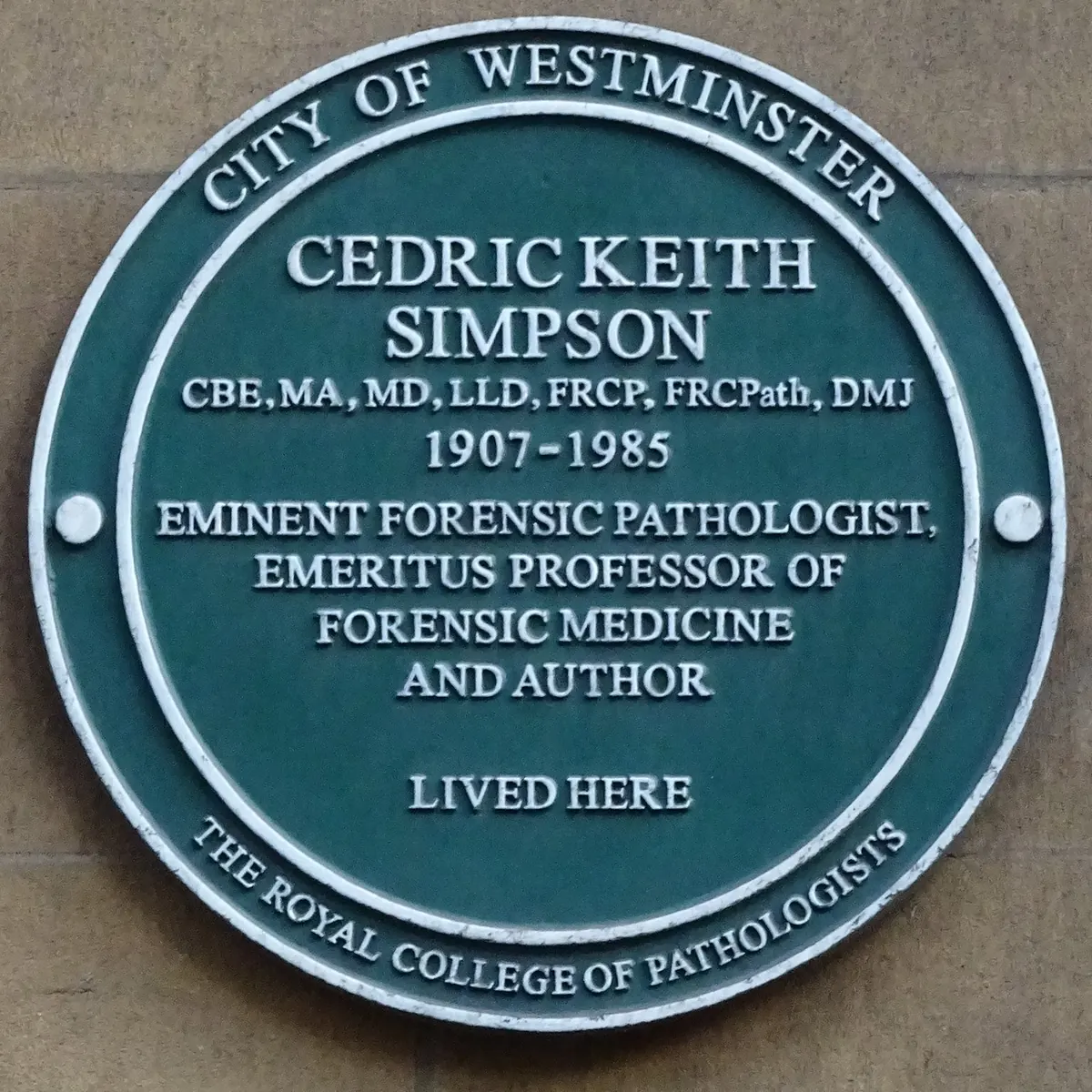
What happened
Rachel Dobkin had spent years pursuing her estranged husband Harry for unpaid maintenance. On 11 April 1941 the two met for tea in Shoreditch, London. She was never seen alive again. He said she had caught a bus to visit her mother, and her sister went to the police.
On 17 July 1942 a workman clearing a bombed Baptist church in Kennington, south London, lifted a stone slab and found a woman's body beneath it. In the Blitz, bodies under ruins were nothing new.
A body under a bombed church looked like one more Blitz death. Was it? And if not, how long had it lain there, and whose was it?
The record, filled in
A report of what the pathologist Keith Simpson read from the body, step by step: how she died, how long ago, and who she was.
Workers on the demolition of the bombed Baptist Chapel had found her under a slab in its crypt. Keith Simpson saw at once that this was no air raid death. The head had been cut off but was there, its face and lower jaw gone so no one would know her, and her throat showed she had been strangled.
In the earth beside her lay a yellowish powder: slaked lime, the builders' kind, spread to kill the smell. It had also kept the blowflies off, so no maggots had eaten the body. Insects feeding on a body normally tell a pathologist how long it has lain. Here there were none, so Simpson judged by the preserved body itself and put her death twelve to fifteen months back.
That fitted Rachel Dobkin, missing since April 1941. Her dentist recognized his own fillings in the upper jaw, and a Guy's Hospital photographer superimposed a photograph of the skull on one of Rachel in life. The two matched.
And she had lain in the ruin next door to the office where Harry Dobkin worked as the night watchman.
The payoff
So what was spread to hide her kept her whole enough to date and to name. Harry Dobkin was charged with her murder, convicted at the Old Bailey in twenty minutes, and hanged in January 1943.
The grid, solved
Afterwards
The case left a question no record can settle: how many other wartime killings were buried in the rubble and counted as air raid deaths?
Go deeper
- Where the picture is kept
- Sources
- The murder of Rachel Dobkin vauxhallhistory.org
- Murder! Looting! Fraud! Wartime London's Crime Blitz Had it All historynet.com
- Harry Dobkin Murderpedia
Parramatta River Murders
Liberal salary to competent person
Solved it? Open the case fileClose the case file
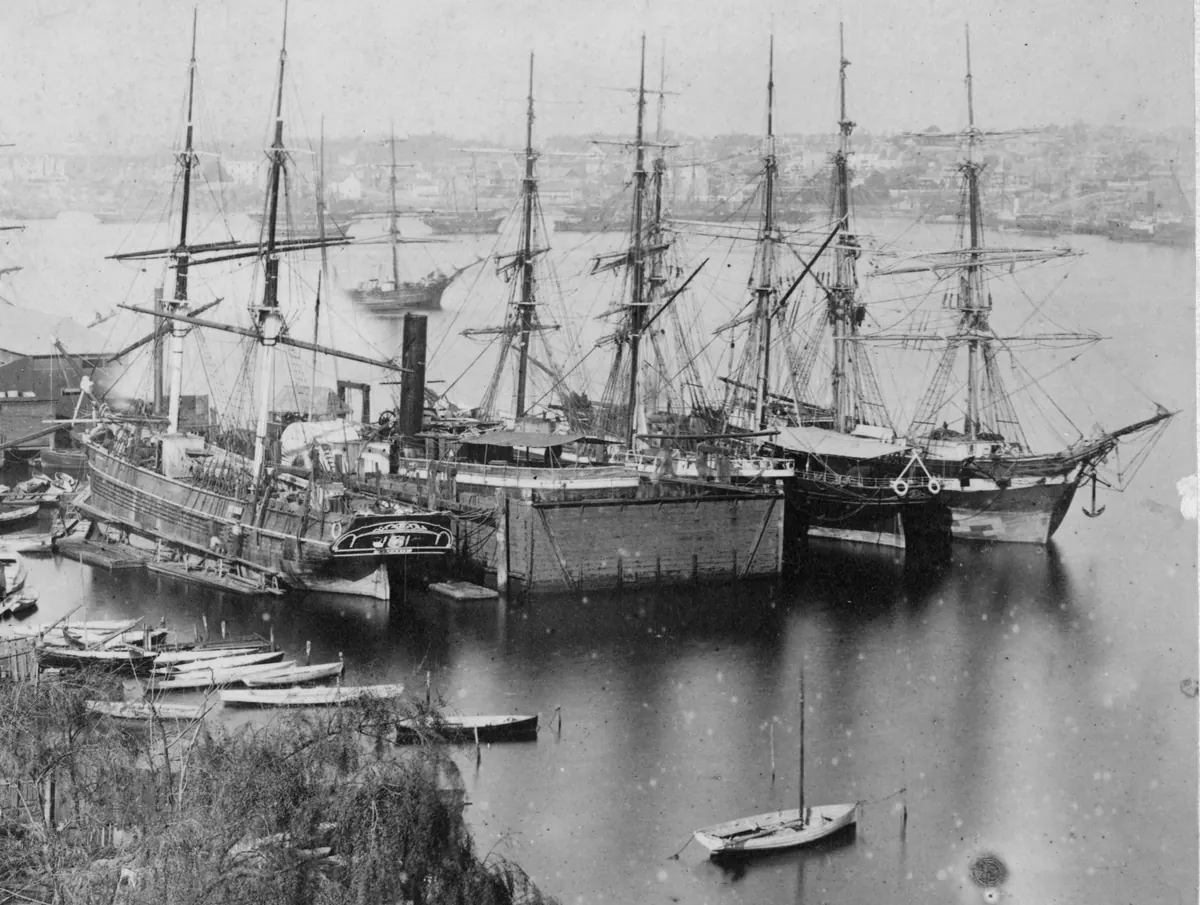
What happened
In early March 1872 two notices in a Sydney newspaper offered work at a country store, with replies to three initials at the paper's office. Several men answered.
In mid-March a man passing in a boat found a body floating on the Parramatta River, a heavy stone tied to its ankles. Papers in the clothes named John Bridger, 25, a ship's steward discharged that month, who had told friends he had a job up the country.
On 13 March William Percy Walker, newly arrived from Victoria, left his lodgings for a job on the river. A friend had begged him not to go.
The notices were signed with three initials, and nobody who had answered them knew the employer's real name. Who was he?
The record, filled in
What the detectives learned in the week after Bridger was found, in the order they learned it, so some steps look back to the day Walker went missing.
The notices wanted a wagon driver and a clerk. The man behind them was George Robert Nichols, writing under false names. He met applicants himself and asked about their friends, their debts and how much luggage they would bring, to make room in the wagon. A seaman named Harrison, who had only a bag of clothes, was told the post was filled.
A detective found clothes marked with Bridger's name for sale at an auction room in Pitt Street and asked to be told if the seller returned.
On Saturday 16 March detectives waited. At half past ten Nichols himself walked in to collect the proceeds of the sale, and they held him.
That evening his partner, Alfred Lester, was found in a Haymarket jeweler's with a silver watch he said Nichols had given him to sell. It was inscribed to W. P. Walker, a lay preacher, from his congregation.
The inscription led detectives to Walker's lodgings. The landlady's son, sixteen, had gone with Walker on the 13th, three days before, to the wharf at the foot of King Street, where Nichols and Lester waited with a boat. There Walker showed the boy his timepiece and chain and told him to take notice, so that the boy could swear Walker had them with him.
A boatman off Kent Street had rented Lester a small sailboat on the afternoon of the 13th. Letters in false names, calling Walker to the job and turning other men away, were sworn to be in Nichols's penmanship.
The payoff
Police dragging the river found Walker's body a week later. The timepiece he made the boy look at was in Lester's hands three days after he vanished, and both men were convicted of his murder.
The grid, solved
Afterwards
The verdict came on 21 May 1872. They were hanged together at Darlinghurst Gaol on 18 June, after both had admitted their part.
Go deeper
- Where the picture is kept
- Sources
- Article of 27 April 1872 paperspast.natlib.govt.nz
- Article of 15 April 1872 paperspast.natlib.govt.nz
- Article of 10 April 1872 paperspast.natlib.govt.nz
- Article of 11 April 1872 paperspast.natlib.govt.nz
- Article of 5 April 1872 paperspast.natlib.govt.nz
- Article of 25 March 1872 paperspast.natlib.govt.nz
- Article of 12 April 1872 paperspast.natlib.govt.nz
- Article of 20 April 1872 paperspast.natlib.govt.nz
13 more sources
- Article of 13 April 1872 paperspast.natlib.govt.nz
- Article of 14 June 1872 paperspast.natlib.govt.nz
- Article of 27 June 1872 paperspast.natlib.govt.nz
- Article of 11 April 1872 paperspast.natlib.govt.nz
- Article of 2 July 1872 paperspast.natlib.govt.nz
- Article of 29 June 1872 paperspast.natlib.govt.nz
- Article of 29 June 1872 paperspast.natlib.govt.nz
- Article of 29 March 1872 paperspast.natlib.govt.nz
- Article of 19 June 1872 paperspast.natlib.govt.nz
- The Glebe Society glebesociety.org.au
- The Parramatta River Murders forgottenaustralia.com
- The power of mind over matter, or, Thoughts suggested on reading Nichols'... Wellcome Collection
- List of people legally executed in New South Wales Wikipedia
Reginald Birchall
A casual acquaintance
Solved it? Open the case fileClose the case file
What happened
On 21 February 1890 two brothers cutting saplings in the Blenheim Swamp, near Woodstock, Ontario, found a young man lying in the brush, shot twice from behind. Every mark that might name him had been cut from his clothes, so detectives gave a photograph of his face to the newspapers.
A week later an Englishman, Reginald Birchall, came with his wife to view the body. It was Fred Benwell, he said, a young man he had met on the ship over and barely knew, last seen at Niagara Falls. Ontario's chief detective, John Wilson Murray, thought he was lying.
Nothing yet put Birchall in that swamp, and nobody could see why a gentleman would kill a man he had barely met.
The record, filled in
The prosecution's case at Woodstock that autumn. Watch two dates: the day Benwell was last seen alive, and the day Birchall wrote to the Benwells.
Douglas Pelly, a vicar's son, was the other young man Birchall had brought out on that ship, and he was still alive to tell Murray the rest. Pelly and Benwell had each answered Birchall's notice in a London paper offering a share in a farm near Niagara Falls: a trade buying horses cheap and grooming them for sale, a brick house, stables lit by electricity. Pelly had paid £170; the Benwells would pay £500 once their son had seen it.
There was no farm. The prosecution proved that Birchall owned not one acre of land in the county. On an earlier trip he had lived near Woodstock posing as a nobleman, Lord Somerset, had often visited that very swamp, and had left town owing a string of unpaid bills.
Benwell was killed on 17 February. That morning passengers saw him and Birchall leave a train at Eastwood, four miles from the swamp. That afternoon Birchall was back at Eastwood station alone, trousers rolled up, shoes caked with mud, buying a ticket for Hamilton. A woman there who knew him from the year before shook his hand. She could put Birchall at that station, alone, that afternoon.
And the prosecution had a letter Birchall wrote to Benwell's father, an army colonel, on 20 February, three days after that walk. His son had inspected the business, it said, was entirely satisfied, and had signed a deed of partnership, so the money could now be sent. It added: “Your son is, I think, writing you by this post.”
The payoff
Its news was invented, written three days after Benwell died. Only a man sure the son would never write home could risk it, and it asked for the money: the lie and the motive in his own hand. The jury convicted him.
The grid, solved
Afterwards
Birchall was hanged at Woodstock jail on 14 November 1890, still denying the murder. Pelly took holy orders, served as an army chaplain in the First World War, and died in 1943.
Go deeper
- The original record
Letter of J. R. Birchall to Lt.-Col. Benwell, Cheltenham, written at Niagara Falls on 20 February 1890, as read by Crown counsel B. B. Osler at the Woodstock trial and printed in Birchall: The Story of His Life, Trial and Imprisonment, as Told by Himself (Toronto: National Publishing Company, 1890), pages xiv to xv.
- Where the picture is kept
- Sources
- Birchall the story of his life, trial, and imprisonment, as told by himself ... Internet Archive
- Memoirs of a great detective, incidents in the life of John Wilson Murray Internet Archive
- BIRCHALL, REGINALD (Lord Frederick A. Somerset) biographi.ca
- John Reginald Birchall thecanadianencyclopedia.ca
- Reginald Birchall archives.oxfordcounty.ca
- The Trial of Reginald Birchall archives.oxfordcounty.ca
- Deadly Swindle: An 1890 Murder in Backwoods Ontario That Gripped the World osgoodesociety.ca
- ACAD A Cambridge Alumni Database: Introduction venn.lib.cam.ac.uk
4 more sources
- Person Page thepeerage.com
- John Wilson Murray thecanadianencyclopedia.ca
- Murray, John Wilson biographi.ca
- Frederick Cornwallis Benwell (1865-1890) Find a Grave
Each picture is credited under it. The source links are the ones used in researching the case.